Clear Sky Science · en
An examination of the impact of carbon emissions trading on corporate green technology innovation from the perspective of supply chain integration
Why climate policy matters for everyday business
Most people now recognize that cutting carbon emissions is essential to slowing climate change. But fewer people see how climate policies reshape what companies actually do. This study looks inside firms to ask a simple question with big consequences: when governments put a price on carbon through emissions trading, do companies merely buy their way out of trouble, or do they truly start inventing cleaner technologies—and how do their relationships with suppliers and customers help or hinder that shift?
Putting a price on pollution
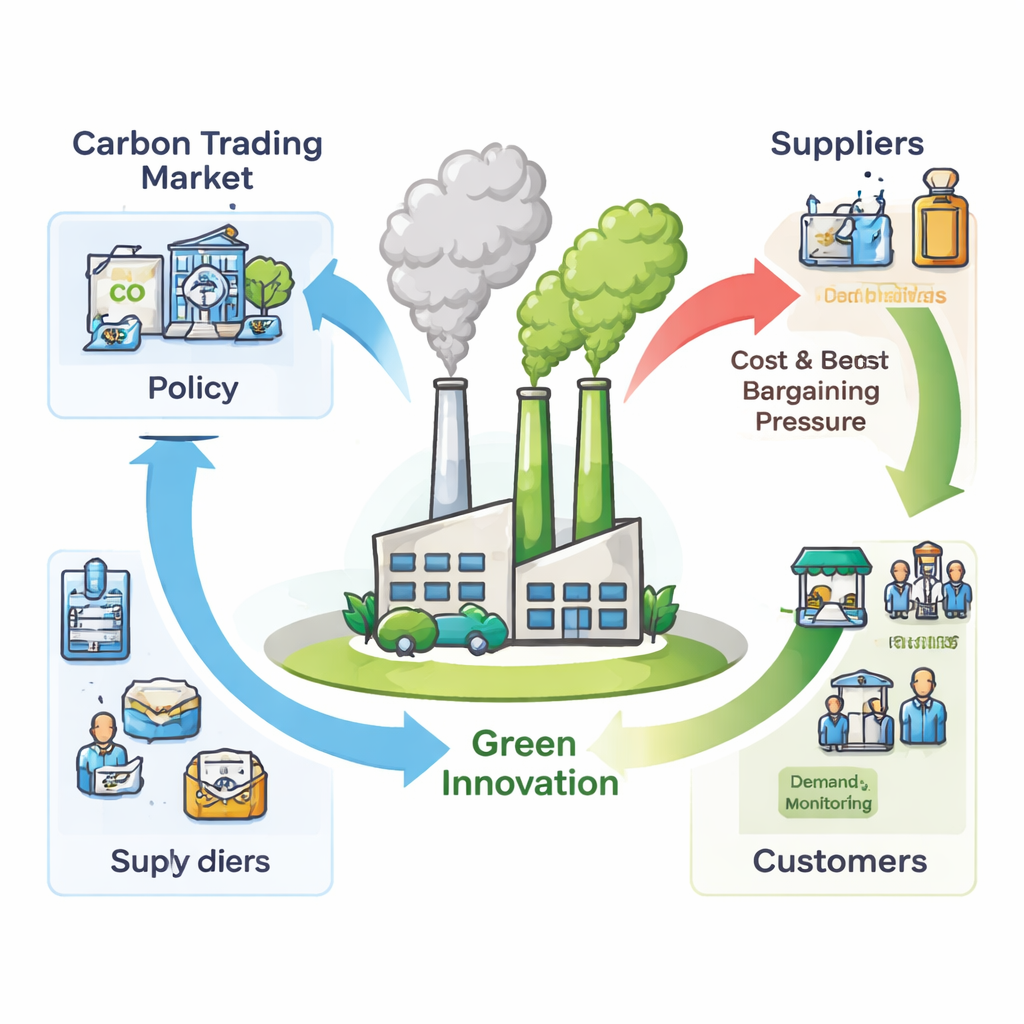
China has rolled out a carbon emissions trading system that caps the total emissions of certain industries and allows companies to buy and sell emission allowances. For a power plant or steel mill, every ton of carbon released now has a financial cost. The authors assembled data on Chinese listed firms from 2011 to 2020, covering years before and after different regions launched carbon markets. They then used advanced statistical techniques, comparing firms inside and outside the pilot regions and industries over time, to isolate how the policy changed companies’ behavior rather than simply tracking broader economic trends.
Counting green ideas, not just smokestacks
Instead of only measuring whether factories emit less, the study focuses on whether they develop more green technology. The researchers tracked “green patents” filed by each firm—official records of inventions specifically tagged as environmental technologies, such as cleaner energy systems, pollution controls, or ways to use materials more efficiently. Counting these patents year by year provides a direct window into whether companies are doing the deeper work of redesigning processes and products to be more climate‑friendly, rather than relying on quick fixes.
The hidden role of supply chains
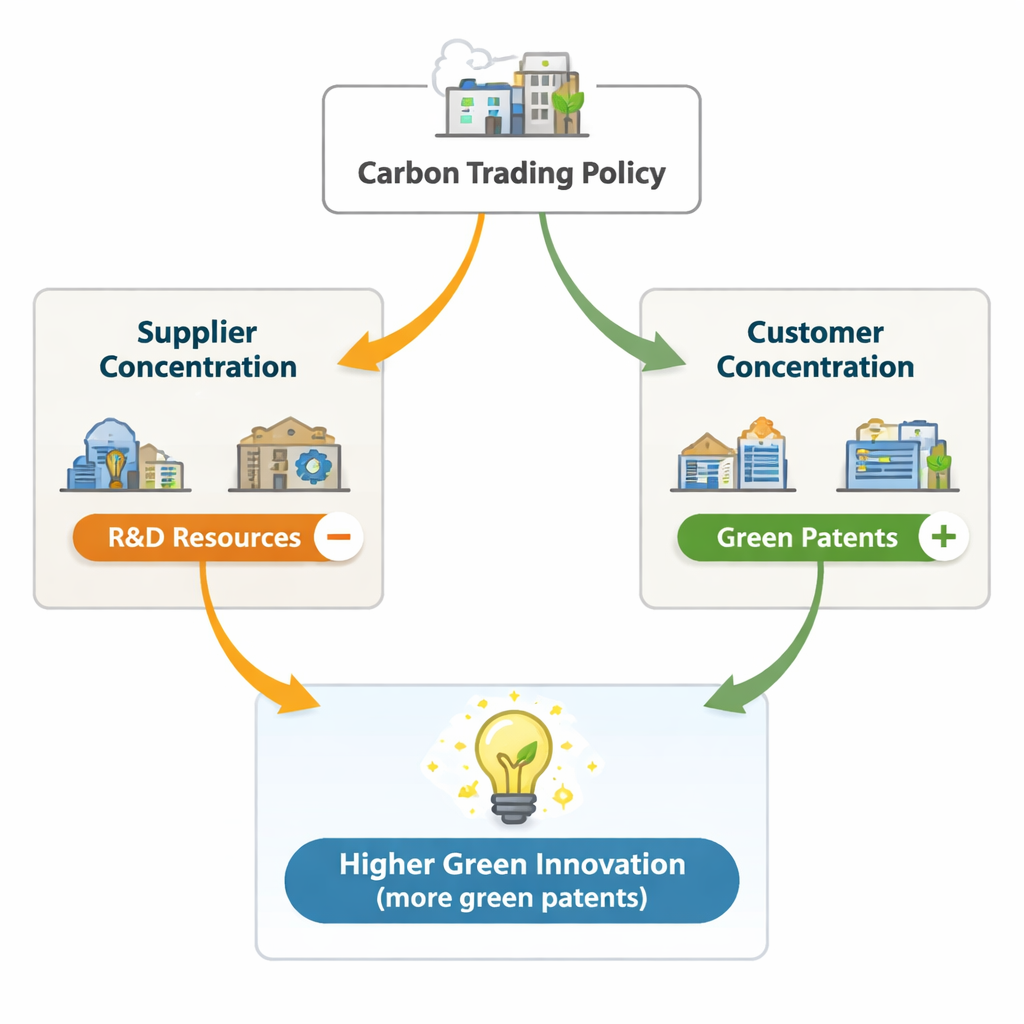
A key innovation of the study is to treat firms not as isolated entities but as hubs in a web of suppliers and customers. The authors measure how concentrated a firm’s supply chain is: what share of its purchases comes from its top five suppliers, and what share of its sales goes to its top five customers. Carbon trading, they argue, sends two different kinds of pressure through this network. Upstream, companies may lean more on a small group of certified, compliant suppliers to guarantee cleaner inputs, but this dependence can give those suppliers more power to raise prices, leaving firms with less money for research and development. Downstream, firms may tighten ties with large customers that demand greener products or are willing to pay more for them, creating a strong incentive to innovate.
A tug‑of‑war with a green outcome
The data reveal that carbon trading does, on balance, push companies toward more green invention. After the policy took effect, firms in covered regions and industries showed a clear rise in green patenting compared with similar firms elsewhere. The supply chain picture is more nuanced. The policy tends to reduce the helpful role of tightly knit supplier relationships, slightly dampening innovation by squeezing profits. At the same time, it strengthens ties with major customers who favor cleaner products, and this channel significantly boosts green patenting. Overall, the positive pull from demanding customers outweighs the negative push from more constrained supplier relationships.
Why ownership and finance change the response
The study also shows that not all companies respond in the same way. State‑owned enterprises, firms with higher profits, and firms with more long‑term debt benefit most. These companies usually have better access to funding and closer links to government or large institutional customers, so they are better able to absorb higher costs from suppliers while still investing in new green technologies to satisfy powerful customers and regulators. In contrast, privately owned or financially weaker firms find it harder to turn carbon costs into innovation opportunities, because short‑term survival pressures limit their room to experiment.
What this means for climate and the economy
For a lay reader, the central message is that carbon trading can be more than a penalty on polluters; when designed well, it can nudge whole supply chains toward cleaner technologies. But this shift is not automatic: it works best when firms have the financial strength and customer demand to turn pressure into creativity. The authors suggest that supportive measures—such as green procurement by large buyers, targeted finance for smaller firms, and policies that ease the strain on suppliers—could help spread these innovation gains more widely, making climate policy a driver of both environmental protection and industrial upgrading.
Citation: Chen, W., Yu, G., Zhao, B. et al. An examination of the impact of carbon emissions trading on corporate green technology innovation from the perspective of supply chain integration. Sci Rep 16, 5998 (2026). https://doi.org/10.1038/s41598-026-36327-2
Keywords: carbon trading, green innovation, supply chains, environmental policy, China industry