Clear Sky Science · en
On the effect of span length on the fire resistance rating of post-tensioned concrete slabs
Why fire and floor span length matter
Modern buildings often rely on sleek, thin concrete floors that can stretch across parking bays, apartments, or open-plan offices without many supporting columns. These long spans are convenient and visually appealing, but they can be more vulnerable in a fire. This study asks a practical question: as we push floor slabs to span farther, do they still stay safe long enough in a serious fire for people to escape and firefighters to work?
Thin floors, hidden steel, and rising heat
Post-tensioned concrete slabs look like ordinary floors, but they contain high-strength steel cables, or tendons, that are pulled tight to hold the slab in a gentle arch. Because this system is so efficient, the slabs can be made thinner and still carry heavy everyday loads. In a fire, however, thin slabs heat up more quickly, and the buried steel tendons are especially sensitive to high temperatures. When these tendons get hot, their strength drops rapidly, and the slab can sag or even fail. Fire safety codes try to prevent this by assigning each floor a fire resistance rating (FRR), usually expressed in minutes, but those ratings are often based on idealized tests that may not fully reflect real buildings.
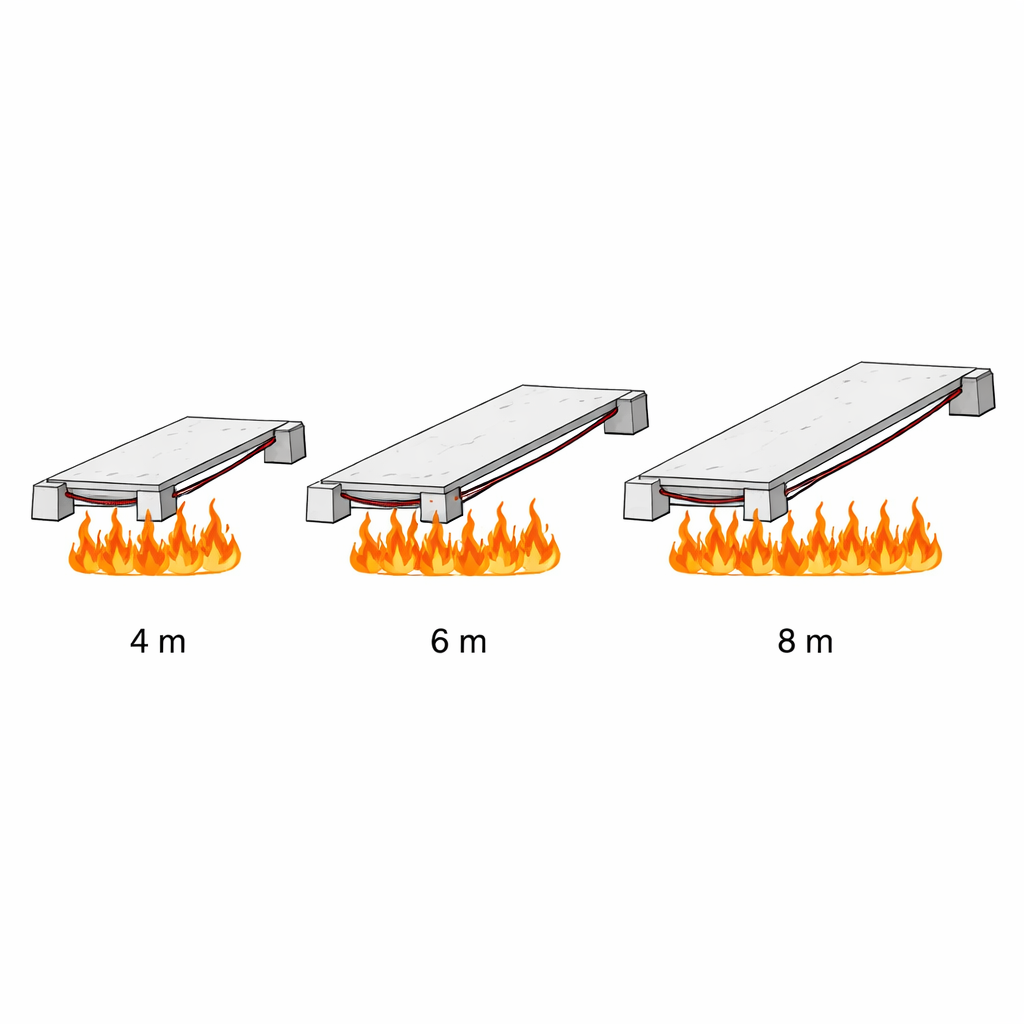
Testing virtual floors in realistic fires
The researchers used advanced computer simulations to explore how span length affects fire performance. They modeled one-way post-tensioned slabs with unbonded tendons spanning 4, 6, and 8 meters, designed for typical residential loads. Each slab was exposed from below to a standard laboratory fire curve and to four more realistic, so-called natural fire scenarios that include both heating and cooling phases and account for factors such as fuel load, ventilation, and firefighting. The virtual tests tracked how temperatures moved through the concrete, how hot the tendons became, and how much the slabs deflected, or sagged, over time. Several failure criteria were checked, including tendon temperature, overall deflection, and how quickly that deflection was increasing.
Longer spans, shorter survival time
The simulations paint a clear picture: as span length increases, the time a slab can safely endure fire drops in a distinctly non-linear way. Under the standard fire, the shortest 4-meter slabs nearly reached their code-intended ratings, but the 6- and 8-meter slabs fell short, especially when judged by how fast they began to sag. Under realistic natural fires, performance was even more concerning. In three of the four natural fire types, the longer slabs lost a large fraction of their expected FRR—around 40% less survival time for the 6-meter slab and almost 50% less for the 8-meter slab in some cases. In short slabs, failure tended to be governed by the tendons finally reaching a critical temperature. In longer slabs, however, the main problem was excessive and accelerating deflection: they started to bend too much, too quickly, before the tendons ever reached their temperature limit.
Fire curves, concrete cover, and code gaps
The study also highlights weaknesses in current design rules. Standard fire curves such as ISO 834, which steadily heat but never cool, often predict longer survival than more realistic fire patterns that include a peak and a cooling phase. For the post-tensioned slabs studied here, relying only on the standard curve could give a false sense of safety in some scenarios. Increasing the concrete cover around the tendons from 30 to 40 millimeters did improve fire resistance by slowing heat transfer, but not nearly as much as code rules assume—far less than the 30 extra minutes per centimeter implied by some guidance. Overall, the calculations showed that simply meeting minimum cover requirements does not guarantee that a long-span post-tensioned slab will actually achieve its target fire rating.
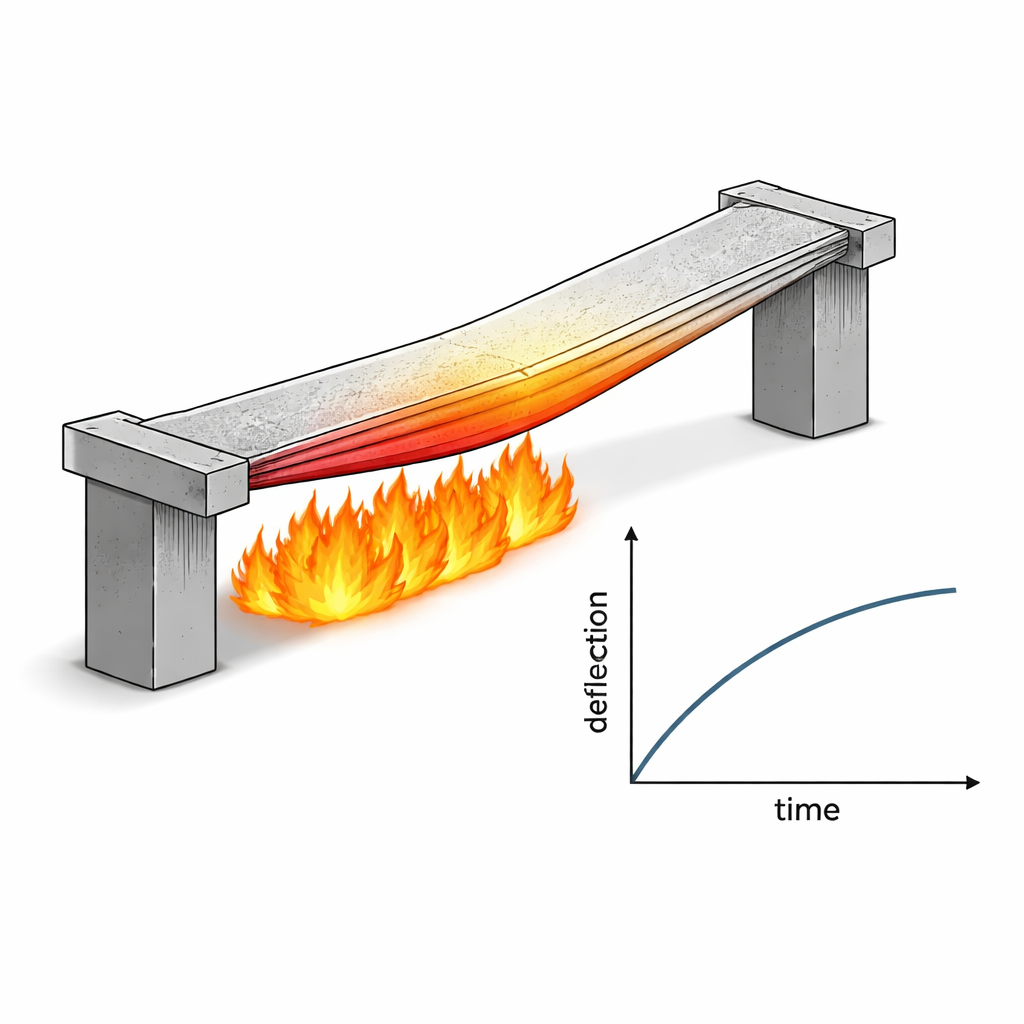
A simple tool to guide safer long spans
Based on the simulated results, the authors proposed simple mathematical relationships that link span length and fire scenario to the expected fire resistance time for these slabs. When they used this approach to predict the performance of a 10-meter slab and then modeled that slab directly, the predicted and simulated fire ratings were very close. This suggests that the method can help designers quickly estimate how much fire resistance is likely for long spans, and whether they need thicker slabs, extra reinforcement, or different fire scenarios in their performance-based designs.
What this means for real buildings
For non-specialists, the takeaway is straightforward: long, thin post-tensioned concrete floors are efficient but can be surprisingly vulnerable in a serious fire, especially under realistic fire conditions rather than ideal test curves. As spans get longer, floors may fail not only because the hidden steel gets too hot, but because the slabs start to sag too much and too fast. The study suggests that building codes and design practices should pay closer attention to span length, realistic fire scenarios, and deflection behavior—not just steel temperature—when assigning fire resistance ratings. Doing so can help ensure that the airy, column-free spaces we enjoy remain safe if fire ever breaks out.
Citation: Hajiheidari, R., Behnam, B. On the effect of span length on the fire resistance rating of post-tensioned concrete slabs. Sci Rep 16, 6254 (2026). https://doi.org/10.1038/s41598-026-36325-4
Keywords: fire resistance rating, post-tensioned concrete slabs, long-span floors, structural fire safety, natural fire scenarios