Clear Sky Science · en
MPPT algorithms for grid-connected solar systems including deep learning approaches
Why squeezing more power from sunlight matters
Solar panels are now a familiar sight on rooftops and in vast solar farms, but most people don’t realize that panels rarely operate at their sweet spot. Changes in sunlight, temperature, and shadows constantly nudge them away from their “maximum power point,” the operating condition where they produce the most electricity. This paper explores how different control methods – from simple rules to deep learning – can keep solar panels closer to that sweet spot, boosting the energy we get from every ray of sunshine.
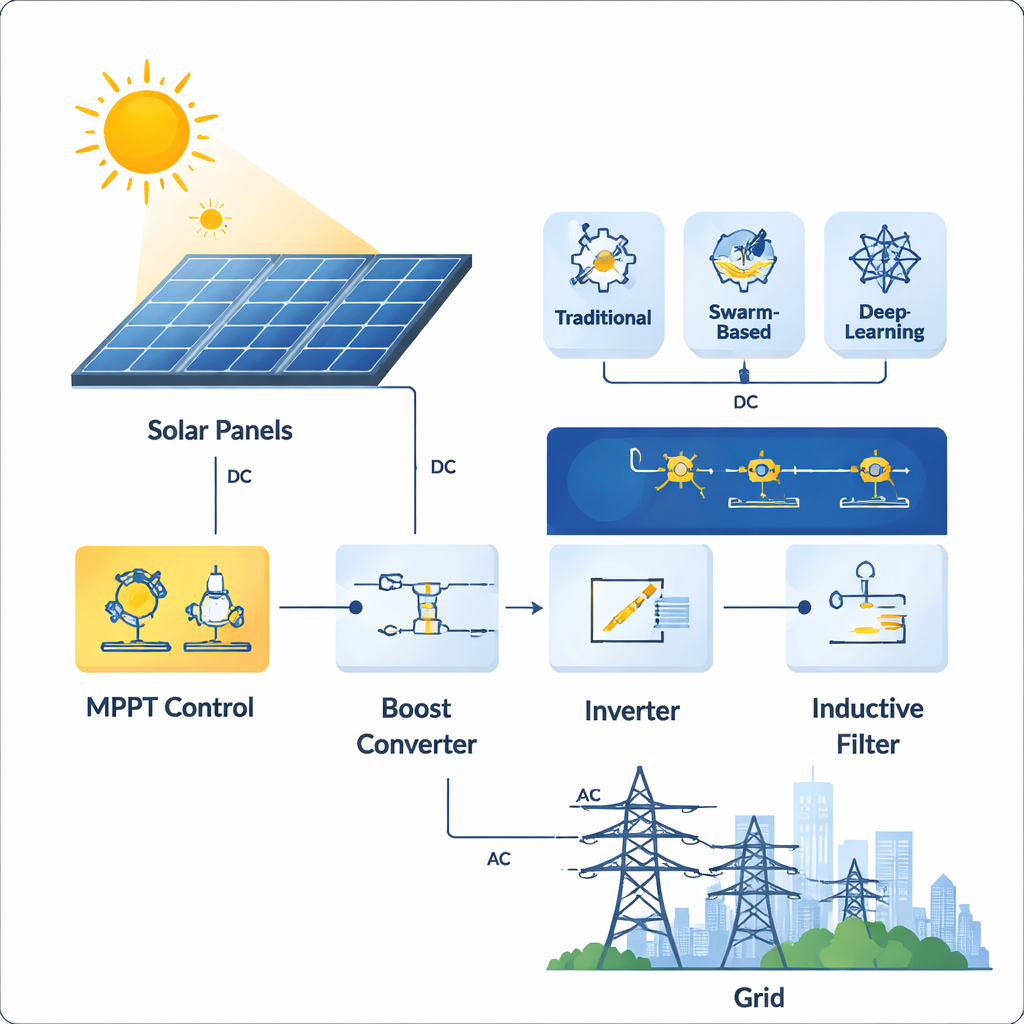
How a smart solar system works
A grid-connected solar system is more than just panels. Sunlight first hits the photovoltaic (PV) modules, which turn light into direct-current (DC) electricity. That power passes through a device called a boost converter, which adjusts the voltage, and then an inverter, which reshapes the electricity into the alternating current (AC) used on the grid. At the heart of this chain sits the maximum power point tracking (MPPT) controller. Its job is to constantly tweak the converter so the panels operate at their most productive point, even as clouds pass, temperatures change, or parts of the array fall into shade.
Different ways to chase the best operating point
The authors compare three broad families of MPPT strategies. Traditional methods, such as “perturb and observe” and “incremental conductance,” use simple measurements of voltage and current to step the operating point up or down and see whether power improves. They are easy to program and run on tiny microcontrollers, but they tend to hunt around the optimum, causing noticeable power swings and wasting some energy. Next come so‑called meta-heuristic methods, inspired by animal behavior, including particle swarm optimization and a “grey wolf” strategy, as well as fuzzy logic control. These methods search more intelligently, coordinating many trial solutions at once or encoding expert rules, and can better handle tricky situations like partial shading.
Teaching algorithms to learn from the weather
The most advanced group are learning-based approaches: artificial neural networks, long short-term memory (LSTM) networks, their bidirectional cousin (BiLSTM), and a hybrid method called ANFIS that blends neural networks with fuzzy logic. Instead of reacting only to the present measurements, these models are first trained on large, synthetic data sets covering many combinations of sunlight and temperature. They learn the relationship between conditions and the ideal operating voltage, so during operation they can jump directly to near-optimal settings. Recurrent networks such as LSTM and BiLSTM are especially good at using past information, which helps when sunlight is changing quickly or parts of the array slide in and out of shadow.
Putting the contenders to the test
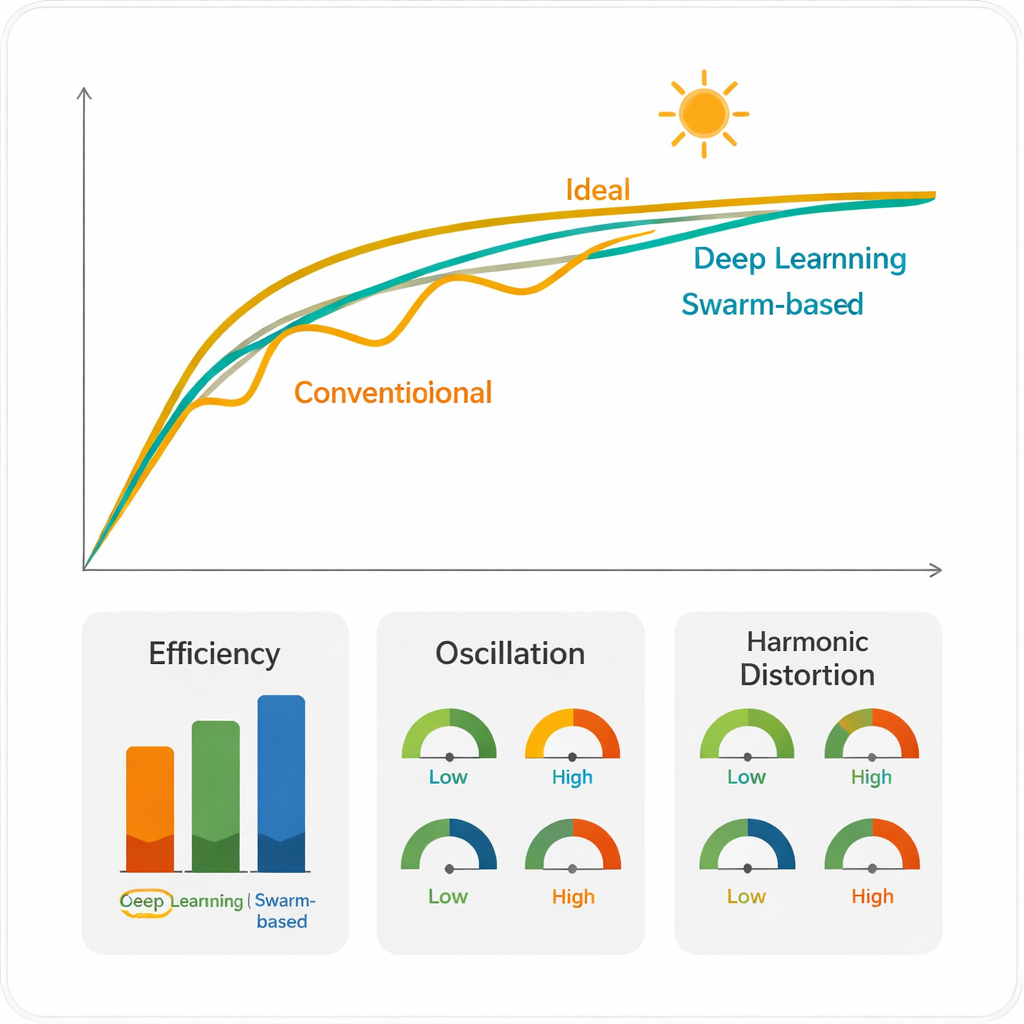
To compare these methods fairly, the researchers built a detailed computer model of a grid-connected PV system in MATLAB/Simulink. They tested all nine MPPT approaches under two demanding scenarios: a smooth, day-like rise and fall in sunlight, and an aggressive four‑second “partial shading” pattern where radiation and shading change quickly. For each algorithm they measured how efficiently it captured power, how much the output wobbled, how many electrical harmonics it fed into the grid, and how heavy a computing load it imposed. Meta-heuristic and learning-based methods consistently captured more than 99% of the available power, with very small oscillations, while the traditional methods reached around 98.5% but with several kilowatts of swing. Fuzzy logic performed worst overall, with higher power loss and distortion despite its sophistication.
Balancing performance and practicality
High-performing algorithms come with a cost: they require more memory, faster processors, and careful tuning. Simple methods like perturb and observe remain attractive for small, low-cost systems because they run quickly on basic chips, even if they leave some energy unharvested. Swarm-inspired approaches such as grey wolf and particle swarm strike a middle ground, offering big efficiency gains with only moderate computing demands. Deep learning and ANFIS provide the best tracking and handle shading extremely well, but they are complex to train and deploy, making them better suited to large solar plants or future “smart” inverters with stronger hardware.
What this means for everyday solar power
For non-specialists, the message is straightforward: smarter control can make existing solar panels behave as if we had quietly added more of them. By choosing the right MPPT strategy for each setting – simple rules for cheap devices, swarm methods for mid-range gear, and deep learning where hardware allows – grid operators and homeowners alike can squeeze extra power from the same sunlight. As solar continues to expand, these intelligent algorithms could play a key role in making clean energy both more efficient and more reliable.
Citation: Değermenci, M., Yalman, Y. & Olcay, K. MPPT algorithms for grid-connected solar systems including deep learning approaches. Sci Rep 16, 6189 (2026). https://doi.org/10.1038/s41598-026-36321-8
Keywords: solar power, maximum power point tracking, photovoltaic systems, deep learning control, renewable energy algorithms