Clear Sky Science · en
Functional and evolutionary diversification of luciferase genes in Metridia lucens Boeck 1865
Why glowing plankton matter
The open ocean at night is full of tiny flashes of cold, living light. Much of this glow comes from microscopic crustaceans called copepods. Their light is not just beautiful; it helps them hide from predators, find food, and talk to one another. This study looks at how one common copepod, Metridia lucens, builds that light at the genetic level, revealing a surprisingly rich family of “light-making” genes that have been shaped by evolution over millions of years.
The tiny lanterns of the sea
Bioluminescence – living light – is powered by a chemical partnership between a small molecule, luciferin, and a protein, luciferase. When luciferase helps luciferin react with oxygen, a photon is released. In many marine animals this system has evolved again and again, often in different molecular forms. Copepods of the Metridinidae family are among the ocean’s brightest microscopic lanterns. Their luciferases are especially attractive to researchers because they are extremely efficient, work without the cell’s main energy molecule ATP, are secreted outside the cell, and remain stable under a range of temperatures. These traits make them powerful tools for laboratory tests, medical imaging, and biosensors.
Hunting for hidden light genes
Although Metridia lucens is widespread in oceans around the world, the exact DNA sequences of its luciferase genes had not been mapped. The authors combined classic gene cloning with massive parallel DNA sequencing to search for all luciferase-like sequences in this species. Working with individual animals and small pools of copepods, they amplified, cloned, and sequenced fragments of luciferase genes, then used high-throughput sequencing to capture many thousands of additional reads. Sophisticated bioinformatic filters helped distinguish real genetic variants from sequencing errors, and evolutionary analyses traced how these sequences are related to one another and to luciferases from closely related species.
Three families of light-makers
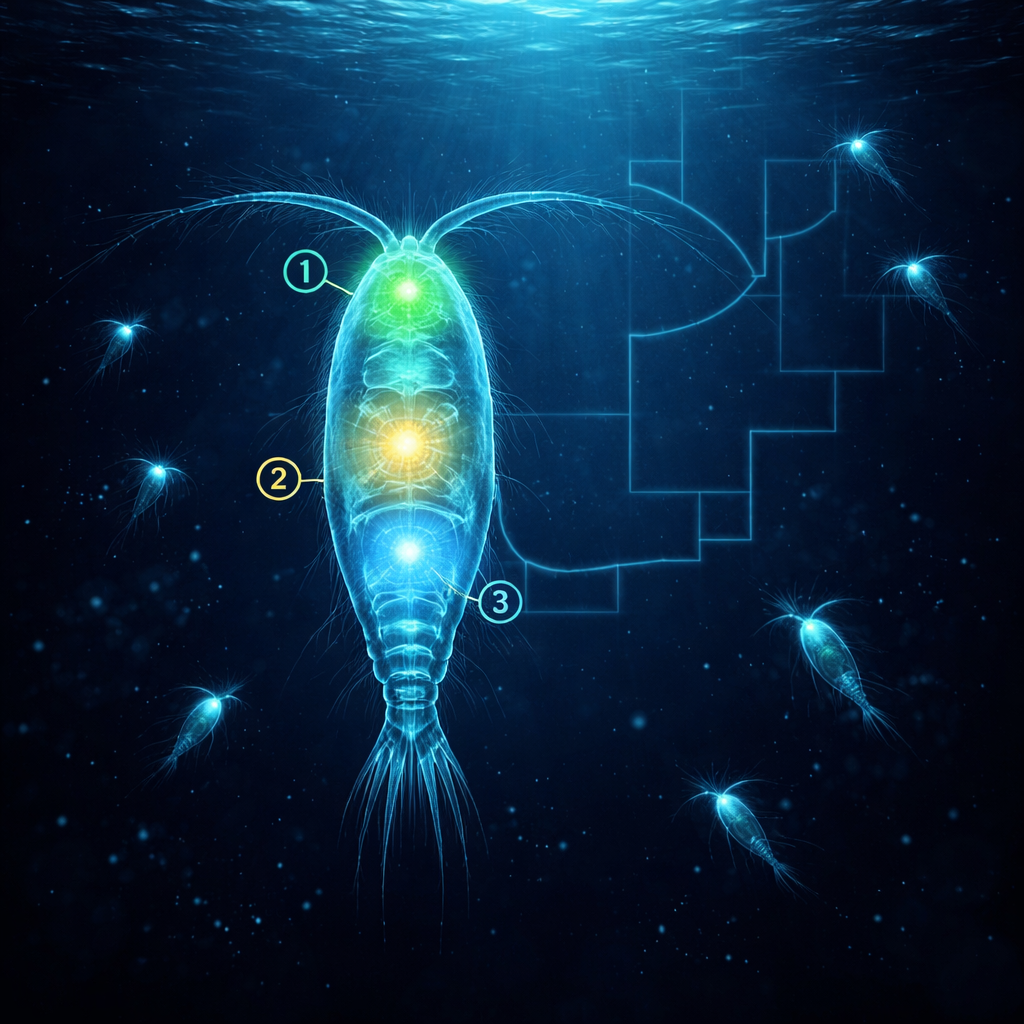
The genetic survey uncovered an unexpectedly complex picture. Instead of just one or two luciferase genes, M. lucens carries three distinct luciferase gene lineages, named MlLuc1, MlLuc2, and MlLuc3. Each lineage is represented by several slightly different copies, so that a single individual can carry many alleles of the same luciferase type. Comparisons with related copepods show that an ancient gene duplication produced two main branches, Luc1 and Luc2, before today’s Metridia species split. Later, in the ancestors of M. lucens and its close relative M. pacifica, Luc2 duplicated again to form a third branch, Luc3. Over time, additional duplications within each branch produced extended gene families while still preserving the key amino acids needed for luciferase function.
How evolution fine-tunes the glow
Despite the high number of variants, most changes in these genes are “silent,” leaving the encoded proteins unchanged. Differences that do alter protein structure are relatively rare, a pattern that points to purifying selection: harmful changes are removed because they would weaken or destroy light production. Detailed statistical tests confirm this, especially for MlLuc1 and MlLuc3. MlLuc2 shows hints that it may have experienced episodes of more adventurous evolution, perhaps to explore new functional roles. Structural modeling and lab experiments suggest that the three luciferase types emit light at similar wavelengths but with different intensities, echoing earlier work in related species where one luciferase produces short, sharp flashes and another produces dimmer but longer-lasting glows. Such diversity could help copepods adapt their signaling to different ecological situations and water temperatures.

What this means for oceans and for medicine
To a non-specialist, the main message is that Metridia lucens does not rely on a single “light switch” gene but on an entire, diversified toolkit of light-making genes that arose through repeated duplications and careful evolutionary pruning. These genes remain strongly protected by natural selection because reliable bioluminescence can mean the difference between life and death in the dark ocean. At the same time, the existence of multiple, slightly different luciferases gives both evolution and biotechnology more to work with: new combinations may improve survival in changing seas, while researchers can harness these naturally optimized light sources as sensitive reporters for medical diagnostics, drug screening, and imaging living cells.
Citation: Gabín-García, L.B., Bartolomé, C., Iglesias, P. et al. Functional and evolutionary diversification of luciferase genes in Metridia lucens Boeck 1865. Sci Rep 16, 6032 (2026). https://doi.org/10.1038/s41598-026-36319-2
Keywords: bioluminescence, luciferase genes, marine copepods, Metridia lucens, gene duplication