Clear Sky Science · en
A hybrid PSO–FPA metaheuristic algorithm for ultra-low sidelobe and high-directivity synthesis of concentric circular antenna arrays for advanced radar applications
Sharper Radar Vision for a Crowded Airwaves World
From self‑driving cars to weather satellites and 5G networks, modern radar and wireless systems all face the same challenge: how to focus their signals like a laser without wasting energy in unwanted directions. This paper presents a new computer algorithm that helps engineers design antenna arrays that concentrate their beams more tightly while dramatically cutting stray radiation that can cause interference, eavesdropping risks, or loss of detail in radar images.
Why Circular Antennas Need Smarter Design
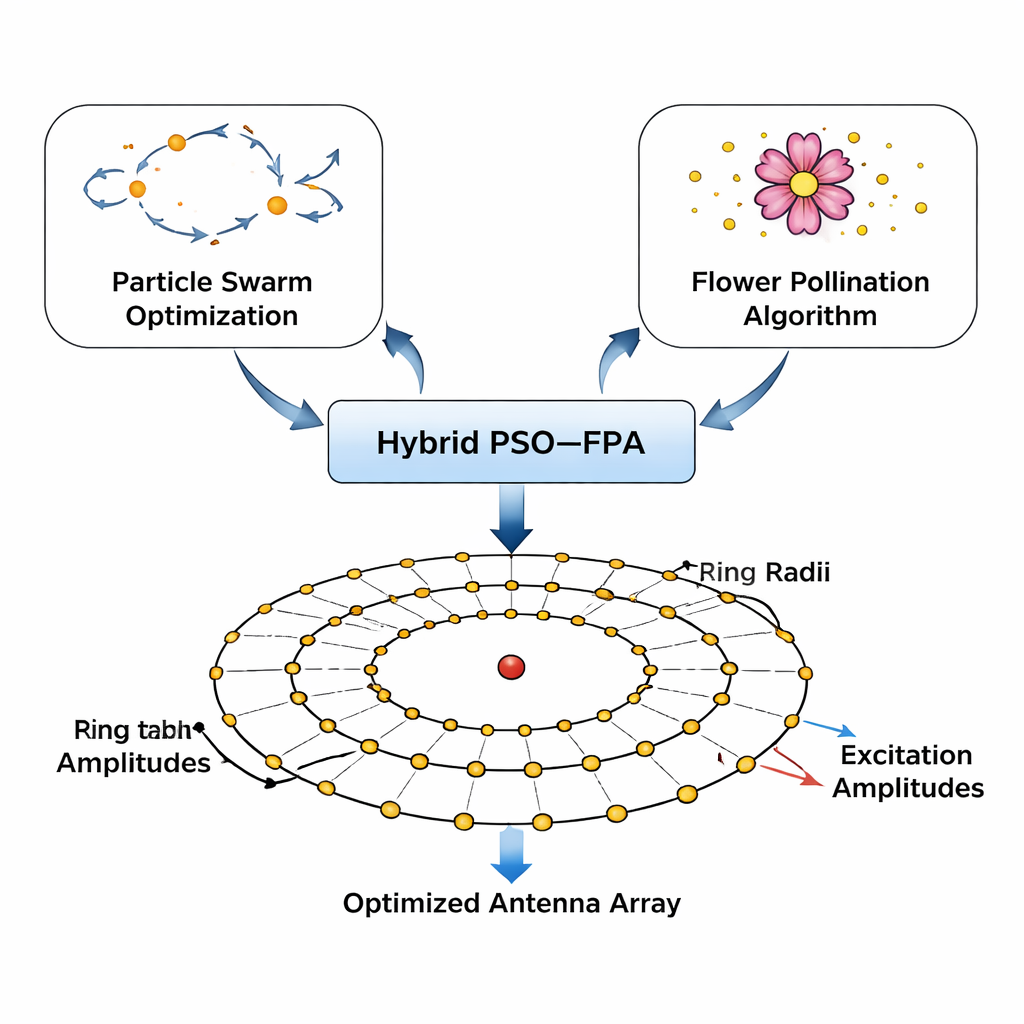
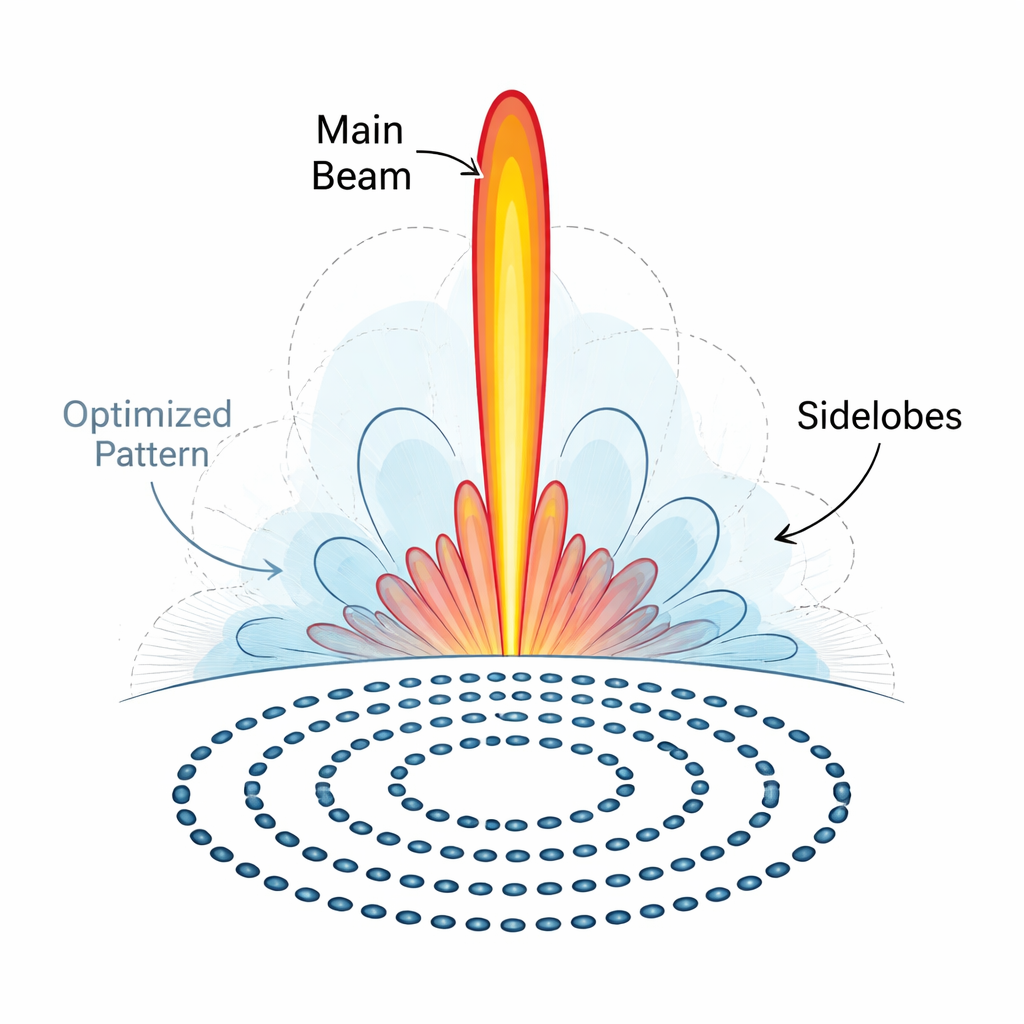
Many advanced radars and communication systems use concentric circular antenna arrays—rings of tiny antennas arranged like ripples on a pond around a central point. This geometry naturally gives full 360‑degree coverage and lets the beam be steered electronically without moving any hardware. The downside is that these arrays tend to produce strong “sidelobes,” weaker beams that shoot off at angles away from the main target direction. Sidelobes waste power and can pick up or generate interference. Designing the exact spacing and strength of each element in multiple rings to suppress sidelobes and keep a narrow, powerful main beam is a complex puzzle with many possible configurations and no simple formula.
Borrowing from Birds and Blossoms
To solve this puzzle, the authors turn to nature‑inspired optimization: search methods that imitate how animals or plants behave when looking for food or spreading pollen. One well‑known method, Particle Swarm Optimization, models a flock of birds that gradually zeroes in on promising spots by sharing what each “bird” finds. Another, the Flower Pollination Algorithm, mimics pollinators making both long jumps to new flowers and short hops among nearby ones. On their own, each method has strengths and weaknesses—one may explore broadly but get stuck in a mediocre design, while the other fine‑tunes well but misses better options elsewhere in the design space.
A Hybrid Search That Learns as It Goes
The core contribution of the paper is a hybrid PSO–FPA algorithm that blends these two strategies into a self‑adapting search engine. In this scheme, candidate antenna designs are treated like flowers and birds at the same time. The “global pollination” steps borrow PSO’s idea of momentum and attraction toward the best designs found so far, helping the search move with purpose rather than wandering randomly. The “local pollination” steps then refine nearby designs, nudged by tuned weights that keep a careful balance between trying new ideas and polishing good ones. This combined process adjusts, ring by ring, both how far each ring sits from the center and how strongly its elements are driven, all while minimizing a cost score that penalizes high sidelobes and excessive beam broadening.
What the New Algorithm Delivers
Using extensive computer simulations, the authors test their hybrid method on several practical array layouts, both with and without a central antenna element. Across all cases, the hybrid approach consistently beats well‑known competitors, including standard PSO, the Flower Pollination Algorithm by itself, the Artificial Bee Colony method, and the Whale Optimization Algorithm. The new method drives sidelobe levels down to about −45 decibels—roughly 38–42% better than earlier techniques—while preserving or improving the sharpness and strength of the main beam. In some dense configurations, the main‑beam gain reaches around 13 decibels with only slight widening of the beam. Just as importantly, these gains are achieved quickly, with typical design runs finishing in under 12 seconds on a standard desktop computer, and the resulting beam patterns remain highly symmetric and stable.
Implications for Future Radar and Wireless Systems
Seen from a non‑technical standpoint, the study shows how combining two nature‑inspired ideas can give radar and communication engineers a powerful new “tuning knob” for their hardware. The hybrid PSO–FPA algorithm acts like an automatic designer, exploring millions of ways to place and drive the tiny antennas in a circular array until it finds patterns that send most of the energy exactly where it is needed and almost nowhere else. This means clearer radar images, better target separation, and less mutual interference between neighboring systems sharing crowded airwaves. While practical deployment will still need to account for real‑world issues like manufacturing tolerances and element coupling, the work provides a robust blueprint for building next‑generation antenna arrays that see farther and more precisely with less waste.
Citation: Brahimi, M., Haouam, I., Bouddou, R. et al. A hybrid PSO–FPA metaheuristic algorithm for ultra-low sidelobe and high-directivity synthesis of concentric circular antenna arrays for advanced radar applications. Sci Rep 16, 7037 (2026). https://doi.org/10.1038/s41598-026-36315-6
Keywords: antenna arrays, radar systems, beamforming, optimization algorithms, wireless communications