Clear Sky Science · en
The association between probable sarcopenia, non-motor symptoms, and fall-related outcomes in parkinson’s disease
Why muscle strength matters in Parkinson’s
For many people, Parkinson’s disease is synonymous with tremors and stiffness. But as this study shows, hidden problems like muscle weakness, poor nutrition, and dizziness when standing up can quietly raise the risk of dangerous falls. Understanding how these factors fit together can help patients, families, and clinicians spot trouble early and take practical steps to preserve independence. 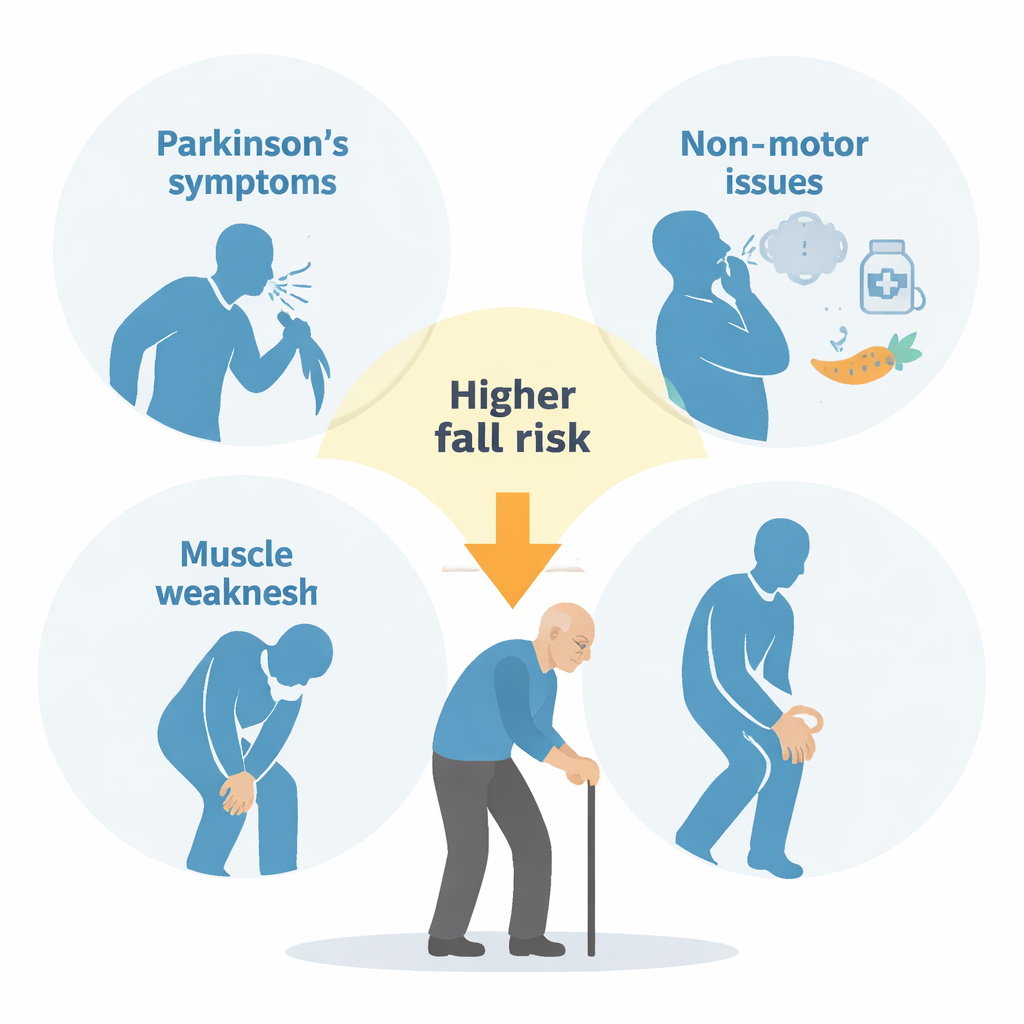
A closer look at Parkinson’s beyond tremors
Parkinson’s disease does not only affect movement. People may experience sleep problems, low mood, constipation, swallowing difficulties, a poor sense of smell, weight loss, and light-headedness when standing. These “non-motor” symptoms can appear years before a diagnosis and can erode quality of life as much as shaking or slow walking. At the same time, many older adults gradually lose muscle strength, a condition known as sarcopenia. When Parkinson’s and age-related muscle weakness collide, everyday tasks such as standing up from a chair or walking across a room can become hazardous.
How the study was set up
To explore these links, researchers in Turkey examined 93 people aged 65 and older. Half had Parkinson’s disease, while the rest were spouses or relatives without Parkinson’s but with typical age-related health problems. All participants underwent detailed testing of handgrip strength, walking speed, balance, daily activities, mood, frailty, and nutrition. The team used hand strength alone to define “probable sarcopenia” — a practical early warning sign of muscle weakness. People with Parkinson’s also filled out a questionnaire on non-motor symptoms and a scale measuring fear of falling. The goal was to see how often probable sarcopenia occurred and which features of Parkinson’s were most closely tied to it.
What the researchers found
Probable sarcopenia was surprisingly common: about 60% of people with Parkinson’s and a similar proportion of controls had low handgrip strength. But in Parkinson’s, this weakness carried a heavier burden. Patients with both Parkinson’s and probable sarcopenia were more likely to have advanced disease, slower walking, worse balance, and greater difficulty with basic and household tasks. They reported more frequent falls, a stronger fear of falling, and higher scores for non-motor symptoms, especially swallowing problems and dizziness when standing. Compared with patients whose muscle strength was preserved, those with probable sarcopenia were also more frail and had poorer nutritional scores, even though body weight did not differ much.
Frailty and nutrition as the key links
When the researchers accounted for overlapping factors statistically, two stood out as independently tied to probable sarcopenia in Parkinson’s: frailty and nutrition. Each step up on a simple frailty scale sharply increased the odds of having probable sarcopenia, while better scores on a brief nutrition test were protective. Age, non-motor symptom burden, mobility tests, and standard Parkinson’s severity ratings were linked to muscle weakness when examined one by one, but they faded in importance once frailty and nutrition were considered together. This suggests that in older adults with Parkinson’s, muscle weakness is tightly woven into a broader picture of reduced reserves and inadequate dietary intake. 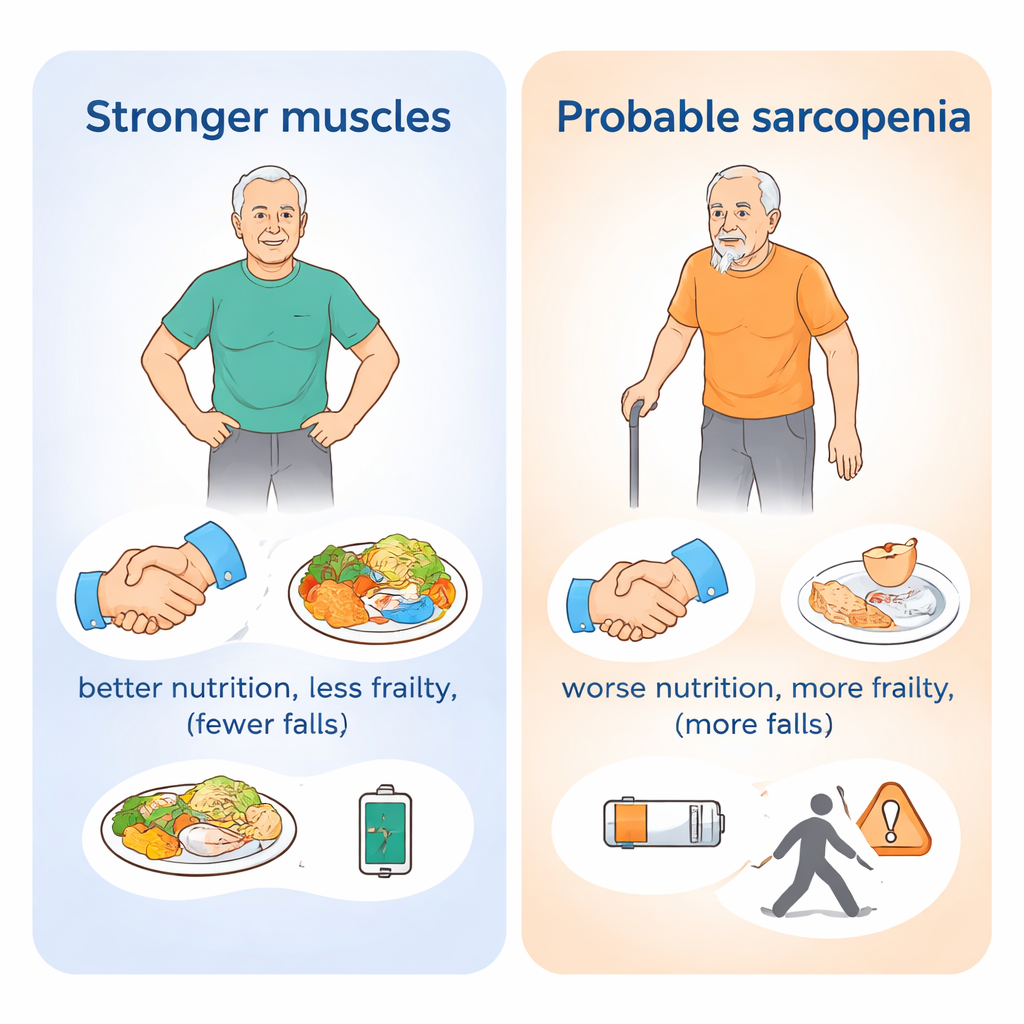
What this means for daily life
For patients and caregivers, the message is straightforward: weak grip strength in Parkinson’s is not just a minor inconvenience—it can signal a higher risk of falls, loss of independence, and increasing care needs. The study suggests that routinely checking handgrip strength, frailty, and nutrition in older people with Parkinson’s could help identify those on a path toward functional decline. Simple interventions such as resistance exercises, balance training, and targeted nutritional support may not cure Parkinson’s, but they could strengthen muscles, lessen frailty, and make falls less likely. In short, paying attention to muscles and meals may be as important as managing tremors when the goal is to stay upright and independent for as long as possible.
Citation: Kamaci Sener, D., Deniz, O., Gemci, E. et al. The association between probable sarcopenia, non-motor symptoms, and fall-related outcomes in parkinson’s disease. Sci Rep 16, 5650 (2026). https://doi.org/10.1038/s41598-026-36313-8
Keywords: Parkinson’s disease, muscle weakness, falls, frailty, nutrition