Clear Sky Science · en
Development of an elastoplastic constitutive model for expansive soil under drying-wetting and freezing-thawing cycles
Why cracking soils matter for canals
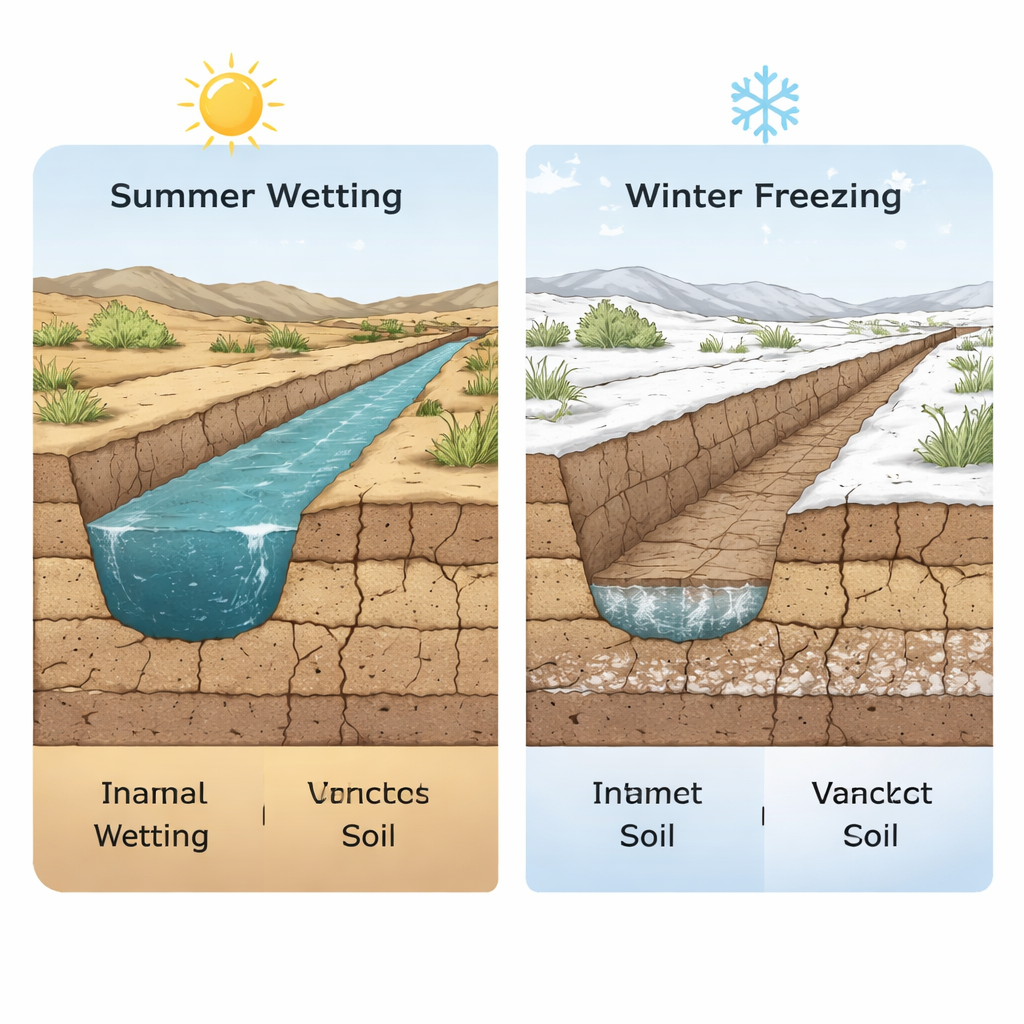
In many dry, cold regions, vital drinking and irrigation water is carried in open canals cut through a special kind of clay known as expansive soil. This soil swells when it absorbs water and shrinks and cracks when it dries or freezes, which can slowly undermine canal banks. The study summarized here explains, in a step‑by‑step way, how repeated seasons of wetting, drying, freezing and thawing weaken such soils—from the scale of invisible pores all the way up to visible cracks and slope failures—and presents a new mathematical model engineers can use to predict this damage.
From solid ground to cracking slopes
The researchers focused on a large water‑transfer canal in Northern Xinjiang, a cold desert area where the canal runs through long stretches of expansive soil. In summer, the canal carries water; in winter, it is emptied and exposed to freezing air. This yearly cycle of soaking, drying and freezing has already produced complex crack networks, slope slides and deformation of canal bottoms, reducing the canal’s ability to move water efficiently. To understand why this happens, the team took soil from the canal, compacted it in the laboratory to mimic field conditions, and then subjected samples to up to nine controlled cycles of wetting–drying and freezing–thawing.
Testing strength and watching cracks grow
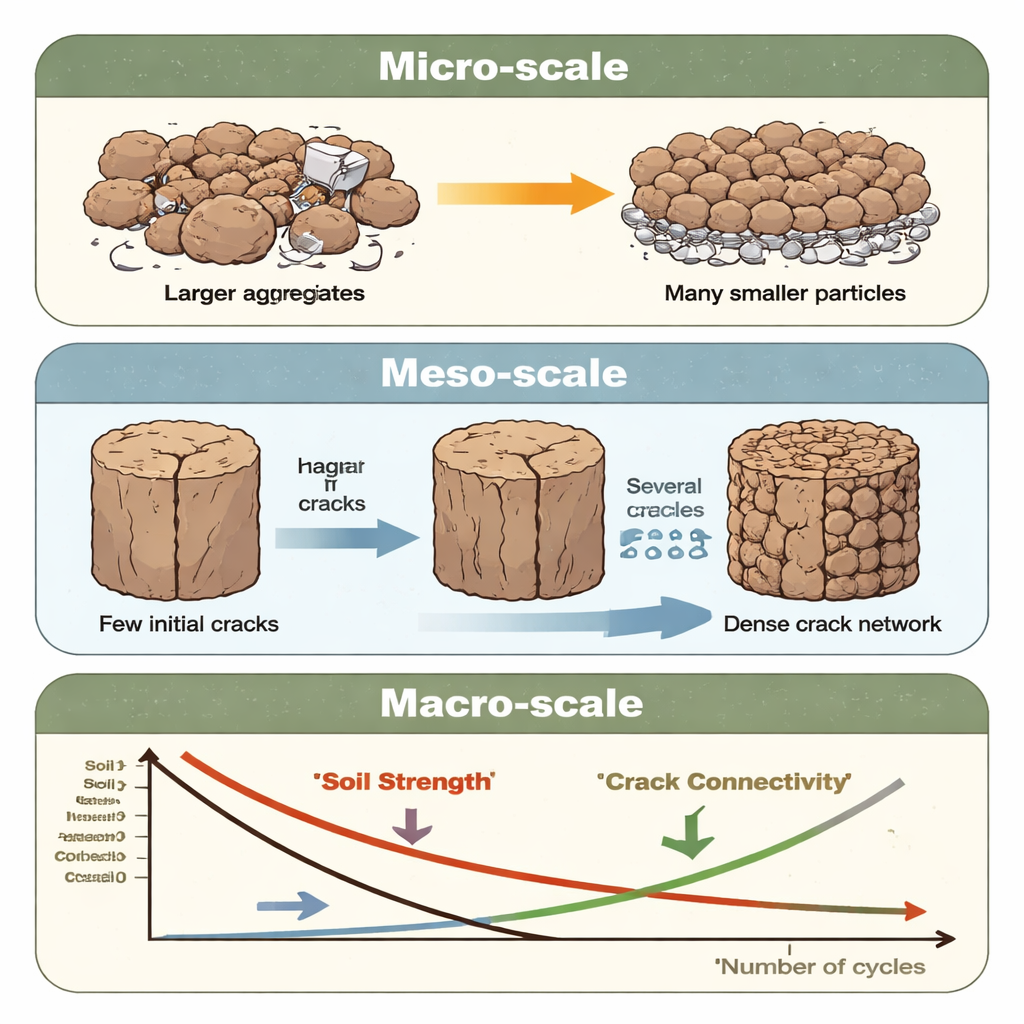
At the visible, or macroscopic, scale, the team used triaxial tests—where cylindrical soil samples are squeezed from all sides and then slowly compressed—to track how the soil’s strength changed with each cycle. The stress–strain curves showed that the soil gradually became weaker and more deformable: failure strength dropped by roughly 30% after nine cycles, with the sharpest decrease after the very first one. A key strength measure called cohesion, which reflects how well particles stick together, fell by about a quarter overall and followed an exponential decline with the number of cycles. By contrast, the internal friction angle—linked to how grains rub and lock against each other—stayed almost unchanged, indicating that bonding between particles, rather than friction, is what mainly deteriorates.
Linking crack networks to hidden pore changes
To capture what happens between the fully visible and the microscopic, the researchers photographed the surfaces of soil specimens after different numbers of cycles and analyzed the crack patterns. They introduced a simple "connectivity" index, Q, which increases as individual cracks merge into a continuous network. Initially, only a few small fissures appeared. With more cycles, vertical, horizontal and inclined cracks widened and linked up, eventually cutting the specimen into blocks and signaling overall structural failure. Q rose quickly at first and then leveled off—mirroring the early rapid loss of strength. At the microscopic level, high‑magnification electron microscope images showed that previously large, bonded soil aggregates broke into many smaller particles, while the total area occupied by solid particles and their average size shrank markedly. Fine pores gradually connected, forming pathways that would later become the visible cracks. Statistical analysis confirmed that the loss of solid particle area strongly tracked both the drop in cohesion and the rise in crack connectivity.
A new way to predict soil weakening
Beyond describing these changes, the authors built an improved mathematical model to predict them. They started from a widely used soil mechanics framework known as the modified Cam‑clay model, which relates how clays compress and shear under load. To represent the bonding between particles in expansive soil, they added an "effective bonding stress" parameter that shifts the model’s stress curve. They then fitted this parameter and others to their test data for different numbers of cycles. The result was a set of simple exponential formulas that describe how the soil’s key properties evolve with repeated wetting–drying and freezing–thawing. When they used these formulas in the model, the predicted curves for stress–strain and volume change matched the experiments closely, showing that the model can realistically capture the progressive damage.
What this means for real‑world canals
For non‑specialists, the main message is that expansive soils under seasonal moisture and temperature changes do not fail all at once. Their inner pores reshape, their particles break down, and their cracks gradually connect into networks that quietly erode strength long before a slope visibly collapses. By tying together observations from the pore scale to the slope scale and by embedding these links in a practical predictive model, this study provides engineers with tools to forecast how quickly canal banks in similar climates will deteriorate and to design reinforcements or drainage measures before costly failures occur.
Citation: Zhang, H., Yang, M. & Cui, Z. Development of an elastoplastic constitutive model for expansive soil under drying-wetting and freezing-thawing cycles. Sci Rep 16, 5756 (2026). https://doi.org/10.1038/s41598-026-36311-w
Keywords: expansive soil, freeze–thaw cycles, soil cracking, canal slope stability, soil constitutive model