Clear Sky Science · en
Interferential current stimulation during dental facial treatment improves masticatory function
Why Chewing Better Matters
Chewing is something most of us take for granted, yet it is central to eating comfortably, enjoying food, and staying healthy. As people age or develop dental and swallowing problems, simply breaking down a bite of food can become tiring or unsafe, raising the risk of choking or pneumonia. This study asks a practical question with big implications: can a gentle, noninvasive electrical treatment applied during routine dental care make it easier to chew right away?
A Gentle Boost for Jaw Muscles
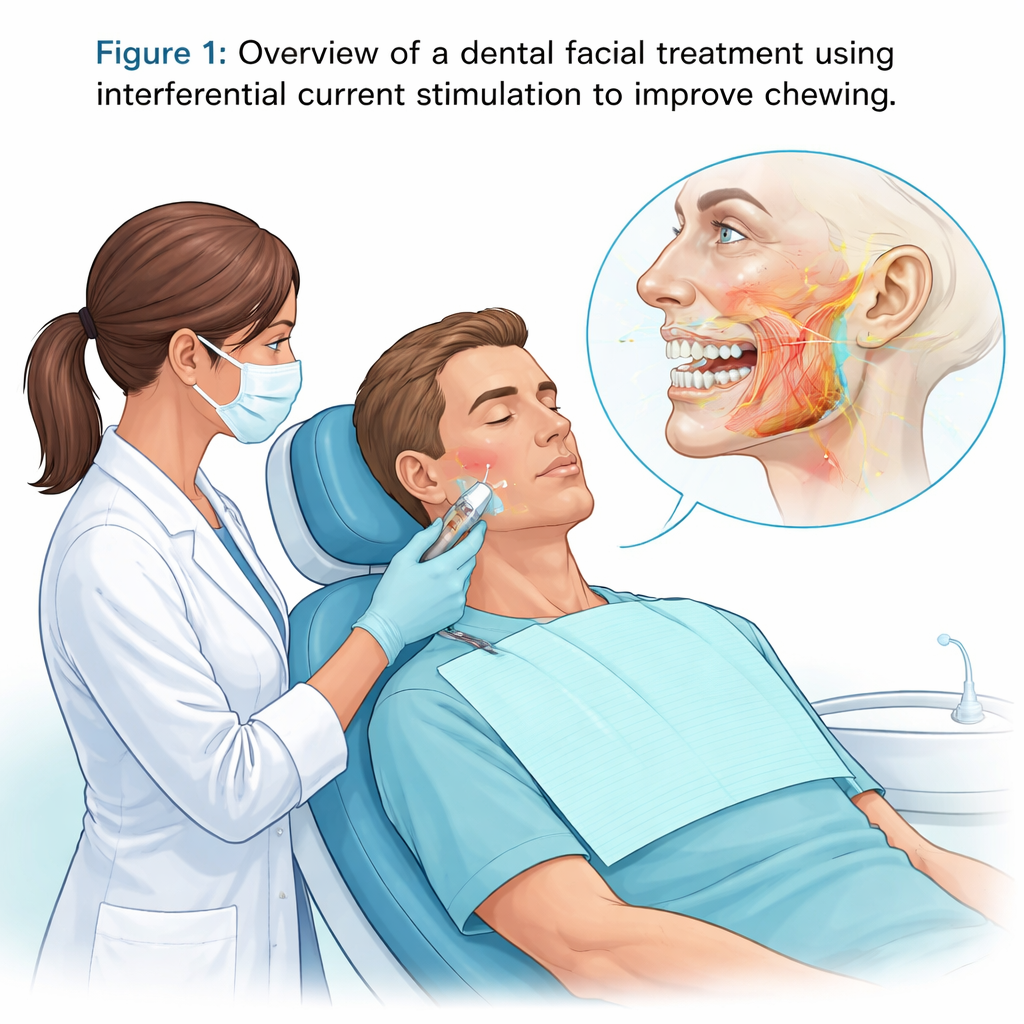
The researchers focused on a therapy called dental facial treatment, in which a small handheld device delivers a soft interferential electrical current through the skin over the cheek muscles used for chewing. Unlike older approaches that use strong currents to visibly contract muscles, this device works near the level of sensation—patients may feel only a faint tingling, if anything. The idea is to stimulate the nerves that carry touch and pressure signals from the face and teeth, in turn nudging the brain circuits that control how hard and how smoothly we bite.
Putting the Treatment to the Test
To find out whether this approach truly improves chewing, the team ran a randomized crossover study with 46 adults who were already coming for regular dental checkups. Each person attended two sessions one month apart. In one visit, they received the active stimulation for five minutes, with the device placed over the main chewing muscle on each side of the face. In the other visit, the device was held in the same position but no current flowed—a sham treatment designed to look and feel similar. Neither session involved surgery or injections; everything was done through the skin during routine care.
Measuring Chewing with Candy and Comfort
Chewing ability was measured in two ways. First, participants were given a standardized gummy jelly to chew for 20 seconds. The chewed jelly was then rinsed, and the amount of sugar released into the liquid was measured. The more completely the candy was broken down and mixed with saliva, the higher the sugar reading—an objective sign of better chewing and biting. Second, volunteers rated how easy chewing felt on a 0–100 scale, from “cannot chew at all” to “extremely easy to chew.” Both tests were done just before and shortly after each session, allowing each person to serve as their own comparison between real and sham treatment.
Stronger Bites, Smoother Chewing
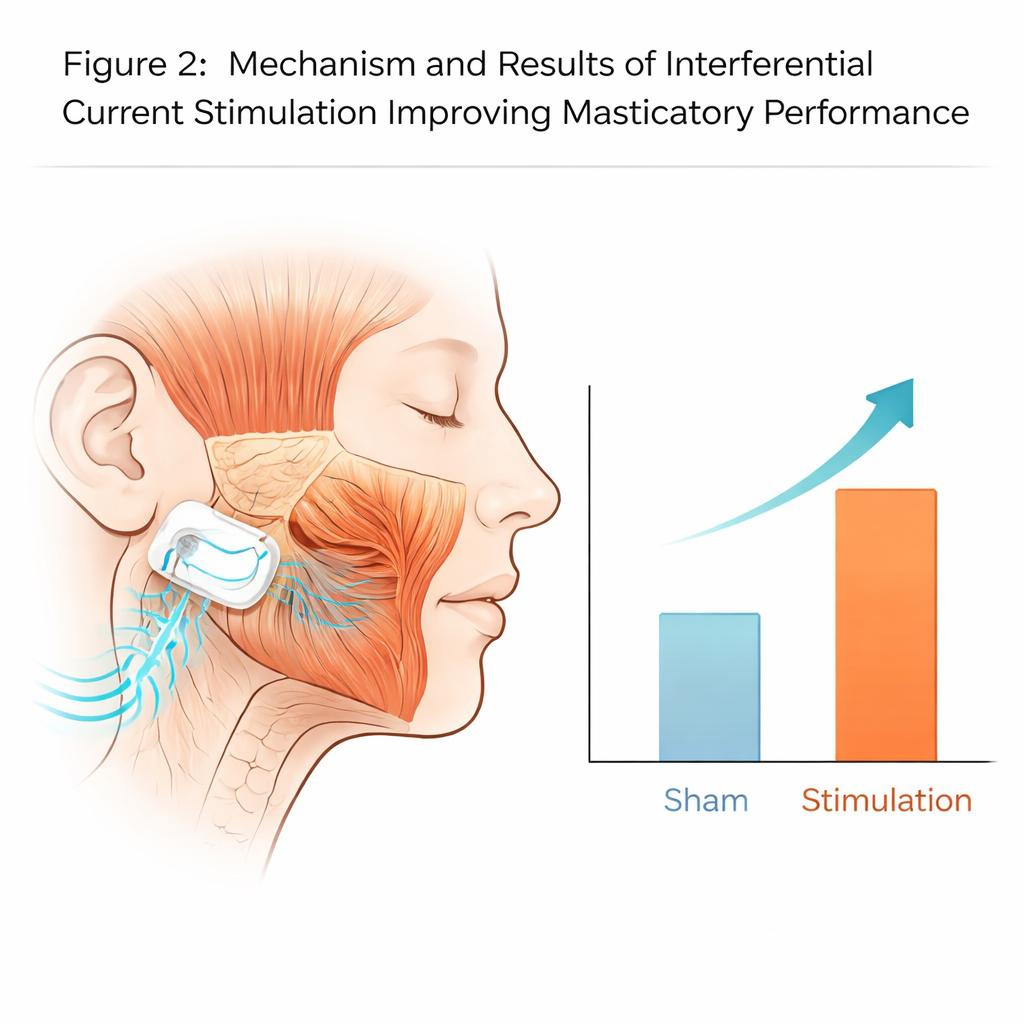
The results were striking. After the sham session, average sugar levels from the chewed candy actually dropped slightly, suggesting no real gain in chewing performance. After the active stimulation, however, sugar levels rose noticeably—by more than 30 mg/dL on average, a change the researchers had defined in advance as not only statistically significant but also clinically meaningful. People also reported that chewing felt easier after both sessions, but the improvement was larger when they had received real stimulation. Statistical models that accounted for visit order and other factors consistently favored the active treatment over sham.
How It Might Work and What Comes Next
Although this study did not record brain or nerve activity directly, the pattern of results fits with what is known about how sensory signals from teeth, gums, and jaw muscles fine-tune bite strength. Gentle electrical currents may heighten these signals, helping the nervous system coordinate stronger, more efficient jaw closing without causing fatigue or pain. Increased chewing speed and slight changes in saliva production may also play a supporting role. The authors caution that expectations and other placebo-like effects cannot be completely ruled out, and they call for future work using more detailed measurements of jaw movement, muscle force, and saliva, as well as longer-term follow-up.
A Simple Add-On with Big Promise
For non-specialists, the main takeaway is that a brief, low-intensity electrical treatment delivered through the skin during ordinary dental visits can, at least in this small study, give chewing an immediate and measurable boost. If confirmed in larger and longer trials, this approach could become a simple add-on to oral care for older adults and others at risk of chewing and swallowing problems. By helping people break down food more effectively and comfortably, such treatments may eventually contribute not just to better dental health, but also to safer eating and improved overall well-being.
Citation: Hara, M., Hara, N. & Oku, Y. Interferential current stimulation during dental facial treatment improves masticatory function. Sci Rep 16, 6063 (2026). https://doi.org/10.1038/s41598-026-36307-6
Keywords: chewing, electrical stimulation, dental therapy, swallowing, oral rehabilitation