Clear Sky Science · en
Compost application enhances soil quality, growth, and yield of durum wheat under saline conditions
Turning Yard Waste into a Lifeline for Wheat
As freshwater becomes scarcer, many farmers are pushed to irrigate with salty water, which slowly poisons their fields and cuts crop yields. This study asks a simple but powerful question: can ordinary green waste—like pruned branches and grass clippings—be turned into compost that helps wheat survive and still produce food in salty soils? By testing different amounts of compost with varying salt levels in irrigation water, the researchers show how a low-cost, recycled material can protect both soil and harvests in a warming, drying world. 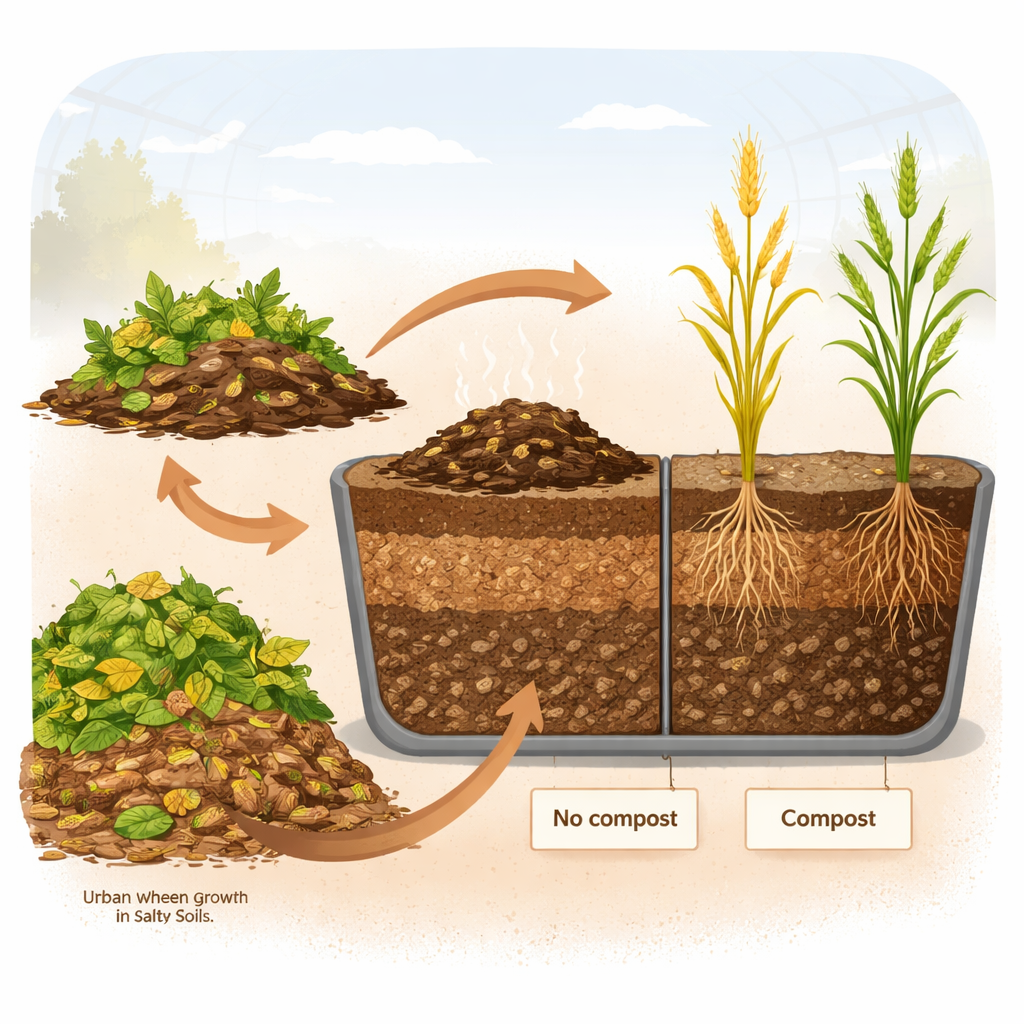
Why Salt in Soil Is a Growing Problem
Salty soils are spreading across the globe, especially in dry Mediterranean regions such as Morocco, where this work was carried out. When farmers rely on brackish water to irrigate their fields, salts—especially sodium and chloride—accumulate around plant roots. This build-up makes it harder for plants to take up water, disrupts their nutrient supply, and gradually damages soil structure. Over time, fields can become so degraded that crops like durum wheat, a staple for pasta, couscous, and semolina, struggle to grow at all. With projections that up to half of the world’s arable land could be salt-affected by mid‑century, finding ways to keep soils productive without relying only on chemical fertilizers is urgent.
Testing Compost as a Soil Shield
The research team grew a widely used Moroccan durum wheat variety, called Faraj, in pots filled with silty-clay soil collected from a salinity-prone area near Rabat. Inside a greenhouse, they carefully controlled four levels of salt in the irrigation water—from almost fresh to strongly saline—and combined these with four compost doses: none, low, medium, and high. The compost came from plant-based green waste that had been aerobically decomposed and matured, similar to what could be produced from city parks or farm residues. Over the full growing season, they tracked how the compost changed soil chemistry, plant growth (height and leaf number), photosynthetic health (via chlorophyll fluorescence), and final yield, including grain and straw.
Healthier Soil Under Stress
Salty irrigation alone pushed soil in the wrong direction: electrical conductivity and sodium levels rose, while organic matter and some nutrients fell, and the soil became more alkaline. Adding compost, especially at the highest rate, reversed many of these trends. Organic matter and total nitrogen increased, and key nutrients such as phosphorus, potassium, calcium, and magnesium became more available. At a moderate salt level, potassium and calcium rose by about a quarter compared with untreated soil. Compost also helped keep soil pH closer to neutral and reduced sodium build-up by nearly one quarter at certain salinity levels. In short, the soil with compost acted more like a living sponge and nutrient bank, even when regularly doused with salty water.
Stronger Plants and Bigger Harvests
These soil changes translated into healthier wheat. As salt levels in the water increased, plants without compost became shorter, had fewer leaves, and showed signs of stress in their photosynthetic machinery. With compost, plants stayed taller, leafier, and more photosynthetically efficient across all salt levels. At the highest compost dose, plant height rose by up to 48%, leaf number by up to 40%, and a standard measure of leaf vitality improved by nearly 20% compared with no compost. Yields also benefited: grain production increased modestly under low salinity but much more under moderate salt stress—by more than 30% at one of the higher salt levels—while grain size, spike length, and straw yield were all better in compost-treated pots. Even under very salty conditions, compost softened the damage, though it could not fully restore yields. 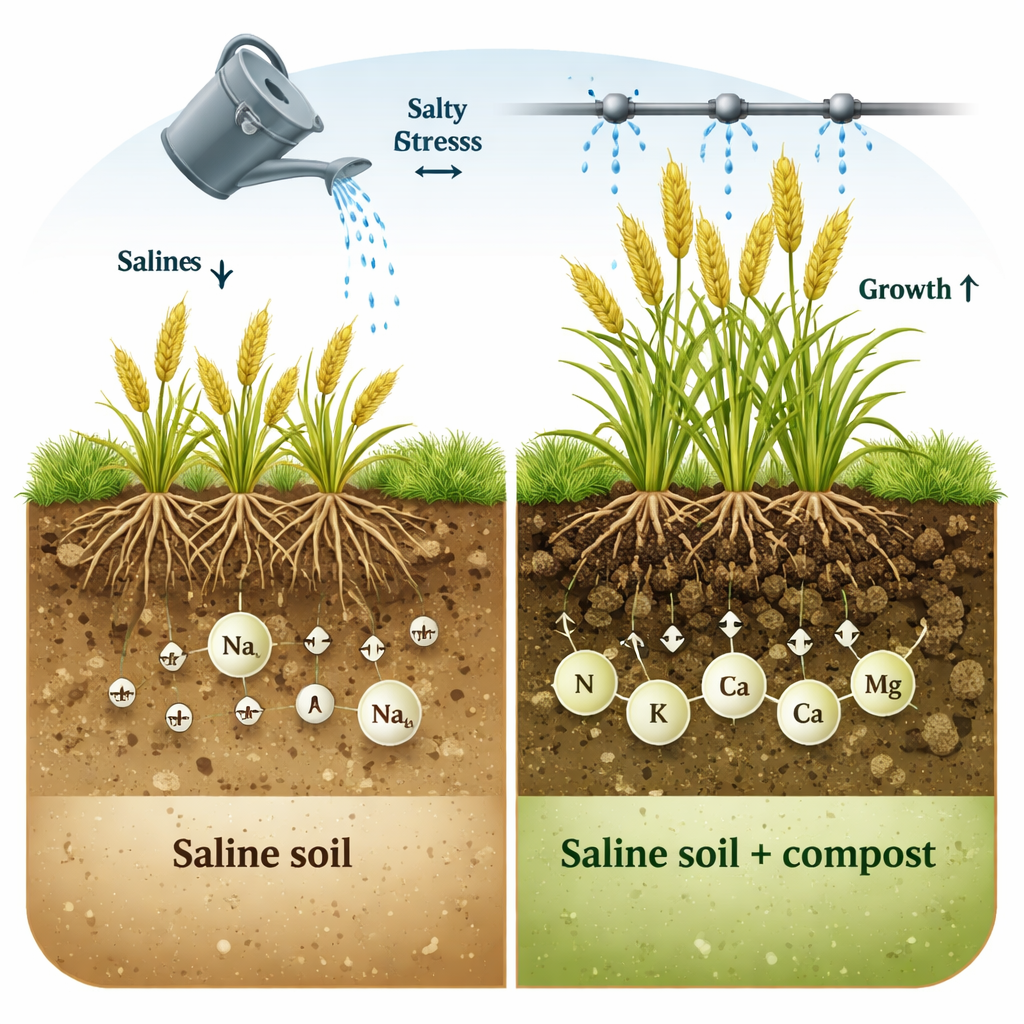
What This Means for Farmers and Food Security
For non-specialists, the core message is straightforward: turning green waste into compost can partially “armor” soil and wheat against the growing problem of salty irrigation water. The compost improves the soil’s structure and nutrient balance, helps push harmful salts away from roots, and keeps plants greener and more productive, particularly when salt levels are moderate rather than extreme. While compost alone cannot rescue crops from very high salinity, and these experiments were done in pots rather than open fields, the findings point to a practical, sustainable tool that farmers can combine with salt-tolerant wheat varieties and better water management. In a future where both water scarcity and soil salinization intensify, such circular use of organic waste could help keep bread on the table in vulnerable regions.
Citation: Manhou, K., Hmouni, D., Moussadek, R. et al. Compost application enhances soil quality, growth, and yield of durum wheat under saline conditions. Sci Rep 16, 7643 (2026). https://doi.org/10.1038/s41598-026-36306-7
Keywords: soil salinity, durum wheat, green waste compost, sustainable irrigation, soil health