Clear Sky Science · en
Optical push broom effect by a moving refractive index front in a silicon Bragg waveguide
Light on a Chip, Swept and Squeezed
Turning continuous beams of light into short, intense bursts is vital for faster communications, precise sensing and compact lasers. This paper shows how a silicon chip can do exactly that by using a fast-moving "front" in the material to sweep up and compress light, much like a snowplow pushing snow. The work demonstrates a long-predicted effect called the optical push broom and brings it from bulky fiber optics down to a millimeter-scale device compatible with modern photonic chips.
How to Catch Light That Is Slowing Down
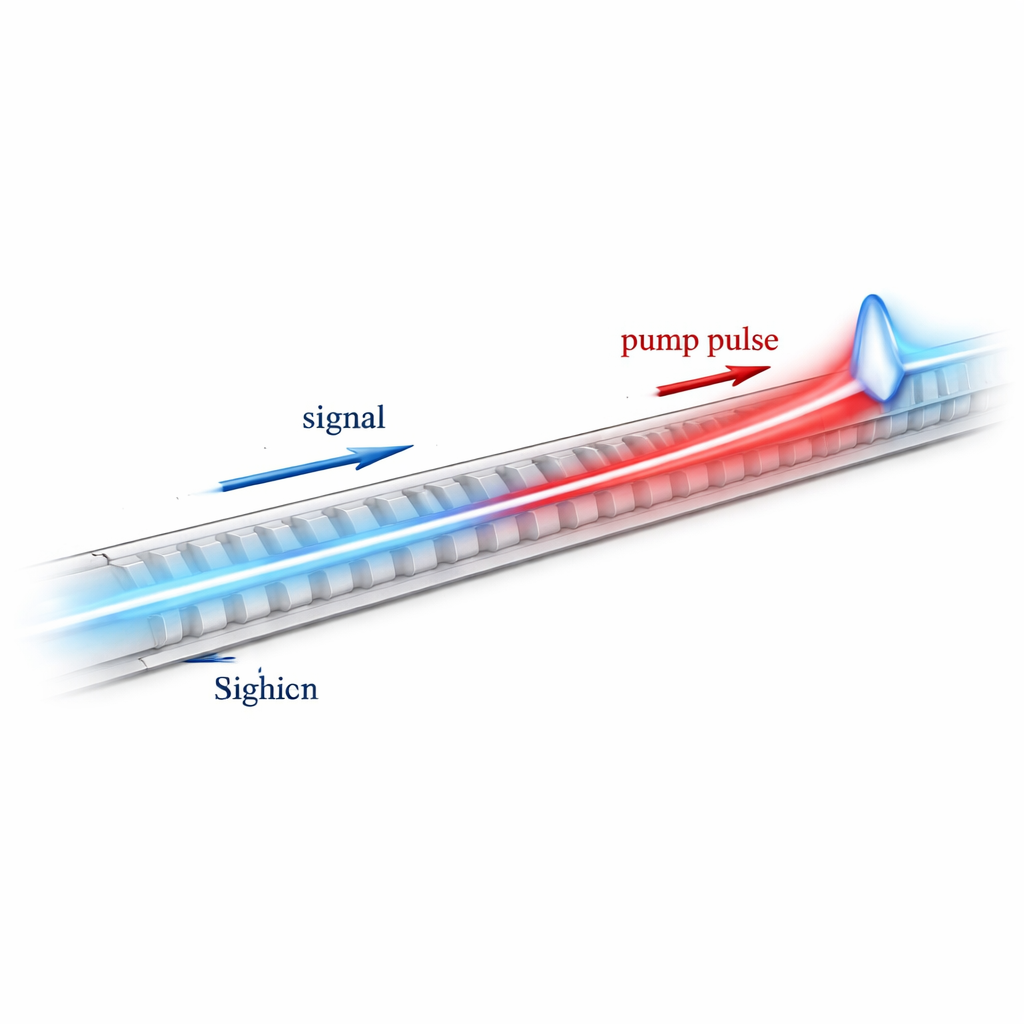
Inside certain optical structures, light can be made to crawl rather than race, lingering in place and enhancing its interactions with the material. The authors use a silicon waveguide patterned with a tiny periodic structure, known as a Bragg grating, to create such slow light. Near a specific wavelength band, this grating opens a "band gap" that blocks transmission, while nearby wavelengths travel with greatly reduced speed. A continuous-wave (CW) laser tuned close to this band edge creeps along the waveguide, providing an ideal target for a faster disturbance to catch and trap.
A Moving Front That Sweeps Up Photons
The key ingredient is a short but intense pump pulse at a different wavelength, launched into the same waveguide. In silicon, this pulse produces a dense sheet of free charge carriers through two-photon absorption, which abruptly lowers the refractive index and forms a sharp moving front. Because the pump travels faster than the slow signal light, this index front overtakes the CW beam from behind. When the front reaches a slice of the signal, it shifts the relationship between light frequency and momentum in the structure. Under carefully chosen conditions, the signal cannot find a normal state either before or after the front, so it becomes trapped inside the moving region where the index is changing.
From Gentle Surfing to a Powerful Sweep
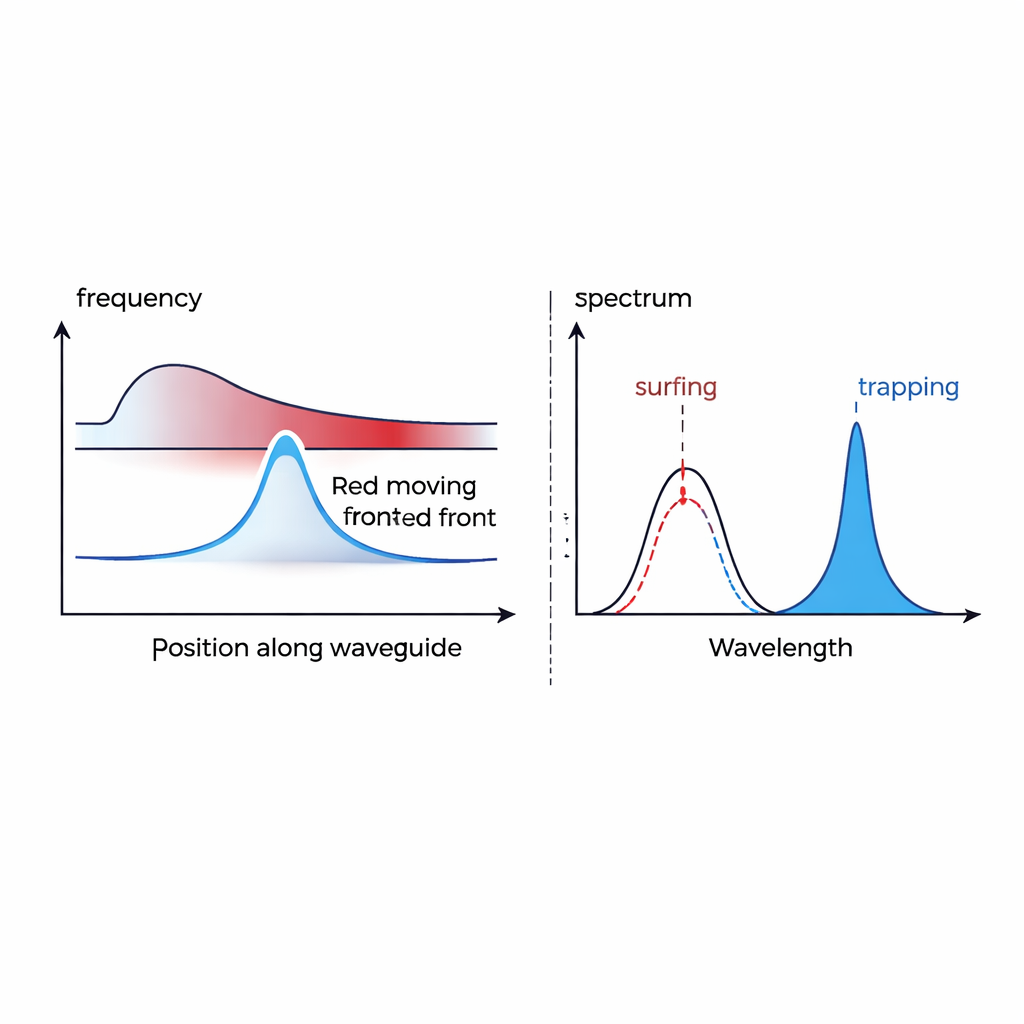
To highlight what is special about trapping, the researchers compare it to a more familiar process they call surfing. In surfing, the signal and the front move at nearly the same speed. The signal samples only the rising and falling edges of the pump-induced index change, leading to modest red and blue frequency shifts over a time span limited by the pump pulse duration. By contrast, in the push broom regime the front is faster than the signal and the waveguide’s built-in dispersion has a special hyperbolic shape. As the front marches through, it continuously gathers more of the CW signal, accelerates it to its own speed, and shifts it mainly toward shorter (bluer) wavelengths. The signal energy piles up at the front, forming a compressed, frequency-shifted packet while leaving a shadow in the original CW beam.
Building the Nanoscopic Broom
Realizing this effect on a chip required careful engineering. The team designed a silicon Bragg waveguide with tiny side "wings" that give the light bands the needed hyperbolic form. They fabricated many versions on a silicon-on-insulator platform, then measured transmission and delay to select the device whose dispersion best matched the trapping conditions. In experiments, a 2-picosecond pump pulse at about 1590 nanometers created the moving front, while a weak CW signal at different wavelengths probed the interaction. When the signal was tuned to match the pump speed, the spectra showed small symmetric shifts characteristic of surfing. When tuned closer to the band edge so that it was much slower, the same pump produced a strong, sharply blue-shifted peak: clear evidence that the front had trapped and swept a long slice of the CW light.
Why This Matters for Future Photonics
The measurements show that, for similar conditions, trapping converts about 20 times more signal energy to new frequencies than surfing. Although only a small portion of the total CW beam meets each short-lived front, the part that does interact is converted with an effective efficiency of roughly one quarter, and is highly compressed in time and space. With longer devices, sharper fronts or higher repetition rates, even larger shifts and stronger compression should be possible. For non-specialists, the take-home message is that a tiny silicon structure can act as a movable broom for light on a chip—catching, shifting and squeezing continuous beams into compact, energetic packets. This capability could enable more efficient on-chip pulse generators, new kinds of lasers that do not require traditional saturable absorbers, and versatile tools for shaping light in advanced optical communication and sensing systems.
Citation: Zhang, B., Li, H., Cai, X. et al. Optical push broom effect by a moving refractive index front in a silicon Bragg waveguide. Sci Rep 16, 3050 (2026). https://doi.org/10.1038/s41598-026-36302-x
Keywords: silicon photonics, slow light, optical pulse compression, Bragg waveguide, nonlinear optics