Clear Sky Science · en
Association between driving pressure and recruitment-to-inflation ratio in personalized PEEP management at the bedside
Keeping Lungs Safe on a Breathing Machine
When someone is too sick to breathe on their own, a machine takes over the work of filling and emptying their lungs. This life‑saving support can also cause damage if the pressures are not set carefully. Doctors therefore look for simple bedside clues to choose the gentlest settings. This study asked whether a newer bedside number, called the recruitment‑to‑inflation ratio, could safely guide these pressure choices as well as, or better than, a more established measure known as driving pressure.
How a Small Extra Breath at the End Helps
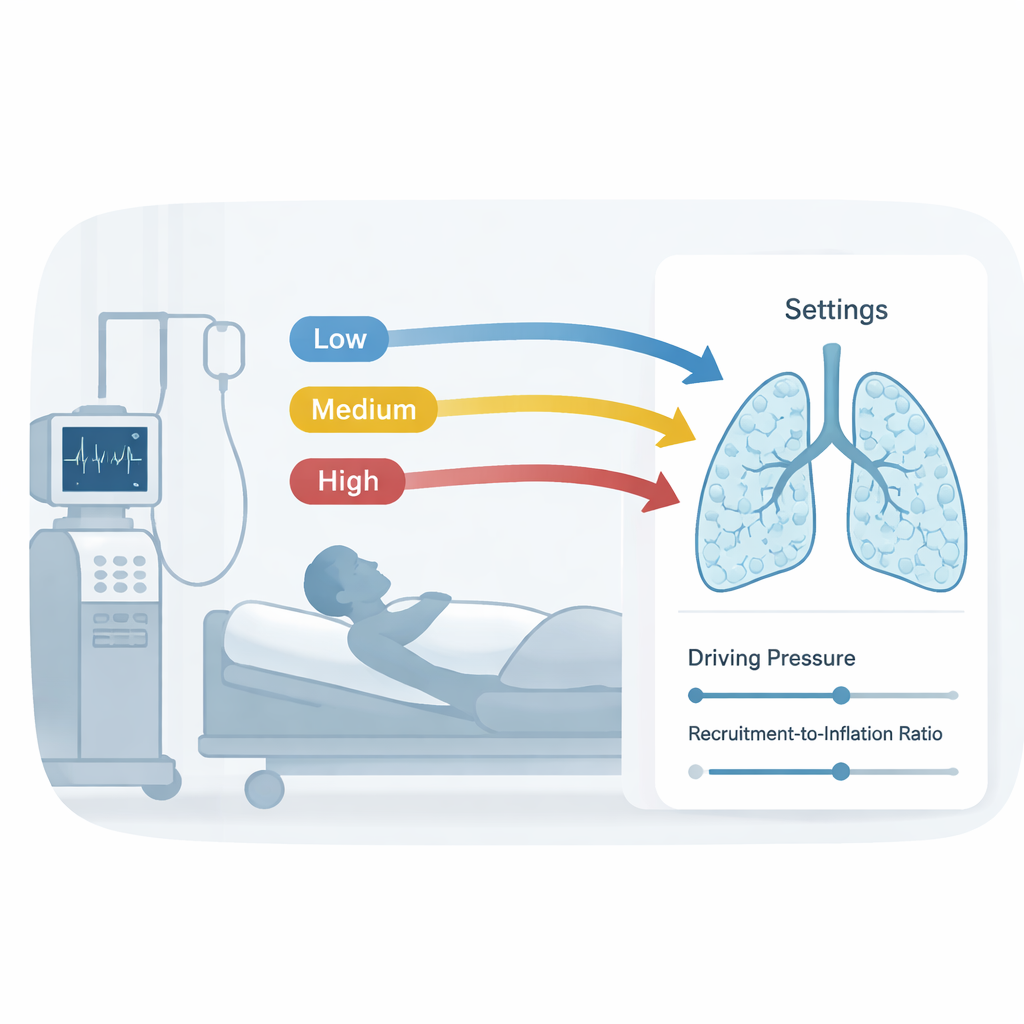
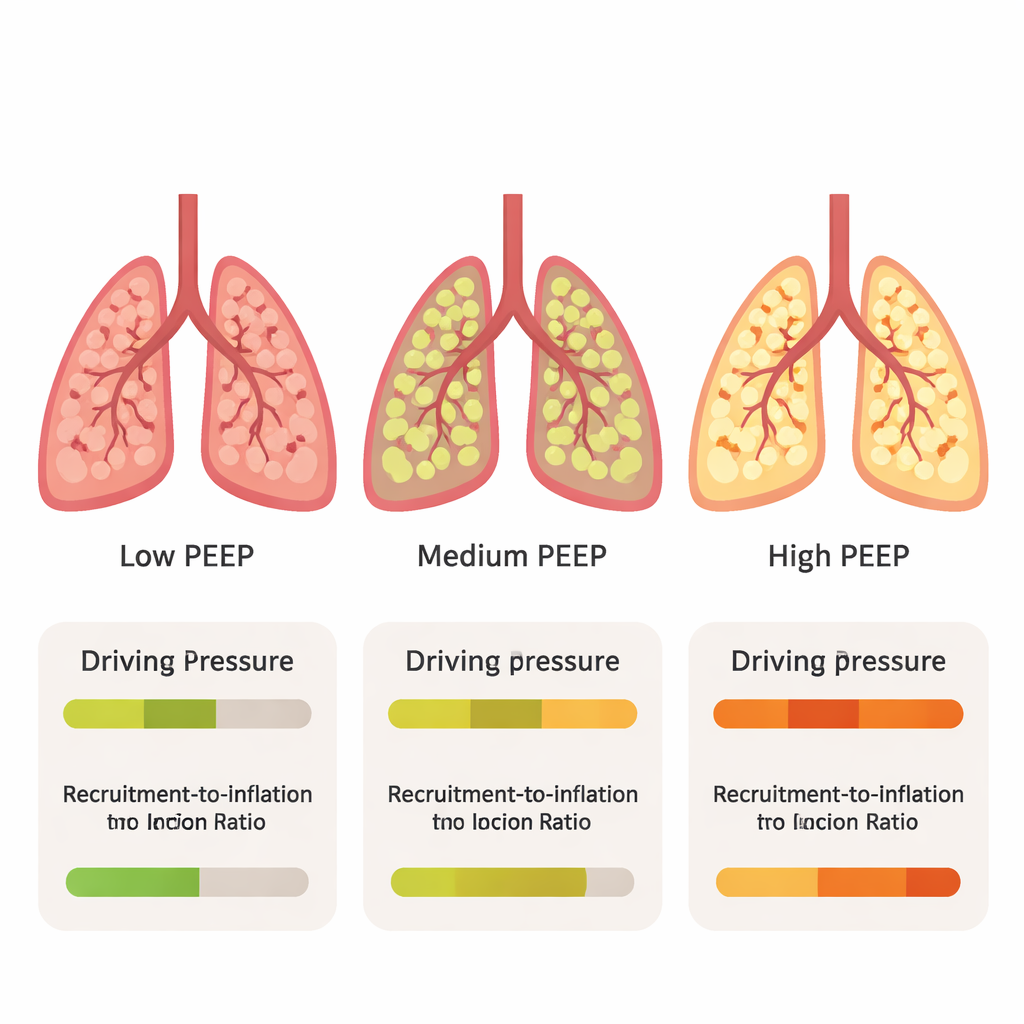
Mechanical ventilators do more than just push air in and out. They can also leave a little pressure in the lungs at the end of each breath, called positive end‑expiratory pressure, or PEEP. PEEP helps keep tiny air sacs from collapsing, but too much can overstretch the lung like an overfilled balloon. Clinicians have long adjusted PEEP using blood oxygen levels and measures of how stretchy the lung is. More recently, they have focused on driving pressure, the difference between the pressure at full breath and the resting pressure; lower driving pressure usually means the lung is being treated more gently.
A New Number for How Recruitable the Lung Is
The recruitment‑to‑inflation ratio, or R/I ratio, is a newer way to estimate how much of the lung can still be “recruited” — that is, opened up by higher PEEP — versus how much is already open and just being stretched. To calculate it, the team measured how the volume of air left in the lungs at the end of a breath changed when they stepped PEEP down from higher to lower levels. By combining these volume changes with how easily the lungs expanded, they derived a ratio that was higher when more lung units seemed to open up with pressure, and lower when extra pressure mostly caused stretching without much new opening.
Testing the Two Approaches at the Bedside
The researchers studied 30 intensive care patients who needed breathing machines but did not have full‑blown acute respiratory distress syndrome. After carefully sedating and paralyzing the patients to remove their own breathing efforts, they set the ventilator to deliver gentle breaths and then applied a standard protocol: PEEP was briefly raised to a high level, then stepped down through four settings (20, 15, 10 and 5 centimeters of water). At each step they measured lung volumes, pressures, and blood oxygen levels. One “best” PEEP was chosen by simply finding the step with the lowest driving pressure. Separately, they calculated R/I ratios between each pair of consecutive steps and used the median value as a cut‑off to label patients as high or low recruiters at each transition.
What the Numbers Agreed on—and Where They Didn’t
The team then compared, step by step, which PEEP level was recommended by the driving‑pressure method and which was suggested by the R/I‑based method. If the R/I ratio was at or above the cut‑off, the higher PEEP in that pair was favored; if it was lower, the lower PEEP was considered sufficient. While the highest PEEP level gave the best oxygen levels overall, the formal agreement between the two decision methods was weak and did not reach statistical significance at any step. In the lowest pressure range, patients labeled as high recruiters by the R/I ratio tended to have larger end‑expiratory lung volumes and better oxygenation than low recruiters, suggesting that the ratio was indeed capturing useful differences in how their lungs responded to pressure.
Why This Matters for Everyday Care
For bedside clinicians, the central message is that the two tools are not interchangeable. Driving pressure still reflects how hard each breath pushes against the lung and remains closely tied to the risk of ventilator‑induced injury. The R/I ratio, while linked to lung expansion and oxygenation, often pointed to different PEEP settings and may partly reflect simple inflation of already open regions rather than reopening of collapsed areas. As a result, the authors conclude that the R/I ratio should not yet be used on its own to pick the “right” PEEP in everyday practice. Instead, it may serve as an additional piece of information alongside driving pressure, lung mechanics, and oxygen levels, while larger studies determine whether it can safely guide personalized ventilation strategies.
Citation: Yetgın, M., Yetgın, H. & Sungurtekın, H. Association between driving pressure and recruitment-to-inflation ratio in personalized PEEP management at the bedside. Sci Rep 16, 5711 (2026). https://doi.org/10.1038/s41598-026-36300-z
Keywords: mechanical ventilation, PEEP, driving pressure, lung recruitment, intensive care