Clear Sky Science · en
Emerging heat stress patterns across India under future climate scenarios
Why future Indian summers matter to everyone
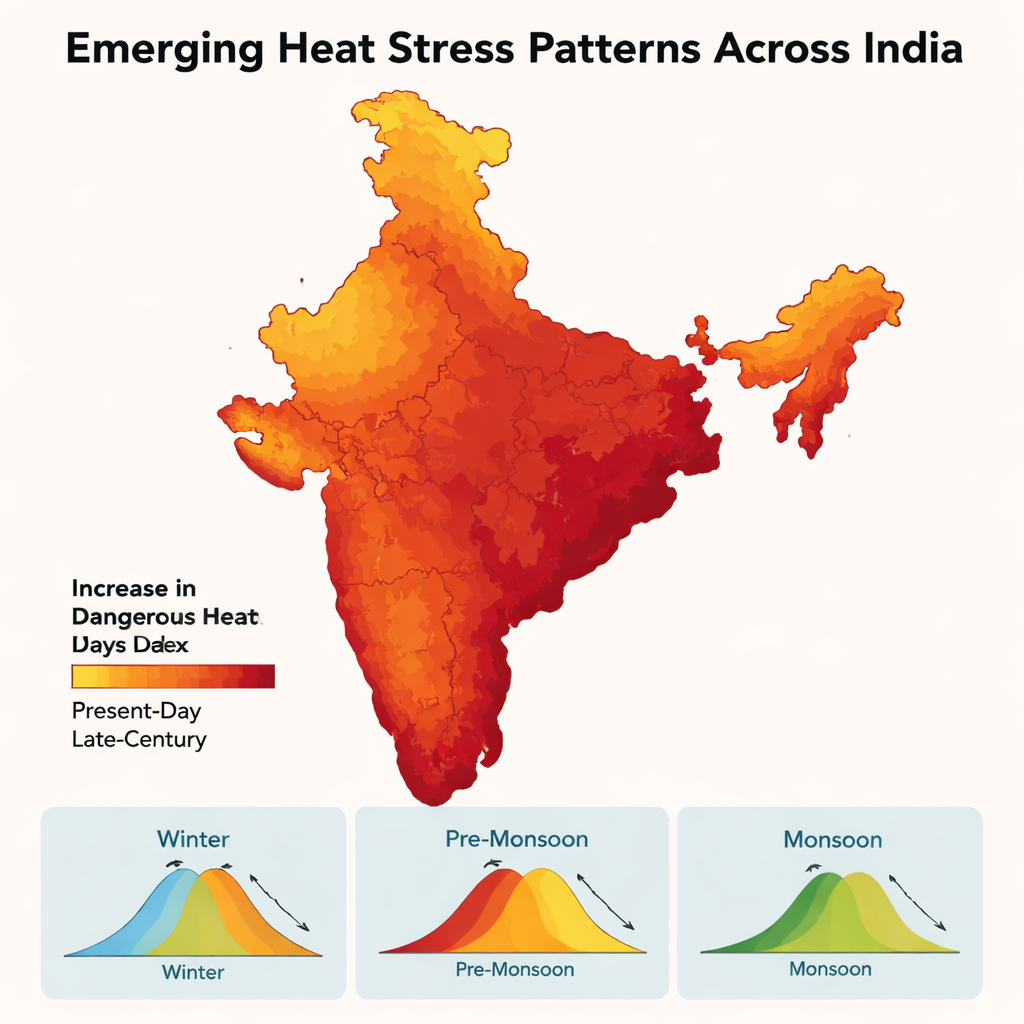
India is already known for scorching summers, but this study shows that in the coming decades the mix of heat and humidity could push large parts of the country into conditions that are not just uncomfortable, but dangerous for human health. Using the latest generation of global climate models, the authors looked beyond simple temperature to a more realistic measure of what the body actually feels: the heat index. Their results suggest that, without strong cuts in greenhouse gas emissions and better planning, hundreds of millions of people will face far more frequent and longer-lasting periods of dangerous heat stress.
Feeling heat, not just measuring it
Most weather reports quote air temperature, but our bodies respond to a combination of temperature and humidity. In humid air, sweat evaporates less easily, making it harder to cool down and increasing the risk of heat exhaustion or heat stroke. To capture this, the researchers used the heat index, a standard measure that blends temperature and relative humidity into a single “feels like” number. They focused on two key thresholds: about 27 °C on the heat index scale, when prolonged exposure can cause fatigue, and 32 °C, when the risk of serious heat illness rises sharply during outdoor work or physical activity. These levels are closely linked to public health warnings used by meteorological services.
India’s climate is already shifting
The team first checked how well modern climate models reproduce India’s recent climate. Comparing model output with detailed observational datasets and the ERA5 atmospheric reanalysis, they found that the models do a good job capturing past warming, especially in winter and the pre-monsoon season. Since the 1980s, winter in particular has warmed markedly, with cold days becoming rarer and very warm events more common. During the monsoon months, the models tend to underestimate the most extreme hot conditions, a sign that they struggle with fine-scale features like thunderstorms and local land–sea breezes. Even with these caveats, the historical record is clear: heat extremes, especially in northern India, have already become more frequent, and humid heat has intensified along the coasts.
More hot days, longer hot spells
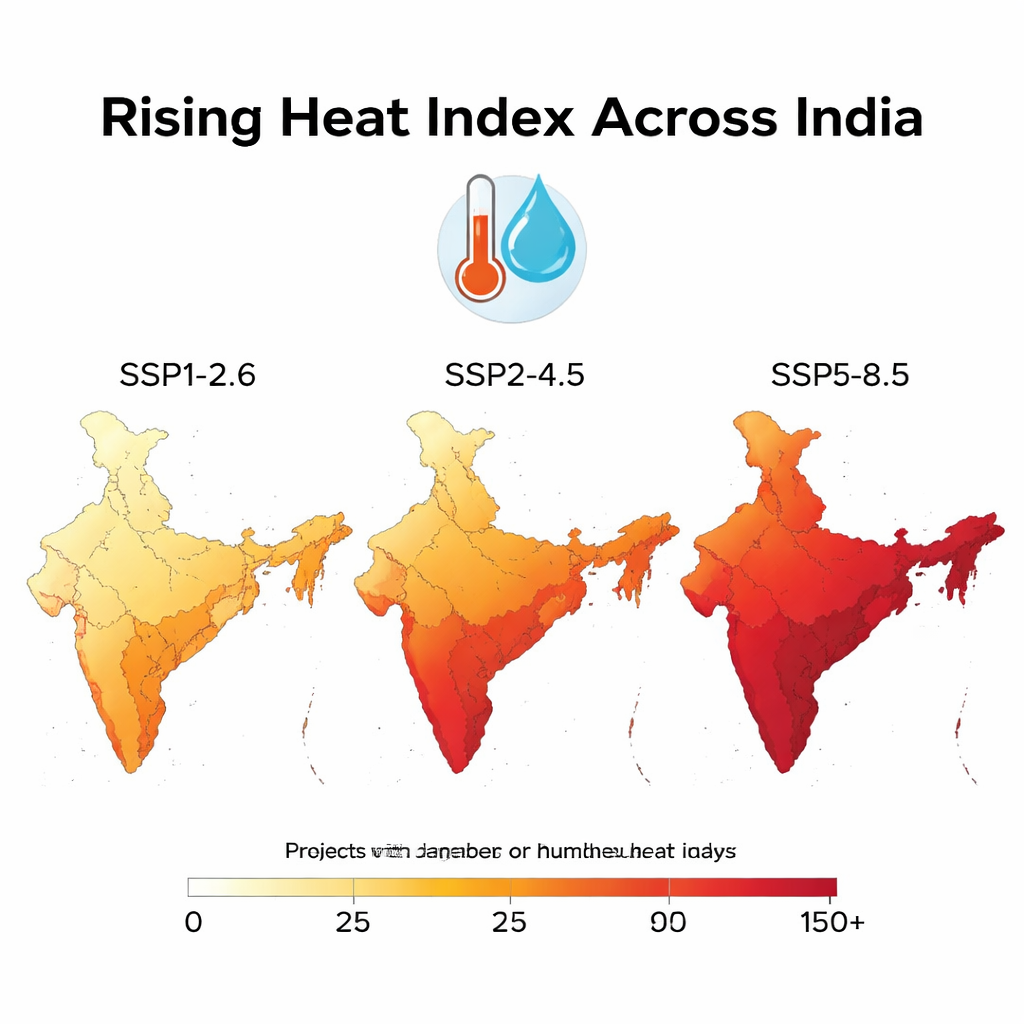
With confidence that the models capture the broad warming pattern, the authors then projected how heat stress will evolve through the 21st century under three different futures: strong climate action (SSP1‑2.6), moderate action (SSP2‑4.5), and very high emissions (SSP5‑8.5). Across all scenarios, India warms in every season, with the largest shifts in winter. But for people on the ground, the crucial change is in the number and duration of days when the heat index crosses the 27 °C and 32 °C danger levels. By mid-century, the country is projected to experience more than 50 extra days per year above 27 °C and more than 5 extra days per year above 32 °C compared with 1971–2000. Under the highest-emissions pathway late in the century, many regions see more than 75 days each summer with a heat index above 32 °C, turning what are now extreme conditions into the seasonal norm.
Different regions, different risks
The study reveals that heat stress will not rise uniformly across India. In winter, coastal regions, especially along the southern and eastern seaboards, stand out as hot spots because warm seas pump moisture inland, boosting nighttime heat index values even when temperatures are moderate. In summer, the greatest risks shift northward, into the Indo‑Gangetic Plain and parts of northwestern and northeastern India, where high temperatures combine with monsoon humidity. Under the most severe scenario, dangerous heat index levels are projected during most monsoon days over large swaths of the country, with some areas enduring multi‑week or even months‑long stretches without relief. Mountain and Himalayan areas remain relatively less affected, but even there, warming is strong enough to raise heat index values despite declining humidity.
What this means for people and policy
For a layperson, the bottom line is that many parts of India are on track to experience far more days each year when simply being outdoors for long periods could be hazardous, especially for outdoor workers, older people, and those without access to cooling. The authors show that limiting global emissions to low or medium pathways can keep some of the most extreme outcomes in check, but even in the best case, heat stress increases noticeably. Because the timing and geography of dangerous heat vary by season and region, the study argues for locally tailored responses: better heat‑action plans in cities, protection for workers, improved housing and shade in rural areas, and long‑term planning for health services. Understanding where and when heat stress will intensify is essential if India is to adapt to a hotter, more humid future while saving lives.
Citation: Molina, M.O., Soares, P.M.M., Agarwal, A. et al. Emerging heat stress patterns across India under future climate scenarios. Sci Rep 16, 5565 (2026). https://doi.org/10.1038/s41598-026-36299-3
Keywords: heat index, India climate, heat stress, humid heat, future warming