Clear Sky Science · en
Quantum-secured routing in drone communication for 6G-enabled smart mobility
Why safer drone skies matter
Delivery drones, disaster-response swarms, and airborne taxis are moving from science fiction into everyday life. All of these flying machines will rely on fast wireless links to share maps, camera feeds, and control commands. If those links are hacked or jammed, the consequences could range from stolen data to collisions in crowded airspace. This paper explores a new way to protect tomorrow’s drone highways by blending quantum physics with smart learning algorithms, aiming to keep 6G-connected drones both fast and extremely hard to compromise.
The coming clash between quantum computers and today’s security
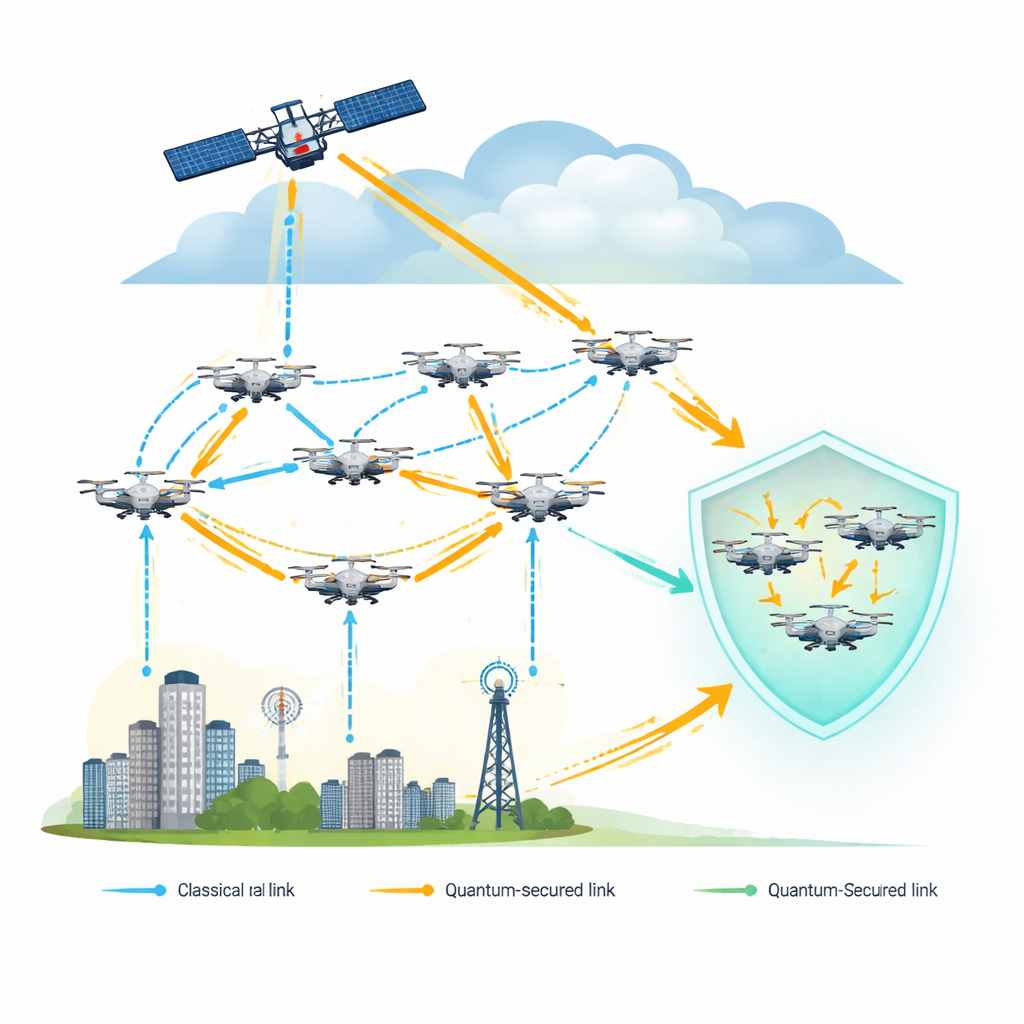
Modern wireless systems protect our data using mathematical puzzles that are hard for ordinary computers to solve. Powerful quantum computers threaten to crack many of these puzzles, potentially exposing keys that secure banking, messaging, and control systems. For drone networks that must react in milliseconds and operate over open air, this is especially worrying. The authors explain that simply upgrading to heavier classical encryption is not enough: drones have limited batteries and processors, and mobile air links are noisy and unstable. A future-proof approach must cope with changing weather, moving aircraft, and adversaries who may wield both classical and quantum attacks.
Using quantum light to share secrets in the air
One pillar of the proposed solution is Quantum Key Distribution, or QKD. Instead of relying on hard math problems, QKD uses individual particles of light to create secret keys; any eavesdropping leaves telltale disturbances in the signal. The team considers drones that talk over narrow, free-space optical beams alongside higher-frequency radio links. Special reflecting panels called reconfigurable intelligent surfaces can bend and focus signals around obstacles and bad weather patches, improving the chances that fragile quantum signals get through. The system constantly tracks indicators such as the error rate in the quantum channel, how quickly fresh secret bits are generated, and how long existing keys will last, deciding when a link is safe to use and when it must fall back to more traditional post-quantum cryptography.
A learning brain that chooses safer paths
At the heart of the work is a new routing method called the Quantum-Secured Adaptive Routing Algorithm, or QSARA. Instead of following rigid rules, QSARA uses a reinforcement learning technique: the drone network is treated as a game in which an agent earns rewards for choosing routes that are fast, energy-efficient, and secure. Each drone observes both everyday network signals—like bandwidth, delay, and battery level—and quantum clues—like key availability and error rates. A learning method known as Proximal Policy Optimization gradually trains policies that favor routes with healthy quantum links, enough secret-key “fuel,” and trustworthy neighbors, while steering away from paths showing signs of jamming, tampering, or key depletion.
Stress-testing the sky with virtual swarms
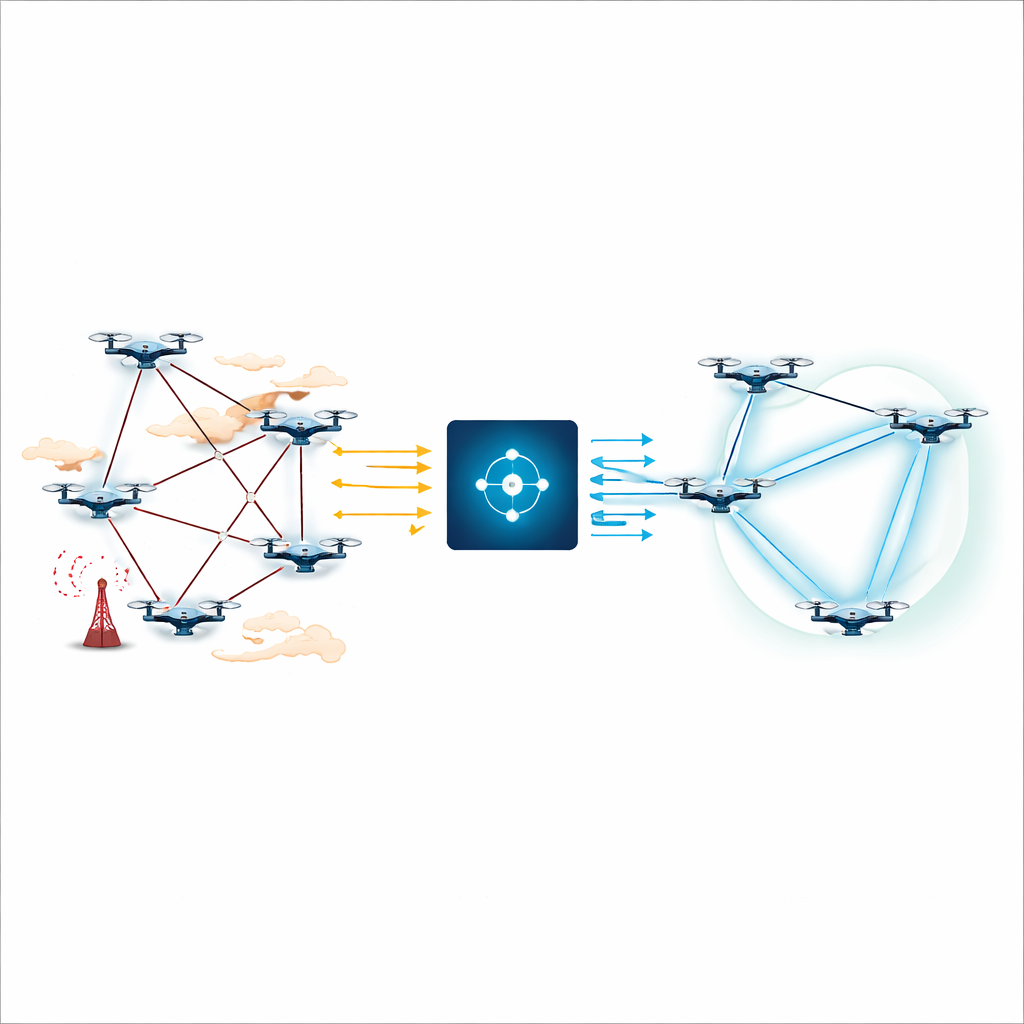
To see how this approach behaves at scale, the authors build a detailed simulation of a three-dimensional urban airspace populated by up to 500 autonomous drones. Each drone carries classical radios, optical quantum links, and the learning-based router. The virtual environment injects realistic disturbances: clouds and fog that weaken light beams, motion that misaligns transmitters and receivers, and deliberate attacks such as jamming, fake routing messages, and side-channel leaks. QSARA is then compared against several alternatives, including classical trust-based routing, simple quantum-aware schemes that do not learn, and routes protected only by post-quantum digital signatures. Across repeated trials, the new method consistently delivers lower delay, higher successful packet delivery, and better use of quantum keys, all while keeping energy consumption in check.
What the results mean for future drone traffic
The study finds that QSARA can maintain secure key generation above 96 percent, reduce end-to-end delay to about 24 milliseconds, and cut energy use compared with existing approaches. It detects and adapts to attacks in a few tens of milliseconds, and can scale to swarms of roughly a thousand drones while staying within demanding 6G timing targets. For non-experts, the key message is that combining quantum-safe key exchange with intelligent routing gives drone networks a way to “bend but not break” under stress: when quantum links are healthy, they provide the strongest protection available; when they falter, the system gracefully falls back to robust alternatives. The authors acknowledge that real-world hardware and weather will pose additional hurdles, but their results suggest a practical path toward drone corridors where security is designed in from the physics up, rather than bolted on after the fact.
Citation: Hafeez, S., Abro, G.E.M., Memon, S.A. et al. Quantum-secured routing in drone communication for 6G-enabled smart mobility. Sci Rep 16, 8626 (2026). https://doi.org/10.1038/s41598-026-36297-5
Keywords: quantum-secure drone networks, 6G smart mobility, quantum key distribution, secure UAV routing, reconfigurable intelligent surfaces