Clear Sky Science · en
Coupled effect of unloading rate and water content on mortar under differential cyclic loading
Why water and stress matter for everyday concrete
From dams and levees to bridges and tunnels, much of our critical infrastructure is made from concrete or mortar that constantly gets wet, dries out, and feels the push and pull of changing loads. When reservoir levels rise and fall or traffic and waves come in cycles, the concrete inside these structures is repeatedly squeezed and released. This study explores a simple but important question: how do changing water content and uneven loading–unloading cycles jointly affect the strength and long‑term durability of mortar, the cement-and-sand mix that binds concrete together?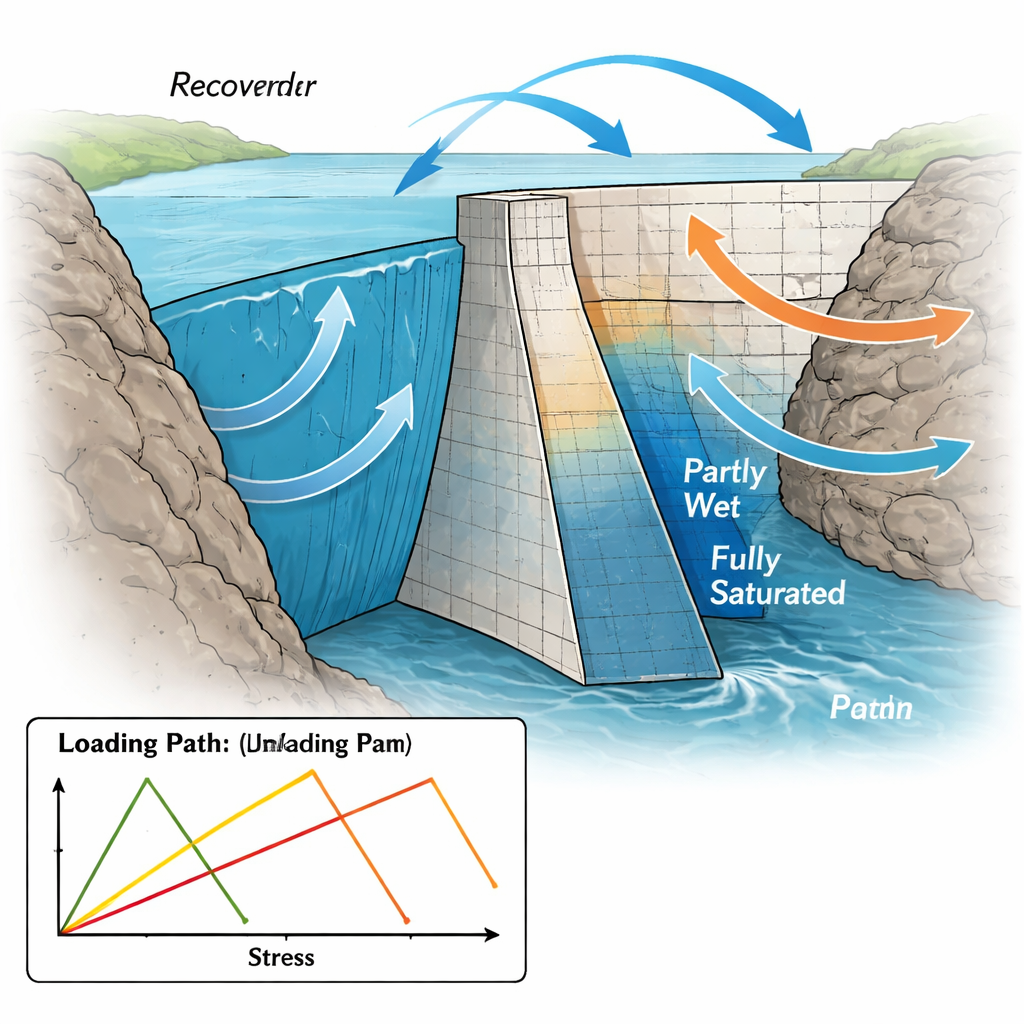
Concrete under real-world push and pull
Most laboratory tests squeeze and release concrete at the same rate each time, which makes the data easier to analyze but does not reflect reality. In real dams, for example, water levels often rise slowly and drop quickly, so the material is loaded and unloaded at different speeds. The authors call this “multi-level differential cyclic loading”: the maximum load in each cycle increases step by step, and the loading rate differs from the unloading rate. At the same time, the concrete can be dry, partly wet, or fully saturated with water. To mimic these conditions, the team cast mortar prisms, carefully controlled their moisture content at three levels (0.00%, 6.99%, and 13.98% by mass), and then subjected them to repeated loading cycles in a test machine while tracking how they deformed and failed.
Designing systematic tests with controlled moisture
To set up realistic moisture states, the researchers first dried some samples completely and then soaked them in water, measuring how their mass increased over time. This allowed them to identify a half‑saturated state around 6.99% water and a fully saturated state at 13.98%. Separate one‑time compression tests confirmed that wetter samples were weaker and more deformable than dry ones. With this baseline in hand, they ran 45 cyclic tests in total, combining the three moisture levels with five different unloading speeds ranging from ultra‑slow to ultra‑fast, while keeping the loading speed fixed. In each test, the maximum load was increased by a fixed amount every cycle until the specimen failed, and the machine recorded stress and strain continuously.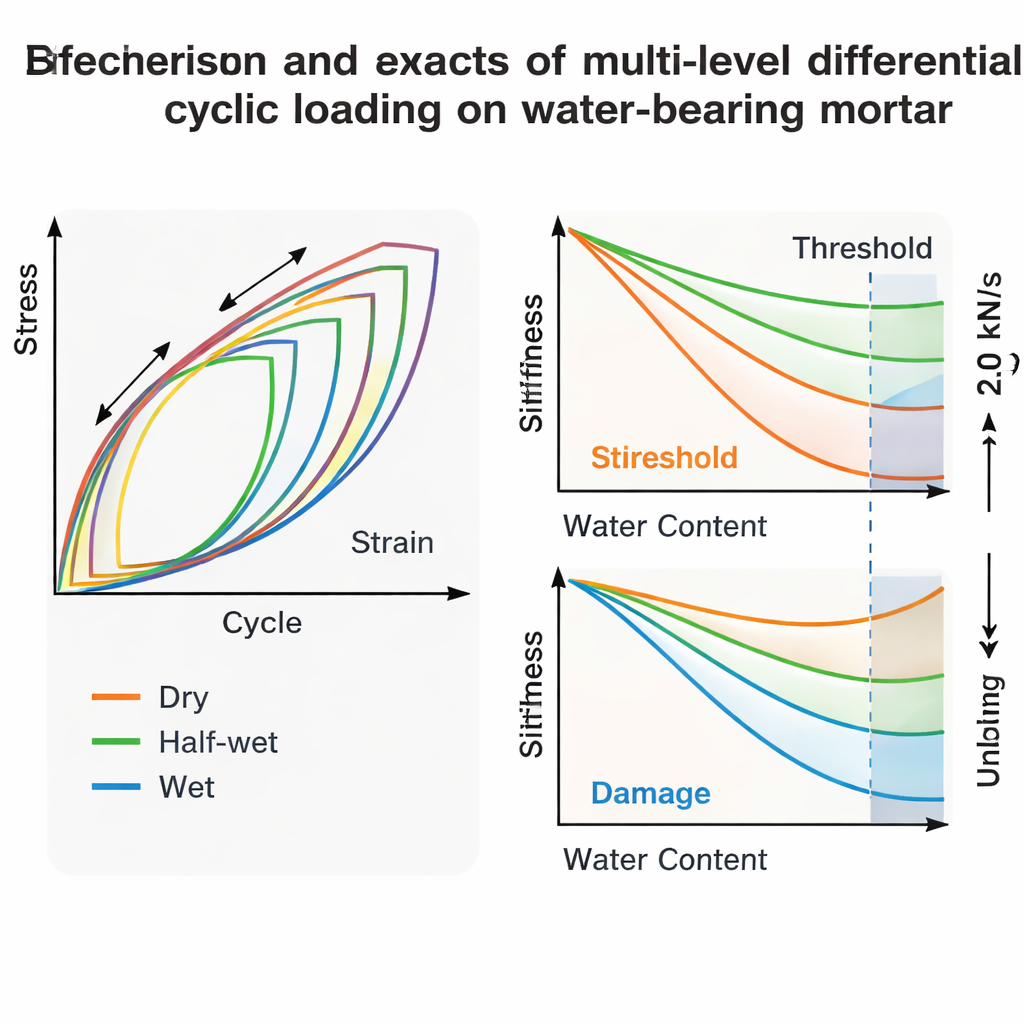
How wetness and unloading speed reshape behavior
Under these stepped cycles, the stress–strain curves of the mortar traced out loops showing how much deformation did not recover between cycles. For wetter samples and faster unloading, these loops became denser and shifted to the right, meaning the material accumulated more permanent deformation while failing at lower stress. The authors tracked how strain built up from cycle to cycle and found a clear, nearly straight‑line relationship between cumulative strain and the number of cycles. That simple linear law held across different moisture contents and loading paths, suggesting it could be used to predict when a structure made from similar mortar is approaching failure. They also separated the stiffness into a loading modulus (how rigid the mortar is while being squeezed) and an unloading modulus (while being released). Repeated cycling tended to compact tiny cracks and pores at first, temporarily increasing stiffness, but higher water content consistently reduced both moduli and made the material more sensitive to the loading pattern.
Energy, damage, and hidden thresholds
Because cracking and plastic deformation consume energy, the team analyzed how much mechanical energy was put into the samples, how much was recovered, and how much was irreversibly dissipated as damage. They showed that wetter mortar needed much less total energy to fail: fully saturated specimens required only about one‑tenth of the energy absorbed by dry ones. The ratio of dissipated to input energy changed irregularly at very slow unloading rates but became stable once the unloading rate exceeded about 2.0 kN/s. Likewise, when comparing dry, half‑wet, and fully wet states, they discovered a pronounced threshold around the medium water content (6.99%), where trends in how energy components changed with unloading rate flipped direction. A damage indicator derived from cumulative dissipated energy rose exponentially with the number of cycles, and higher moisture levels both increased the overall damage and blurred the differences between unloading speeds.
What this means for dams and other structures
In accessible terms, the study shows that water makes mortar not only softer and weaker, but also more prone to hidden fatigue when loads rise and fall at uneven speeds. There are critical combinations—a medium moisture level around half saturation and an unloading rate of about 2.0 kN/s—where the material’s stiffness and energy behavior change character. For engineers, recognizing these thresholds is vital for assessing how dams, levees, and other water‑exposed concrete structures will age under realistic operating conditions. The results suggest that long‑term safety cannot be judged by strength alone; the history of wetting and drying and the details of how loads are applied and removed are equally important for predicting when damage will accumulate to dangerous levels.
Citation: Liu, Z., Cao, P., Liu, L. et al. Coupled effect of unloading rate and water content on mortar under differential cyclic loading. Sci Rep 16, 5927 (2026). https://doi.org/10.1038/s41598-026-36289-5
Keywords: concrete durability, cyclic loading, water saturation, dam safety, material fatigue