Clear Sky Science · en
Need for cognitive closure predicts preference for similar others and reduced diversity in social networks
Why We Gravitate Toward People Like Us
Think about your own circle of friends, coworkers, and neighbors. Are they mostly similar to you in age, background, or beliefs, or do they come from very different walks of life? This paper explores a powerful, often invisible force that helps answer that question: how strongly we crave clear answers and dislike uncertainty. The authors show that this basic mental preference can quietly shape who we talk to, who we avoid, and how diverse—or narrow—our social worlds become.
Craving Certainty in a Messy World
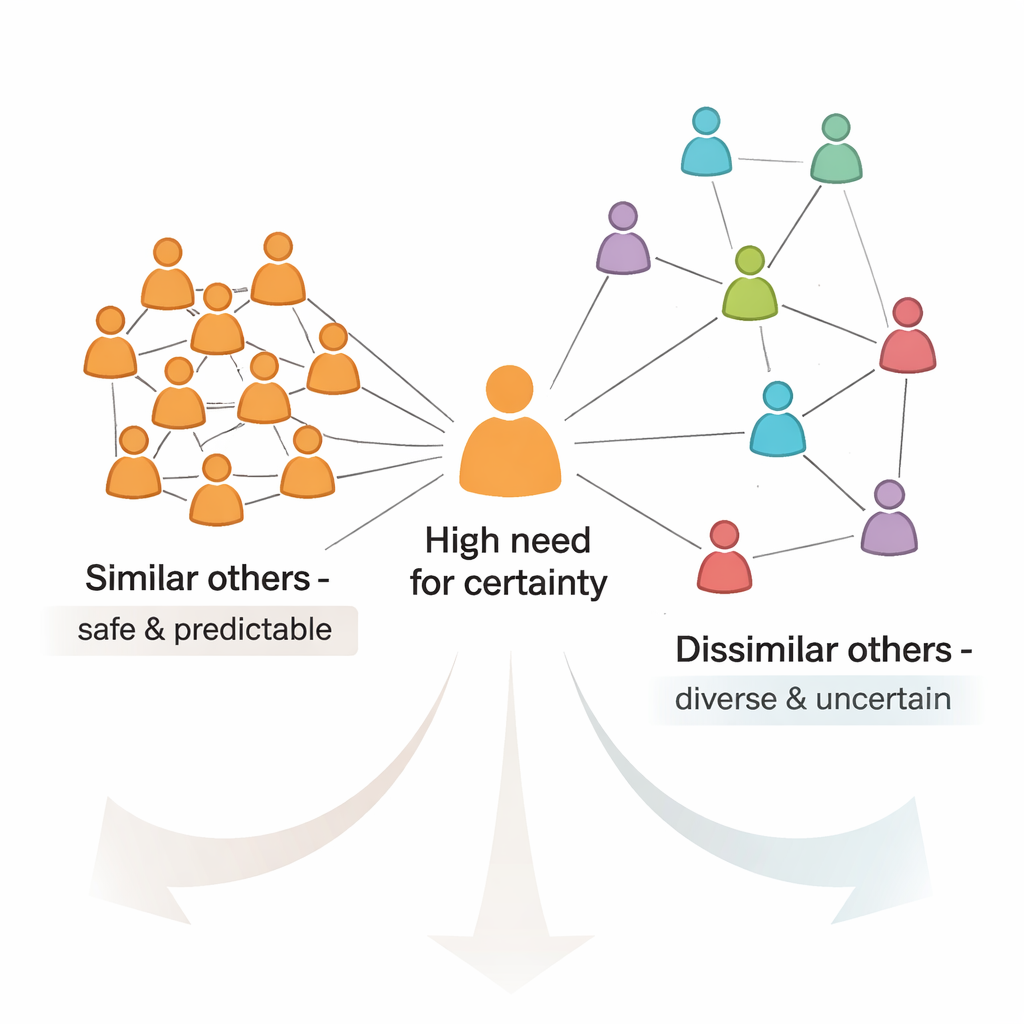
Life is full of unknowns, and social life is no exception. Meeting someone new means not knowing what they think, how they will react, or whether you will get along. For some people, this uncertainty is exciting. For others, it is deeply uncomfortable. Psychologists call this tendency “need for cognitive closure”: a desire for quick, firm answers and clear structure, rather than open questions and gray areas. The authors reasoned that people high in this need would prefer familiar, like-minded companions, because such relationships feel safer and easier to predict. In contrast, ties to different others may bring new ideas and opportunities, but they also bring ambiguity and the risk of disagreement.
Similar Friends, Narrower Social Circles
To test these ideas, the researchers ran four separate survey studies with university students in Poland and the United States. Participants filled in a standard questionnaire measuring their need for closure and another that asked how many people in their close circle differ from them in age, education, income, lifestyle, worldview, and similar traits. Across all four studies, the same pattern emerged: the higher someone’s need for closure, the fewer dissimilar people they reported in their networks. A combined analysis of all four samples confirmed that this link was reliable, not a fluke of any one group. People who strongly preferred clear, stable answers also tended to have less diverse social ties.
Fewer Weak Ties and Fewer Voices
The authors then looked beyond who people know to how many people they know. In one study, participants reported how many family members, friends, and acquaintances they regularly socialized with, and how many people they had talked to about important matters. The need for closure was not related to the number of family members or close friends—but it was linked to having fewer acquaintances and fewer people to discuss serious topics with. In other words, those who disliked uncertainty did not necessarily have tiny inner circles, but they did have smaller and potentially less varied outer circles. This could mean fewer sources of fresh information, fewer weak ties that open doors, and fewer different viewpoints to challenge one’s own.
Uncertainty Makes Similarity More Appealing
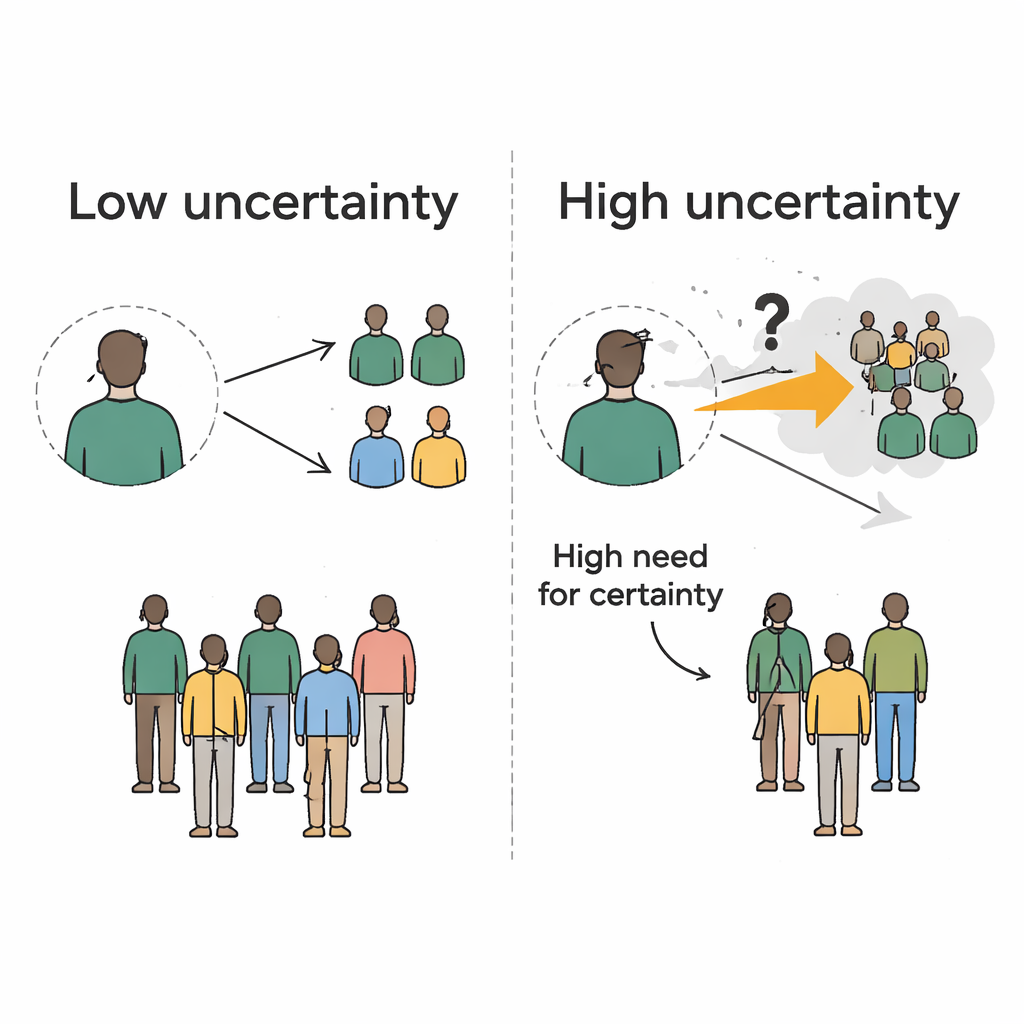
Surveys can reveal patterns, but they cannot prove cause and effect. To dig deeper, the authors ran an experiment. Adult participants first listed friends and acquaintances from their real lives, and rated how similar each person was to them in background and tastes. Then they were randomly assigned to recall either a neutral event (such as watching a TV show) or a time when they felt very uncertain. After this mental exercise, participants rated how much they would like to meet, talk with, or spend time with each person they had listed. Under normal conditions, people already leaned a bit toward similar others. But when uncertainty was stirred up, similarity mattered more—especially for those high in need for closure. In this group, being reminded of uncertainty made them clearly favor similar over different contacts.
Why This Matters for Everyday Life
For a layperson, the message is straightforward: a basic preference for mental comfort can quietly shape our social worlds, making them more familiar but less diverse. People who strongly dislike uncertainty tend to surround themselves with like-minded others, avoid contacts who see the world differently, and maintain fewer loose connections. This may feel safe, but it also limits exposure to new ideas, reduces access to varied support, and can strengthen group stereotypes by keeping different groups apart. Recognizing this tendency in ourselves is a first step toward deliberately opening our circles—by choosing, at least sometimes, to tolerate a bit of uncertainty in exchange for richer, more varied relationships.
Citation: Growiec, K., Szumowska, E. Need for cognitive closure predicts preference for similar others and reduced diversity in social networks. Sci Rep 16, 5582 (2026). https://doi.org/10.1038/s41598-026-36288-6
Keywords: social networks, similarity bias, uncertainty, need for closure, diversity