Clear Sky Science · en
Evidence of a genomic basis for growth rate variation in a natural kelp population
Why kelp growth matters to us
Kelp forests are the underwater equivalent of rainforests: they shelter fish, buffer coasts from storms, and support fisheries and aquaculture. Yet not all kelp plants grow at the same pace, and scientists have long wondered how much of this difference comes from the environment—such as temperature and light—and how much is written in the kelp’s DNA. This study explores whether the genes of a common kelp, Ecklonia radiata, help determine how fast individual plants grow in the wild, with implications for conserving kelp forests and boosting harvests on kelp farms.
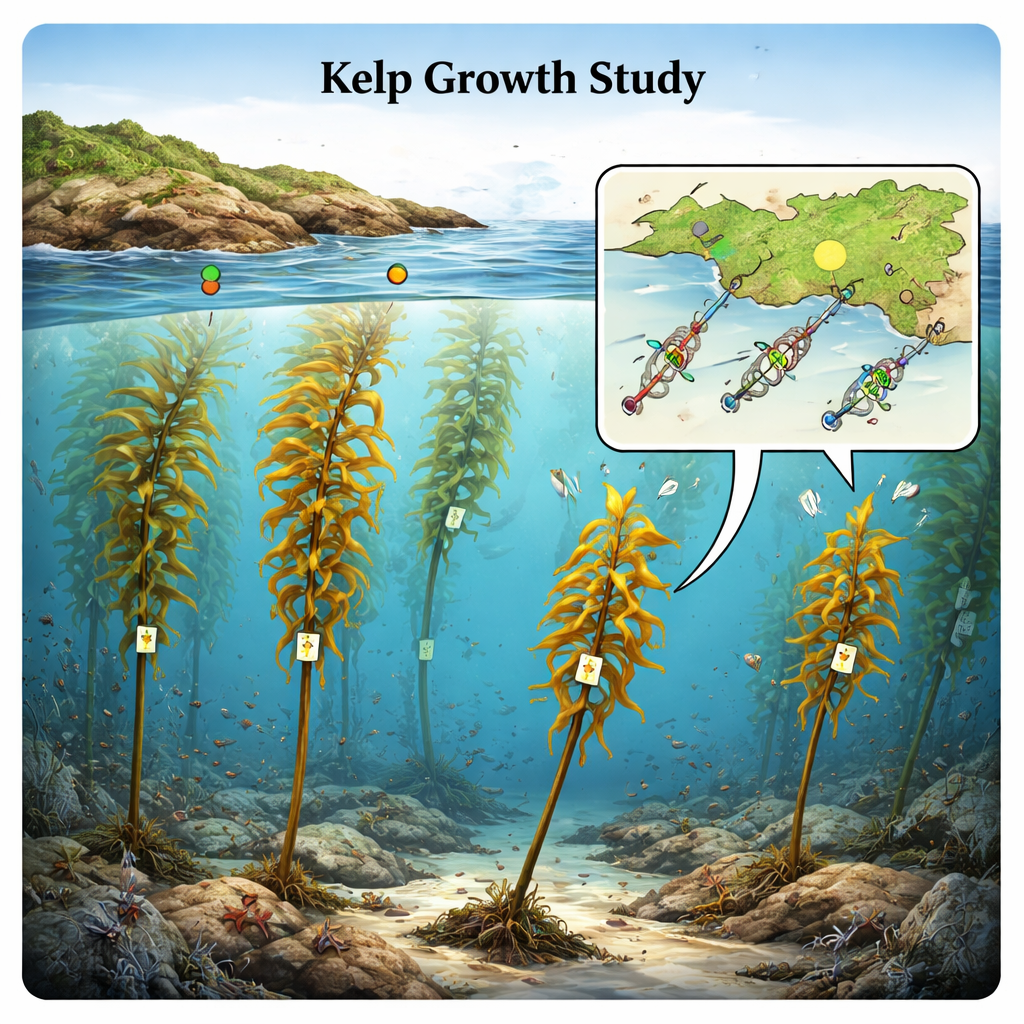
Following individual kelp in the wild
The researchers worked on subtidal reefs near Perth, Western Australia, where golden kelp forms dense underwater forests. Divers tagged 52 adult kelp plants across three nearby reef sites and tracked their growth over nearly three months during spring, the season when this species grows fastest. Growth was measured using a simple “hole punch” method: a tiny hole was made in each leaf at a set distance from the growth zone, and the movement of that hole along the leaf was used to calculate how many centimeters per day each plant elongated. At the same time, small tissue samples were collected from each tagged kelp so that the team could read portions of their DNA.
Reading kelp DNA to look for growth clues
To probe the kelp’s genetic makeup, the team used a technique that samples thousands of positions across the genome, focusing on single-letter DNA differences called SNPs. This produced data for 5,121 genetic markers for each individual. The scientists then used a suite of statistical tools—borrowed from human and crop genetics—to test whether particular DNA variants were consistently associated with faster or slower growth. Importantly, they checked results with three different analytical approaches and emphasized only those markers that showed up repeatedly across methods, reducing the chance that patterns were due to random noise in a relatively small sample.
Strong links between genes and growth
Although overall growth did not differ between reef sites, individual kelp plants grew at very different rates, with nearly a four-fold range in daily elongation. The striking result was that a tiny fraction of genetic markers—just 18 out of more than 5,000—could together account for about half of the observed variation in growth rate. Five of these markers were highlighted by all three statistical methods, and each of these alone explained around one quarter of the difference in growth among individuals. When combined in a “polygenic” model, the 18 markers allowed the researchers to predict how fast a plant grew in the field with surprisingly high accuracy, even though the plants experienced the full complexity of real-world conditions such as waves, competition, and subtle microhabitat differences.
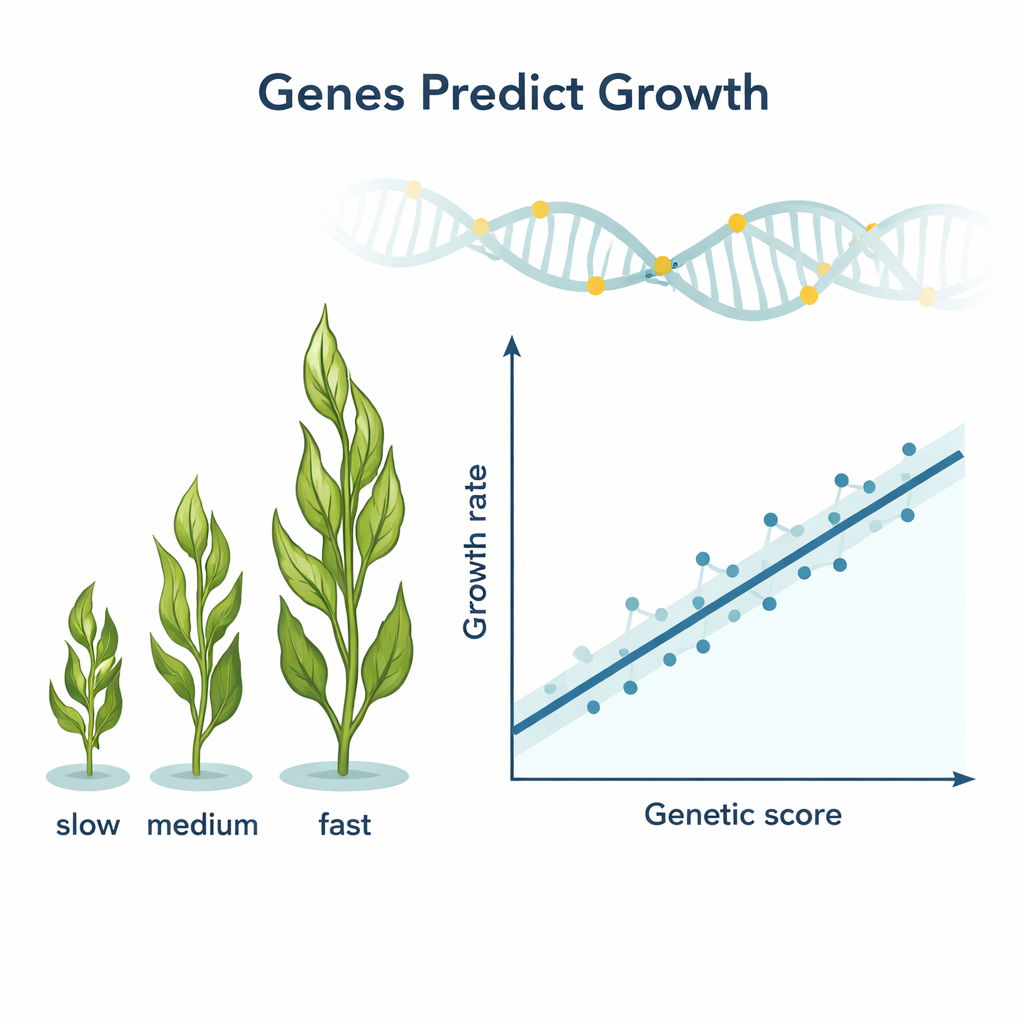
What the candidate genes might be doing
To move beyond simple correlations, the team asked whether these key DNA markers sit near active genes and whether those genes have known roles in other organisms. Many of the associated regions matched pieces of Ecklonia’s transcriptome, meaning they are switched on and used to make RNA in the kelp, but most did not resemble any well-known gene family and were labeled “unknown function.” Two exceptions stood out. Some growth-linked markers lay next to genes similar to ROCO-family signaling proteins, which are unusually abundant in brown algae and are involved in cell signaling in other species. Others were near genes resembling Caffeoyl-CoA O-Methyltransferases, enzymes that help build structural components of plant cell walls. Together, these hints suggest that both cell-wall construction and internal signaling pathways may play roles in determining how rapidly kelp individuals can grow.
Why this matters for kelp forests and farming
Finding a strong genetic signal behind growth rate in wild kelp has practical and ecological implications. For restoration projects and “assisted adaptation” efforts that aim to help kelp cope with warming seas, knowing that growth is partly heritable raises the possibility of choosing donor plants with favorable genetic profiles. For aquaculture, where demand for kelp as food, feed, and a carbon sink is rising, these markers could guide selective breeding to produce faster-growing strains, much as has been done with crops and trees. At the same time, the study highlights that much of the kelp genome remains poorly understood, and that environmental conditions and trade-offs with other traits, such as heat tolerance or resistance to storm damage, will also shape which genetic variants are favored in nature.
A simple takeaway for non-specialists
In plain terms, this research shows that some kelp are naturally “born to grow faster,” and that this difference can be traced to specific stretches of their DNA. By pinpointing a small set of genetic markers that predict how quickly individual kelp plants elongate in the ocean, the study provides one of the first clear demonstrations that growth in a wild kelp population has a strong genomic basis. While more work with larger samples and controlled experiments is needed to confirm which genes actually cause faster growth, this early evidence suggests that kelp forests—and kelp farms—could be shaped not only by the environment but also by careful use of genetic information.
Citation: Starko, S., Burkholz, C., Edgeloe, J.M. et al. Evidence of a genomic basis for growth rate variation in a natural kelp population. Sci Rep 16, 6622 (2026). https://doi.org/10.1038/s41598-026-36286-8
Keywords: kelp genetics, growth rate, marine forests, seaweed aquaculture, genomic selection