Clear Sky Science · en
AI-enabled energy baselines for verified building decarbonization
Why this matters for everyday life
Buildings keep our homes cool, our offices lit, and our hotels comfortable—but they also use enormous amounts of electricity and pump out a major share of global climate‑warming emissions. This paper explores how artificial intelligence (AI) can help large buildings constantly "tune" their energy use in real time, cutting waste without sacrificing comfort. The work shows that smart algorithms, when combined with trusted certification rules, can turn everyday buildings into powerful tools for fighting climate change and unlocking green finance.
From fixed guesses to living baselines
Today, most building energy assessments rely on fixed baselines and rough rules of thumb about weather, occupancy and equipment performance. These approaches were designed for a more static world and struggle when people’s schedules shift, new devices are installed, or extreme weather hits. As a result, claimed energy savings after a retrofit are often uncertain and hard to audit. This study replaces those rigid methods with a "living" baseline that updates hour by hour. It feeds streams of data—from meters, sensors and local weather stations—into AI models that continually learn how a building really behaves, so savings can be measured against a moving but trustworthy reference instead of a one‑time guess. 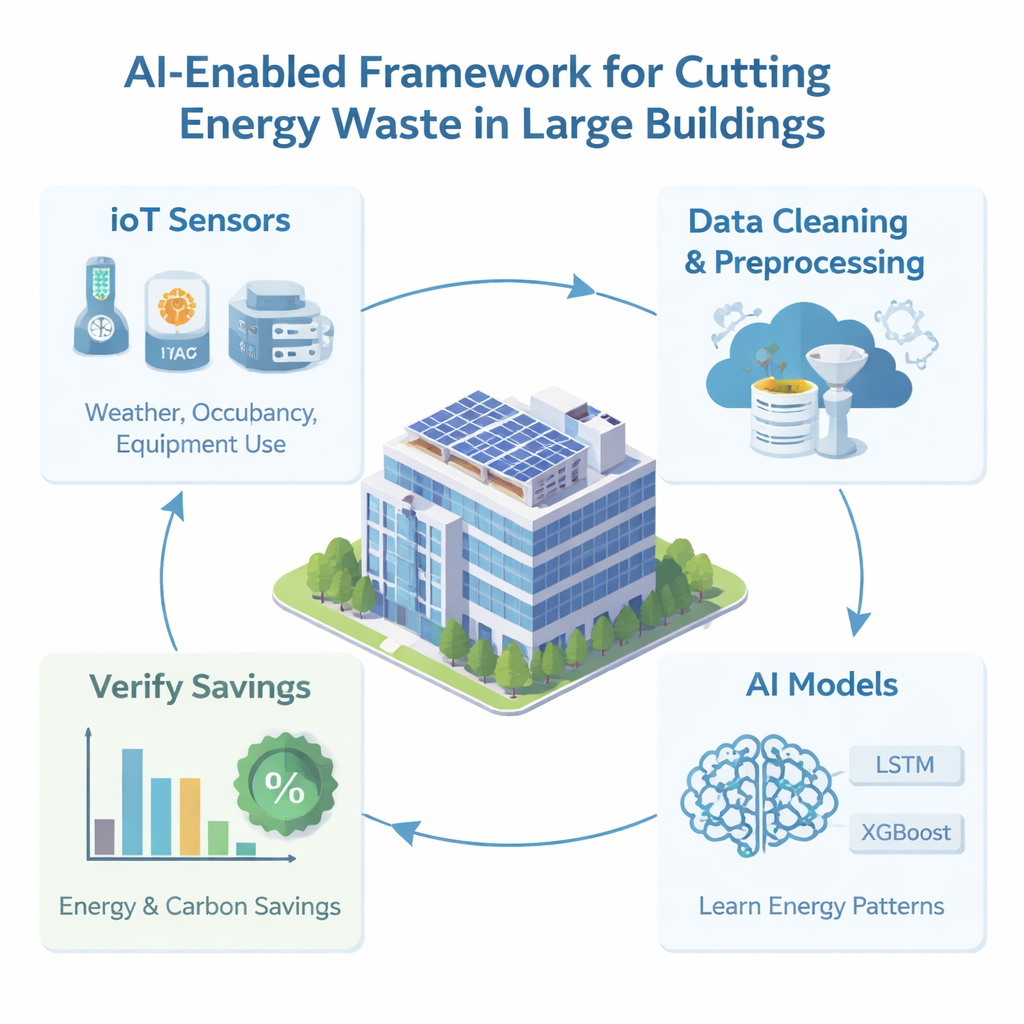
How the smart engine works
The authors build a hybrid AI engine that combines two strengths: one model (LSTM) is good at spotting patterns over time, such as daily and seasonal swings in cooling demand, while another (XGBoost) excels at handling many different building features at once, like floor area, equipment type and retrofit year. Working together, they digest hourly data on energy use, occupancy and weather for ten commercial, residential and mixed‑use buildings in Singapore. The system learns what the building would have used under "normal" conditions and compares that to what it actually used after efficiency upgrades or smarter controls were applied. This gap becomes a carefully calculated estimate of real energy savings.
Turning numbers into trusted climate proof
A key step is translating AI predictions into metrics that regulators and financiers already recognize. The framework plugs directly into Singapore’s Energy Conservation Calculation (ECC) method, which underpins the national Green Mark building certification. Using established formulas, the system converts predicted and actual energy use into energy savings and then into carbon dioxide reductions, based on the country’s grid emission factor. Deployed for three years across ten buildings, the AI‑ECC combination achieved prediction errors typically below 5%, verified energy savings of about 6,885 MWh, and avoided emissions of 3,221 tonnes of CO₂ equivalent. In some retrofitted buildings, energy use per square meter fell by more than 60%, all documented in a way auditors can check and certification bodies can accept. 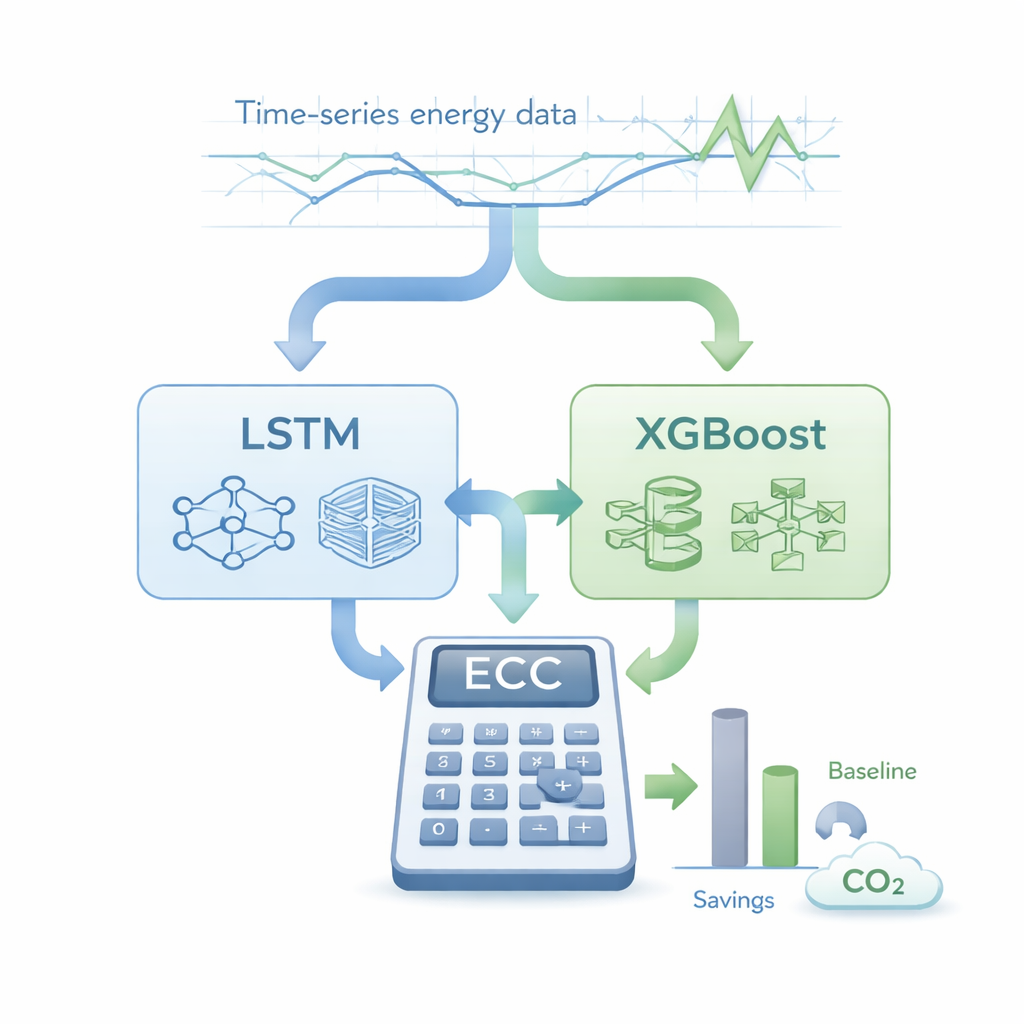
A hotel as a real‑world test bed
To show how this works in practice, the authors detail a case study of an eight‑storey hotel in central Singapore. After installing more efficient chillers, LED lighting and smart ventilation that responds to indoor CO₂ levels, the hotel connected its meters and sensors to the AI system. The model, pre‑trained on national data and then fine‑tuned on site, forecasted energy use and suggested operational tweaks such as adjusting cooling setpoints and starting chillers earlier on hot, humid days. Over 2020–2023, the hotel’s energy use intensity dropped from nearly 500 to about 200 kWh per square meter per year, cutting 290–310 tonnes of CO₂ annually. These results helped the property earn top‑tier Green Mark Platinum status and secure a sustainability‑linked loan with lower interest tied to continued emission reductions.
From smart buildings to greener finance
Beyond individual sites, the authors argue that this approach can reshape how cities and investors think about building decarbonization. Because the framework follows international guidance on energy performance evaluation and produces clear, explainable dashboards, its outputs can support environmental reporting, certification, and even carbon credit or green bond schemes. In other words, verified energy savings become a kind of currency that can attract investment into further upgrades. While up‑front costs, data gaps in older buildings, and the need for skilled staff remain hurdles, the study shows that an integrated AI‑and‑policy toolkit can turn routine building operations into a reliable, scalable pathway toward net‑zero goals.
Citation: Li, J., Hao, Y. & Li, Y. AI-enabled energy baselines for verified building decarbonization. Sci Rep 16, 5815 (2026). https://doi.org/10.1038/s41598-026-36284-w
Keywords: smart buildings, energy efficiency, artificial intelligence, building retrofits, carbon emissions