Clear Sky Science · en
Co-transmission of radio frequency reference and data signal over multi-core fiber
Why Your Future Internet Depends on Better Timing
Streaming, cloud gaming, autonomous vehicles, and 6G wireless all depend on data moving not just fast, but in perfect step. Inside today’s data centers, however, the digital “clocks” that keep equipment synchronized are starting to struggle. This research shows a new way to send both huge volumes of data and an ultra-stable timing signal down the same strand of an advanced optical fiber, promising faster networks with far tighter coordination between devices.
Sharing the Road for Data and Precise Time
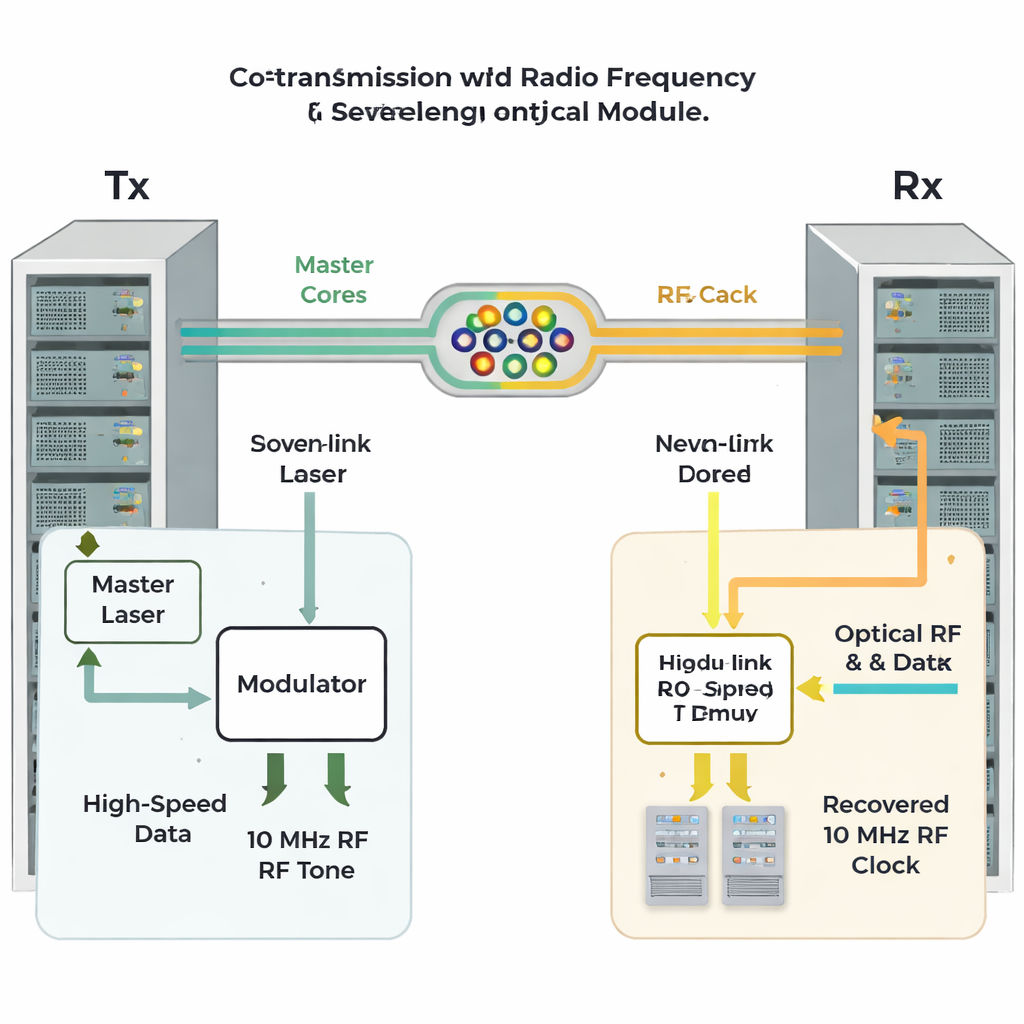
Modern communication systems rely on optical fibers to carry vast amounts of information, and on radio-frequency (RF) reference signals to keep all the hardware running in sync. Standards such as the Precision Time Protocol are already being pushed to their limits by 5G and the even more demanding future 6G networks. Traditional timing methods often use separate links or extra wavelengths and can be thrown off by tiny delays and noise in the fiber. The authors explore a more efficient idea: use a special kind of fiber with several light-carrying cores, and let one optical channel carry both a high-speed data stream and a low-frequency clock reference at the same time.
A New Kind of Fiber Highway
The team works with seven‑core fiber, which bundles seven individual light paths inside a single glass cladding. This design dramatically boosts capacity and, importantly, makes it easier to keep signals in different directions experiencing nearly identical conditions. In their architecture, two of the cores act as the “uplink” and “downlink” between data center racks. A master laser supplies an ultra-clean optical carrier shared by multiple units, so all transmitters and receivers start from the same optical reference. Onto this carrier, the researchers imprint a 224‑gigabit‑per‑second data signal and, tucked into the same optical spectrum, a simple 10‑megahertz RF tone that serves as the common clock.
How One Light Beam Carries Two Jobs
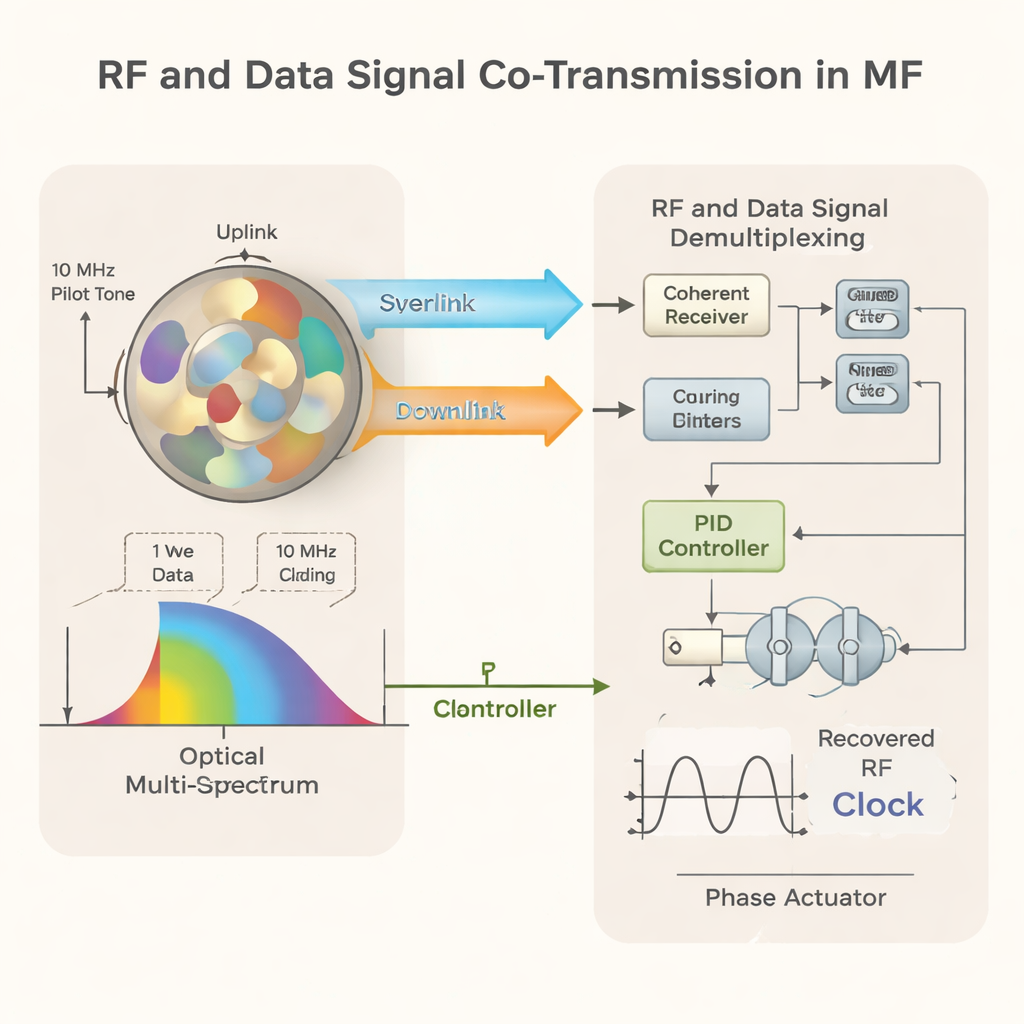
At the transmitter, the data are encoded on the light using an advanced modulation format that efficiently packs multiple bits into each symbol. The 10‑MHz RF reference is inserted as a narrow “pilot” tone at a specific point in the signal’s spectrum, with only about one percent of the data power so it barely disturbs communication quality. After traveling 1 or 10 kilometers through the seven‑core fiber, the combined signal reaches a specialized receiver called the RF and data signal demultiplexing (RFDSD) module. There, a coherent optical front end separates the high-speed data and the low-frequency tone, converts them to electrical form, and sends the RF tone into a feedback loop that measures and corrects slow drifts in frequency and phase.
Proving Stability and Speed in the Lab
The researchers tested their scheme over 1‑kilometer and 10‑kilometer links, distances representative of connections between racks or buildings in large data centers. They measured how steadily the 10‑MHz clock arrived at the far end by tracking its tiny frequency fluctuations over time. With the feedback system active, the timing stability improved by four to five orders of magnitude compared with an uncontrolled link and outperformed commercial rubidium atomic clocks—devices already used as trusted time references. At the same time, the 224‑Gb/s data stream was cleanly recovered in four separate tributaries, all staying below the error rate that modern forward error correction can comfortably fix, even at relatively low received optical powers.
What This Means for Future Networks
For a non-specialist, the takeaway is that the same piece of glass can now do double duty: it can move vast amounts of information while also delivering an exceptionally precise shared clock. By using multi-core fiber and an all-optical receiver that needs no heavy digital signal processing, the authors show a practical path toward short-reach links with picosecond-level timing—trillionths of a second. Such accuracy can simplify network design, improve coordination between servers, and support the tight timing budgets demanded by 5G+, 6G, and beyond. In other words, this approach could help future data centers run faster, more efficiently, and in much better sync.
Citation: Liu, L., Liu, F., Jin, Z. et al. Co-transmission of radio frequency reference and data signal over multi-core fiber. Sci Rep 16, 5286 (2026). https://doi.org/10.1038/s41598-026-36283-x
Keywords: multi-core fiber, optical timing, data center networks, RF clock transfer, coherent optical communication