Clear Sky Science · en
Enhancing potassium availability and dynamics in some Egyptian soils through biochar application
Turning Crop Waste into a Soil Booster
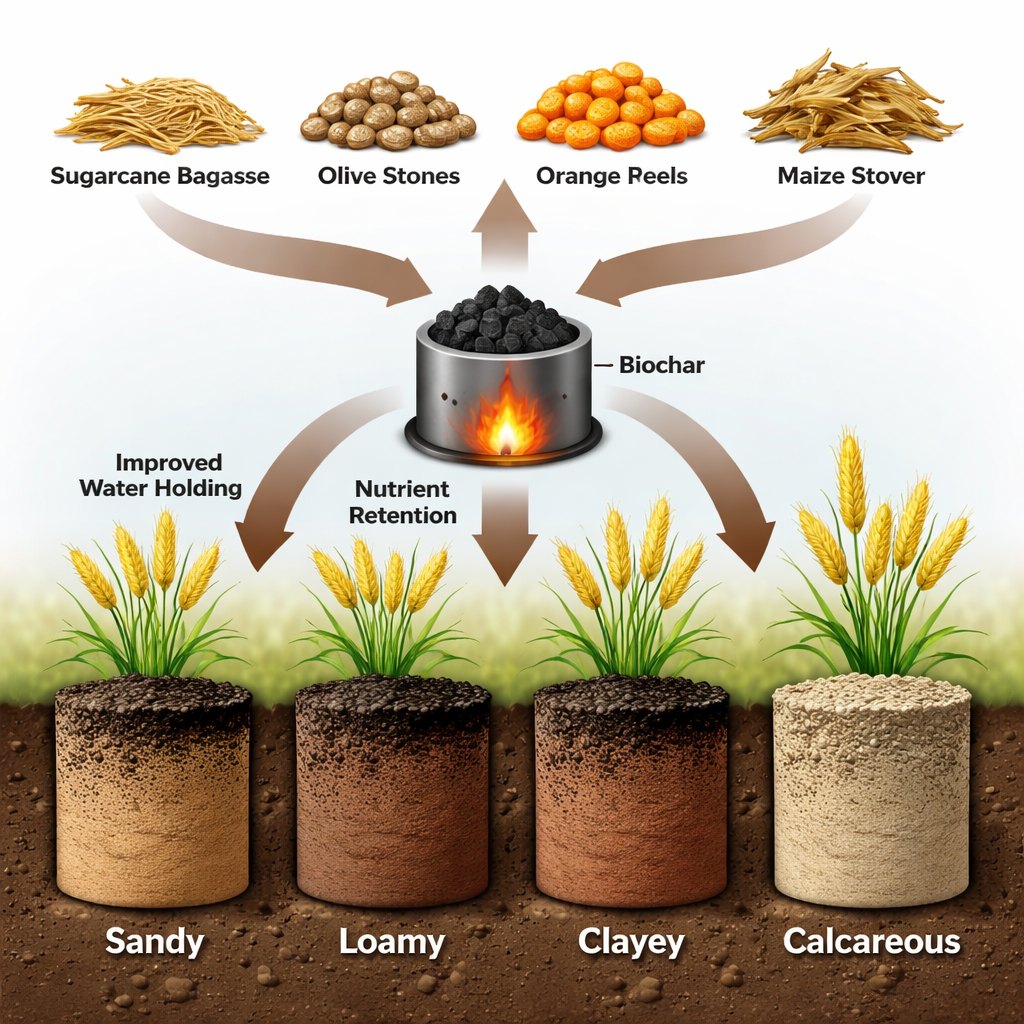
Across Egypt, farmers struggle with tired soils that cannot supply enough potassium, a key nutrient that helps crops like wheat grow strong and withstand drought and disease. At the same time, huge piles of crop and food-processing residues—such as sugarcane bagasse, olive stones, orange peels, and maize stalks—are often burned or left to rot, adding to air pollution and greenhouse gas emissions. This study explores a way to tackle both problems at once: transforming these wastes into biochar, a charcoal-like material, and using it to recharge poor soils so they hold more water and nutrients and grow healthier crops.
From Farm Waste to Biochar
The researchers collected four common agricultural wastes—sugarcane bagasse, olive stone pomace, orange fruit pomace, and maize stover—and heated them in a low-oxygen furnace to make biochar. This process locks carbon into a stable, porous solid rather than releasing it as smoke. Each biochar had its own personality: the maize-stover version was richest in plant nutrients and had the largest internal surface area, while the olive-stone biochar carried the greatest ability to hold positively charged nutrients, such as potassium, on its surfaces. All of them were slightly alkaline and contained mineral ash, making them promising candidates for improving the chemistry and structure of nutrient-poor soils.
Putting Biochar to the Test in Four Soils
To see how these biochars behave in real-world conditions, the team mixed each one into four typical Egyptian soils—sandy, loamy, clayey, and calcareous—at a rate of 3 percent by weight and grew wheat in pots for 50 days. Compared with untreated soils, the biochar-amended pots held more water and carried more sites where nutrients can attach instead of washing away. Water-holding capacity rose by up to about one-third, especially in sandy and calcareous soils that normally drain quickly. The soils’ ability to hold nutrients against leaching also jumped sharply, in some cases more than doubling. These improvements were strongest where soils started off weakest, showing that biochar is particularly effective in light, low-organic-matter soils common in arid regions.
Keeping Potassium in Reach of Roots
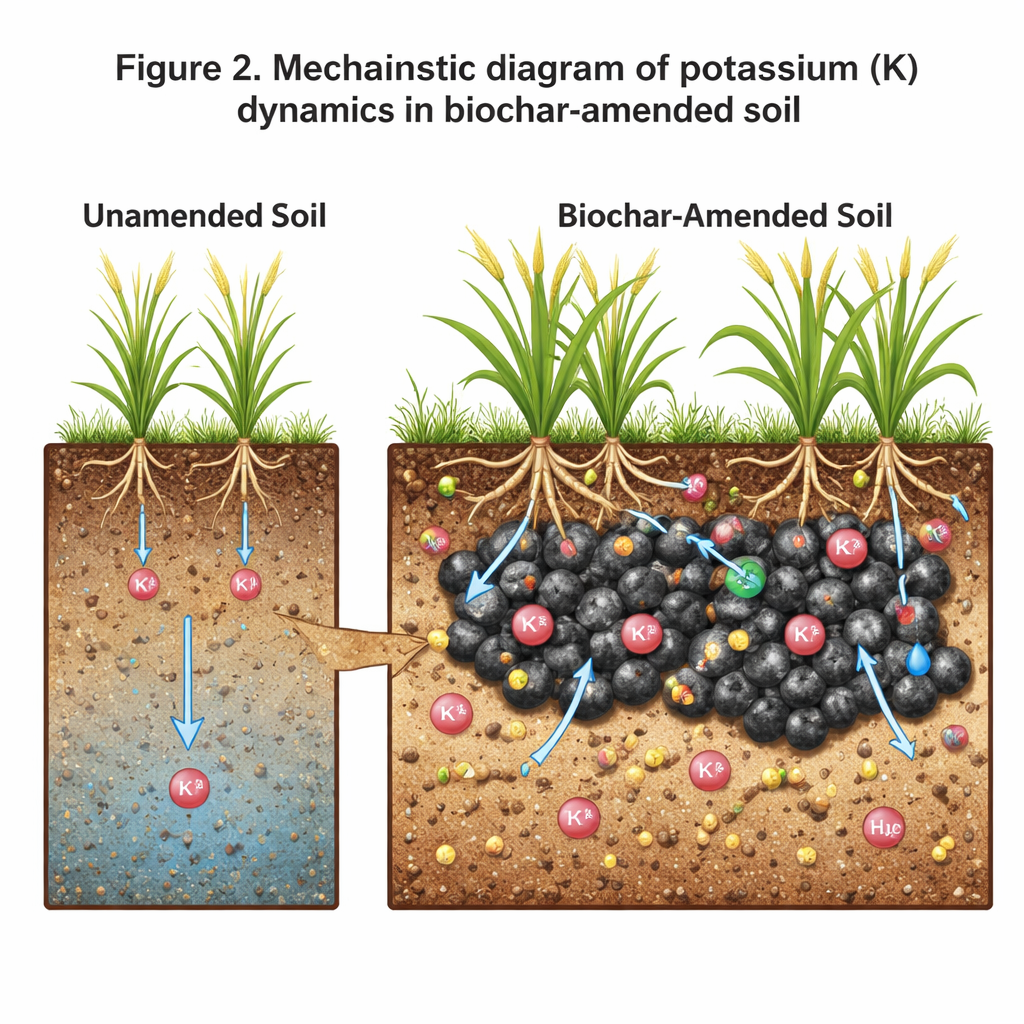
Beyond simple nutrient amounts, the study examined how readily potassium moves between soil particles and soil water—the pool plants actually drink from. Biochar made more potassium immediately available while also increasing the soil’s capacity to refill that pool over time. In sandy soil amended with maize-stover biochar, the readily available potassium fraction roughly doubled, and in calcareous soil it increased nearly ninefold. Measures of how strongly soil holds on to potassium, and how easily it can replace what plants remove, also improved across all soil types. In everyday terms, the biochars turned soils into better “batteries” for potassium: they could store more of it, release it when plants needed it, and resist sudden depletion.
Wheat Growth and Nutrient Uptake
The payoff for plants was clear. Wheat grown in biochar-treated soils built much more biomass than wheat in untreated pots. Depending on soil and biochar type, fresh weight rose by about 26 to 85 percent and dry weight by about 17 to 64 percent. The plants also contained and absorbed far more nitrogen, phosphorus, and potassium. In sandy soil, olive-stone biochar gave the biggest boost, more than doubling wheat uptake of all three nutrients. In loamy, clayey, and calcareous soils, maize-stover biochar consistently delivered the strongest gains, greatly improving nutrient capture even where clays or lime would normally tie up potassium and make it harder for roots to access.
Practical Promise for Farmers and the Environment
For non-specialists, the message is straightforward: carefully made biochar from local crop wastes can turn weak soils into more reliable nutrient reservoirs and help crops thrive with less dependence on costly mineral fertilizers. By choosing biochar feedstocks that match particular soil types—maize residues for broadly improved fertility, olive stones for boosting potassium storage in sandy and calcareous soils—farmers and policymakers can recycle agricultural by-products into long-lasting soil amendments. The study suggests that, especially in arid and semi-arid regions, biochar offers a practical way to raise yields, cut fertilizer losses, and reduce pollution from open burning, all while building healthier, more resilient soils for future harvests.
Citation: Ayman, M. Enhancing potassium availability and dynamics in some Egyptian soils through biochar application. Sci Rep 16, 6338 (2026). https://doi.org/10.1038/s41598-026-36281-z
Keywords: biochar, potassium in soil, Egyptian soils, wheat growth, sustainable fertilization