Clear Sky Science · en
A hybrid optimization and graph network for sustainable electric vehicle charging using a dual active bridge converter and renewable energy
Why cleaner car charging matters
Electric vehicles promise cleaner streets and lower carbon emissions, but the way we charge them still leans heavily on the conventional power grid. This study explores how to build a smarter charging station that draws power mainly from the sun and hydrogen fuel cells, supports batteries for backup, and still delivers reliable, affordable charging. By combining an efficient power converter with advanced algorithms borrowed from both nature and modern artificial intelligence, the authors show how tomorrow’s charging hubs could be greener and cheaper at the same time.
Mixing sun, hydrogen, and batteries
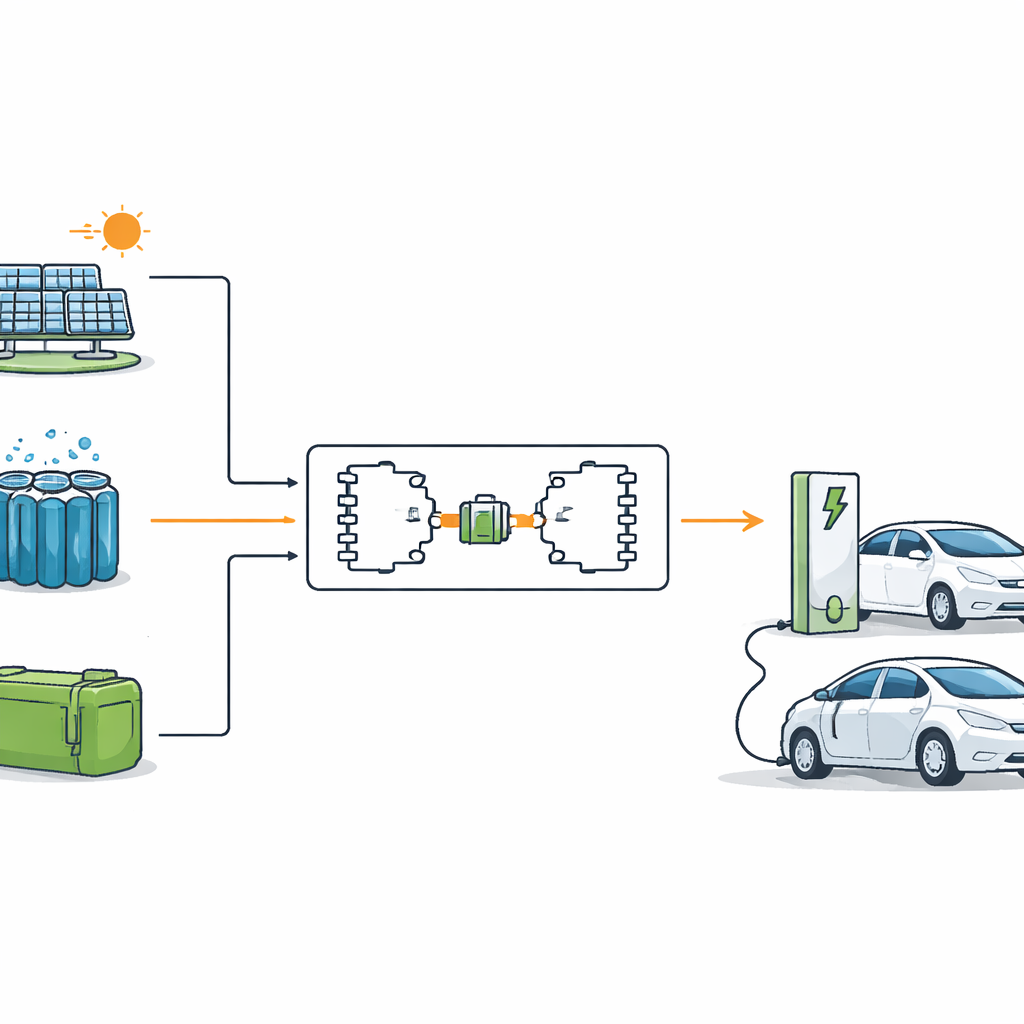
The charging station examined in this work uses a blend of solar panels, a fuel cell, and a battery bank that all connect to a common direct-current “bus,” a kind of energy highway. Solar panels provide low-cost electricity when sunlight is available, while the fuel cell offers controllable backup power when clouds roll in or demand surges. A battery stores surplus energy and fills in gaps, smoothing out the natural ups and downs of renewable output and driving patterns. Together, these three sources aim to keep electric car charging steady even though both energy supply and driver behavior are highly variable.
The power electronics at the heart of the station
Between this shared energy bus and the vehicle’s battery sits a key piece of hardware called a dual active bridge converter. It acts like a smart gearbox for electricity, allowing power to flow in both directions with high efficiency and electrical isolation for safety. By carefully shifting the timing of its internal switches, the converter can regulate how much power is sent to or from the car and the station’s storage battery. This fine control helps hold the bus voltage around a constant level and shapes the current so that the vehicle battery charges quickly at first and then more gently, helping preserve battery health.
Nature-inspired planning for cheaper energy
Hardware alone is not enough; the station also needs a brain to decide when to use solar, when to call on the fuel cell, and when to charge or discharge the battery. For this, the researchers turn to a “pelican optimization algorithm,” a mathematical method modeled on how pelicans cooperate while hunting for fish. In the study, each virtual “pelican” represents a different way to schedule power flows and converter settings. By repeatedly exploring and refining these options, the algorithm searches for operating plans that minimize the long-term cost of energy, taking into account equipment limits and the fluctuating behavior of drivers and renewables.
A graph-based brain for real-time decisions
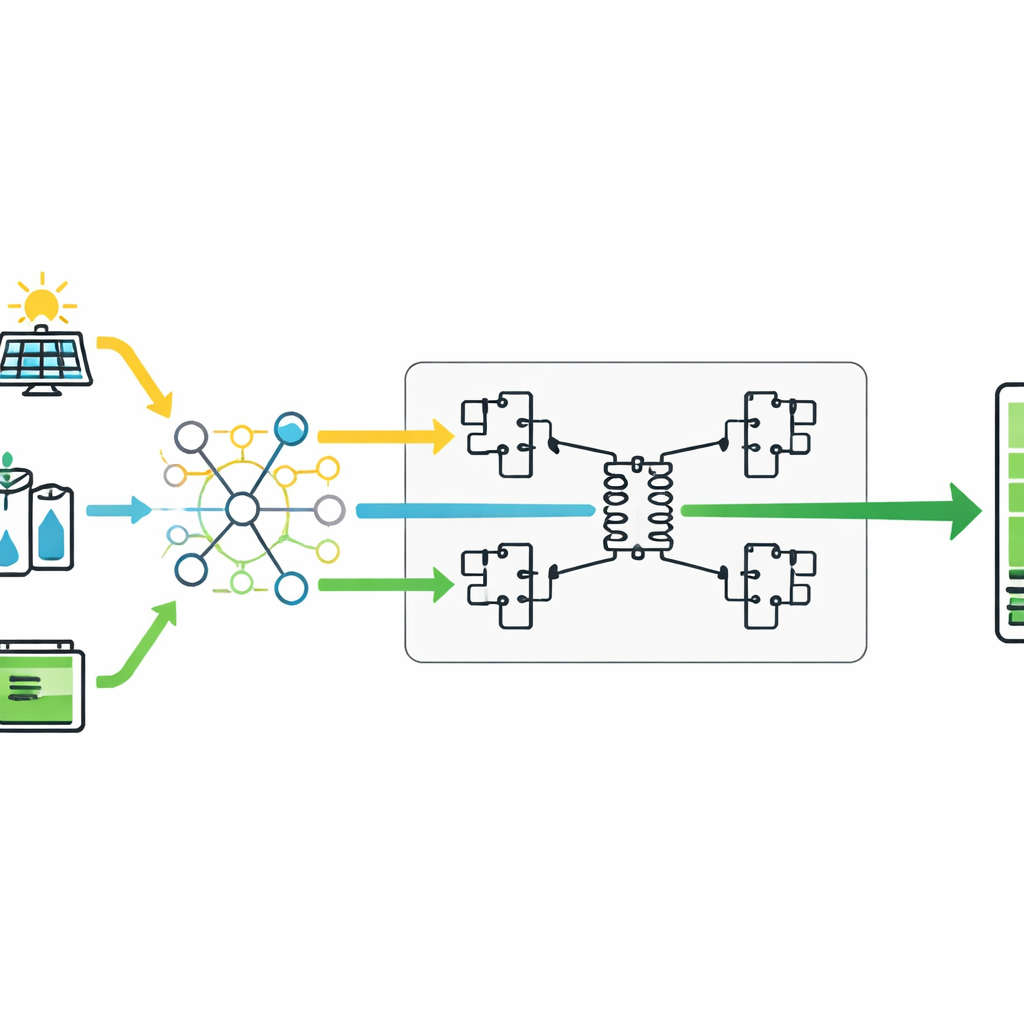
To complement this planner, the team uses an advanced neural network called an attributed multi-order graph convolutional network. Instead of looking at each energy source or load in isolation, this model treats the station as a web of interconnected nodes: solar output, fuel cell behavior, battery state of charge, bus voltage, and vehicle charging demand. It learns how changes at one point ripple through the rest of the system, capturing multi-step relationships that simpler models miss. Once trained, this graph-based brain predicts the best control signals for the dual active bridge converter, helping the station respond in real time to sudden shifts in sunlight or charging demand.
What the simulations reveal
Using detailed computer simulations, the authors show that their hybrid control scheme keeps the key electrical quantities—such as the central bus voltage, load current, and vehicle battery voltage—stable within seconds of start-up. Solar power gradually tapers off in their test scenario, while the fuel cell and battery adjust their contributions so that the car continues to receive nearly constant power. The charging profile of the vehicle battery mirrors what drivers expect: a fast rise in voltage and current at the beginning, followed by a smoother phase that protects the battery from stress. Overall, the station delivers around 4 kilowatts of steady charging power with only minor, quickly corrected dips.
Lower costs for greener charging
Perhaps the most striking result is economic. When the new method—combining pelican-based optimization with the graph neural network—is compared against a range of popular planning techniques, it yields the lowest cost per unit of delivered energy. The study reports a levelized cost of energy of about five and a half cents per kilowatt-hour, a reduction of roughly half compared with a standard particle swarm method and more than 70 percent compared with some other heuristic approaches. For a lay reader, this means that by orchestrating when and how different clean energy sources feed the charger, and by precisely steering the power electronics, the station can offer dependable, renewable charging at a price competitive with or better than conventional grid-based options.
Citation: Narayanan, P., Kandasamy, P., Kandasamy, N. et al. A hybrid optimization and graph network for sustainable electric vehicle charging using a dual active bridge converter and renewable energy. Sci Rep 16, 8868 (2026). https://doi.org/10.1038/s41598-026-36280-0
Keywords: electric vehicle charging, renewable energy, smart grids, power electronics, energy optimization