Clear Sky Science · en
Experimental and numerical study on interfacial impact load transfer mechanism
Why the shock inside a projectile matters
When a hardened bomb slams into concrete or rock, the violence is not only at the surface. Powerful shock waves race through the projectile’s metal shell and its internal components, including the small but crucial fuze that decides when to detonate. If those internal shocks are misunderstood, the fuze may trigger too early, too late, or not at all. This study explores how impact forces travel through the joints between different parts of a projectile and shows how engineers can predict those hidden loads more accurately, helping make modern penetrating munitions both more effective and more reliable.
Hidden journeys of an impact
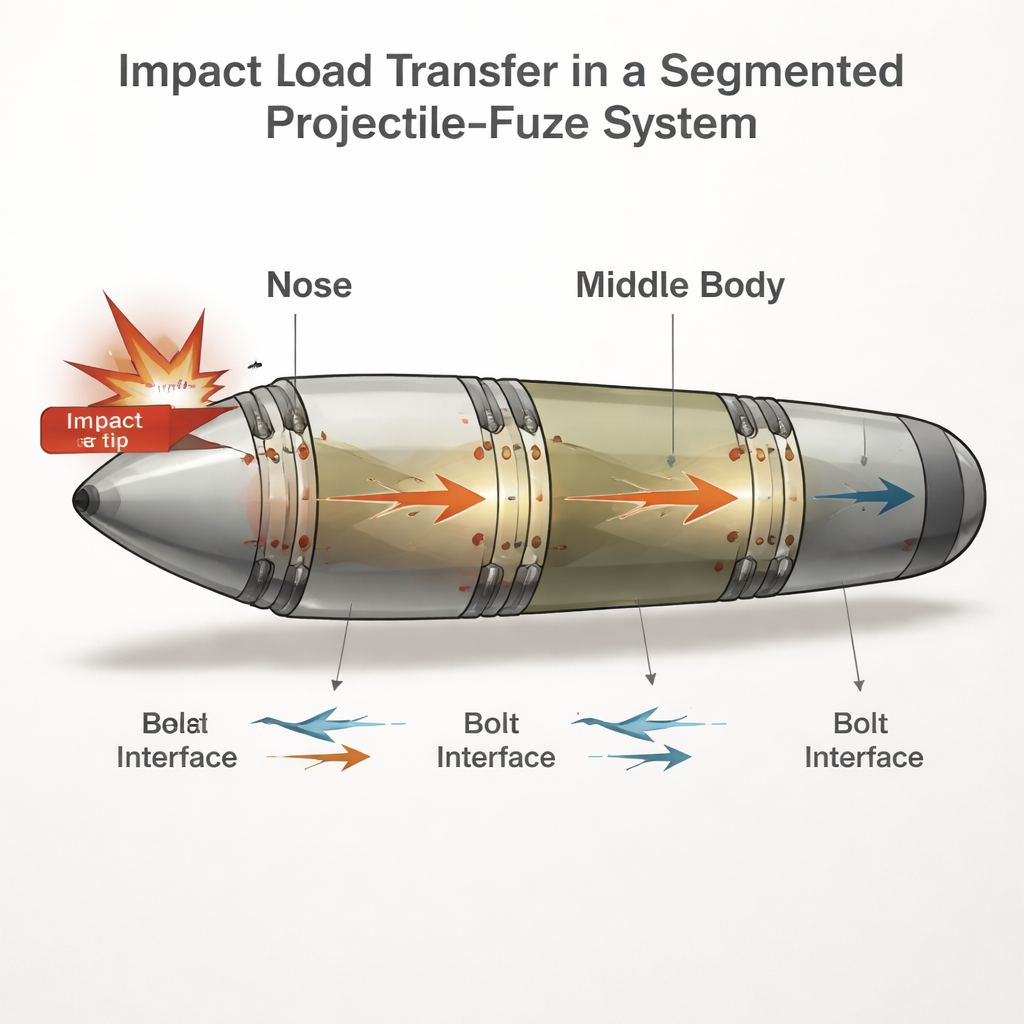
As projectiles have become faster and targets more complex, the forces during penetration have grown more intense and more intricate. A brief but powerful shock at the first instant of impact is followed by strong inertial forces as the projectile slows down inside the target. These forces contain a wide mix of frequencies and do not simply move straight through the metal. Instead, they are reflected, scattered, and partly absorbed at each mechanical joint—such as threaded connections, flanges, and bolts—between the body of the projectile and the fuze assembly. The connection is far from perfectly rigid, and its microscopic roughness and material differences can dramatically reshape the shock signal that finally reaches sensitive components like accelerometers.
Probing the forces with controlled hammer blows
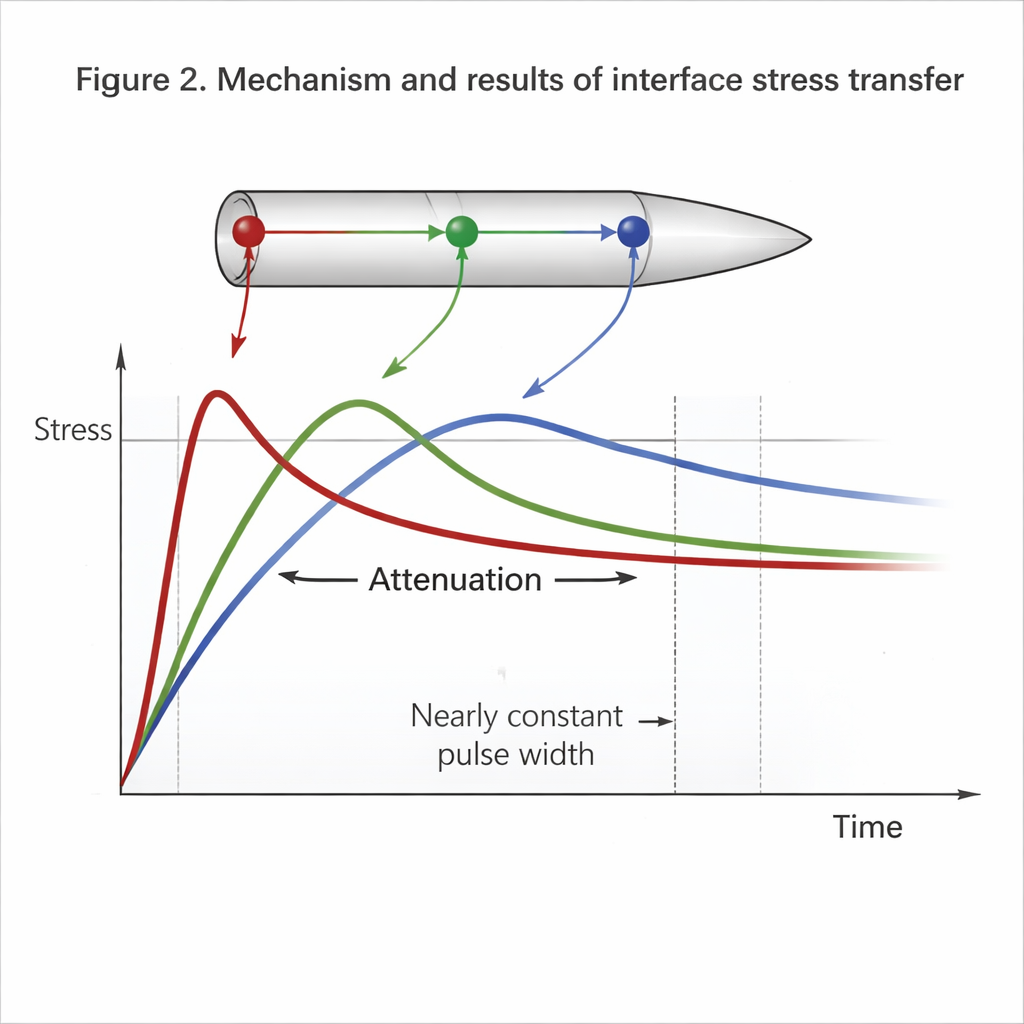
To see how these internal forces really behave, the researchers built a scaled-down projectile made of a nose, a middle body, and a base, all bolted together to create two key interfaces. Using a specialized impact hammer and a data-acquisition system, they struck the front of the model while strain gauges at several positions recorded how the stress varied over time. By repeating the test three times with gradually stronger hammer blows, they observed how stress waves crossed each interface. The peak stress at each sensor grew roughly in proportion to the input force, showing that the system behaved uniformly, but the stress amplitude clearly decreased as waves passed through the threaded joints. Interestingly, the sharpness, or pulse width, of the first major stress wave changed very little as it moved from section to section, suggesting that the interfaces mainly reduced amplitude rather than stretching the pulse in time.
Building a simple model that mimics a complex structure
Instead of modeling every bolt thread in three dimensions—which would be extremely costly in computer time—the authors treated the projectile-fuze assembly as an equivalent multi-mass, multi-spring system. In this picture, different parts of the projectile and fuze become lumped masses linked by effective stiffness and damping values that stand in for the real joints. Using system-identification tools in MATLAB, they fed the measured input and output stress histories at each interface into a mathematical procedure that estimates the transfer function, a compact formula that relates incoming load to outgoing response. The resulting models, containing a fixed number of poles and zeros, reproduced the measured stress curves with coefficients of determination typically above 0.75 and up to 0.92, indicating that the simplified representation captured most of the true behavior.
Checking the model with detailed simulations
To test whether these compact transfer models held up beyond the laboratory hammer tests, the team built a refined finite element simulation of the projectile. They simplified fine geometric details but preserved the main shapes and connections, and they used advanced material descriptions to handle plastic deformation at the nose. When they simulated impacts at different velocities, they compared the numerically predicted stress histories at the same interface locations with the stresses predicted by their identified transfer functions. While the full waveforms did not match perfectly point by point, the key engineering features—such as the peaks and pulse widths of the first compression and tension waves, and the strongest frequency peaks—agreed within about 15 percent. This level of accuracy meets common design criteria for elastoplastic response models.
What this means for safer, smarter fuzes
For a non-specialist, the central message is that the authors have turned a messy, hard-to-predict internal shock environment into a manageable set of simple models. Their work shows how to combine targeted experiments and numerical simulations to describe how impact forces are filtered and reduced by the joints inside a projectile before they reach the fuze. With transfer models that can reliably predict peak loads and pulse widths, designers can better tune fuze thresholds and structure, reducing the risk of misfires and improving the effectiveness of penetrating weapons without having to simulate every microscopic detail.
Citation: Hao, JC., Cui, SK., Ma, GS. et al. Experimental and numerical study on interfacial impact load transfer mechanism. Sci Rep 16, 5282 (2026). https://doi.org/10.1038/s41598-026-36273-z
Keywords: impact load transfer, projectile fuze, stress waves, finite element simulation, system identification