Clear Sky Science · en
Energy absorption and rebound behavior of 3D-printed TPU lattice structures
Soft Shock Absorbers for Safer Drone Landings
As drones take off and land on snow, sand, grass, or rocky slopes, their landing gear is repeatedly slammed against the ground. Hard impacts can shake cameras, damage electronics, and shorten the life of the aircraft. This study explores how soft, 3D-printed plastic lattices—lightweight blocks filled with tiny repeating openings—can act like miniature shock absorbers, soaking up impact energy and then springing back into shape so drones stay stable and ready to fly again.
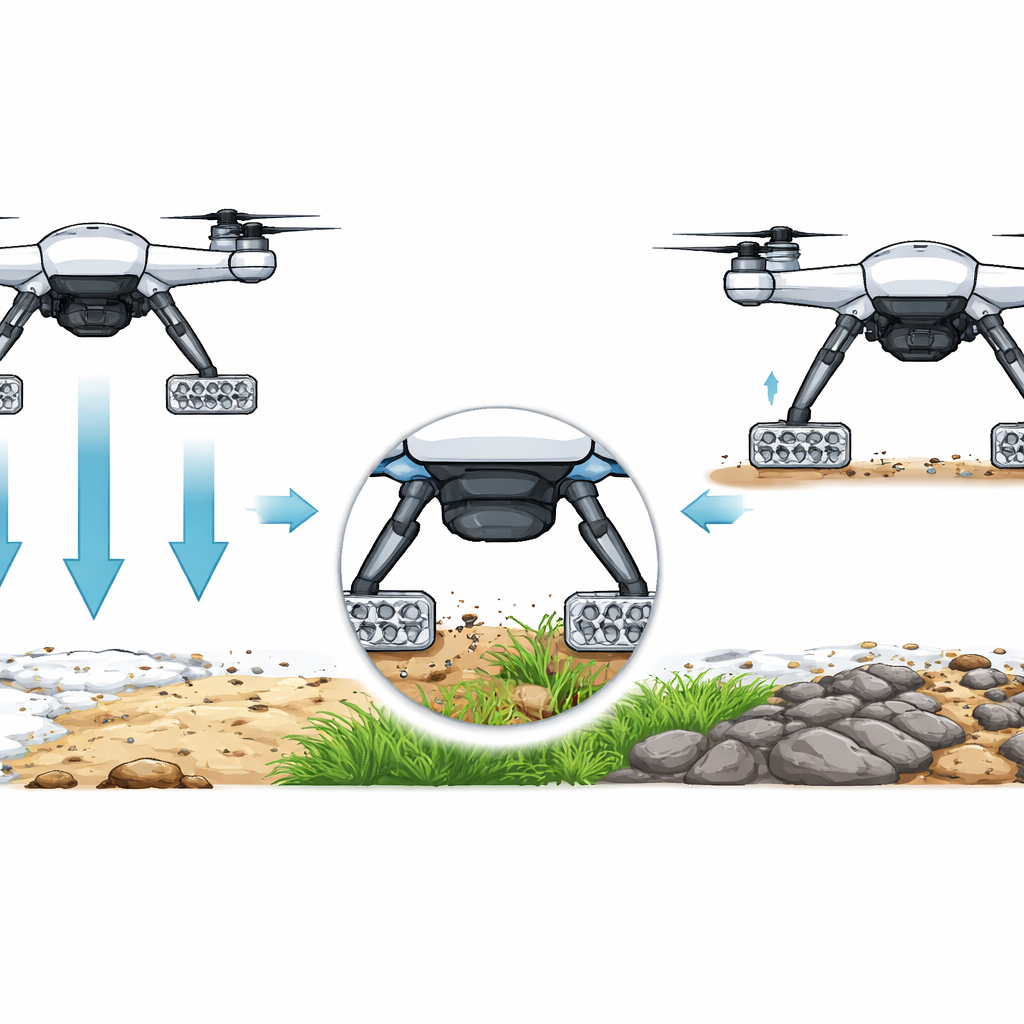
Why Spongy Plastics Beat Solid Metal
Traditional landing gear and crash-protection parts are often made from solid metals or simple honeycomb structures. They can be strong, but they are heavy and tend to deform permanently under repeated hits. The authors instead use a flexible material called thermoplastic polyurethane (TPU), which behaves a bit like a tough rubber: it bends, absorbs energy, and then largely recovers. Thanks to 3D printing, this TPU can be formed into intricate internal patterns, allowing engineers to tune how it squashes and rebounds without changing the overall size of the part. For drones and other light vehicles, that means less weight, better vibration control, and more design freedom.
Five Tiny Grids with Big Differences
The researchers designed five small block-shaped test pieces, each filled with a different pattern of hexagonal cells—like miniature honeycombs. Some blocks had the same cell size throughout, while others were graded: large openings on one side smoothly transitioning to smaller ones on the other. Several designs also added thin horizontal beams between layers to stiffen the structure, while one design deliberately left these beams out. All samples were 3D printed from the same TPU material, so any performance differences would come from geometry alone rather than changes in the plastic itself.
Putting the Lattices Under the Press
To mimic landing and repeated bumps, each TPU block was squeezed between flat plates in three slow press-and-release cycles, up to a set displacement. From the load–displacement curves, the team calculated how much energy each block absorbed, how much it gave back when it sprang up, how much permanent squashing remained, and how its stiffness changed with use. They also built computer models to visualize how the cells buckled, folded, and densified. Certain patterns showed orderly, layer-by-layer collapse, while others without reinforcing beams failed by skewed, unstable shear, leading to poorer control and faster damage.
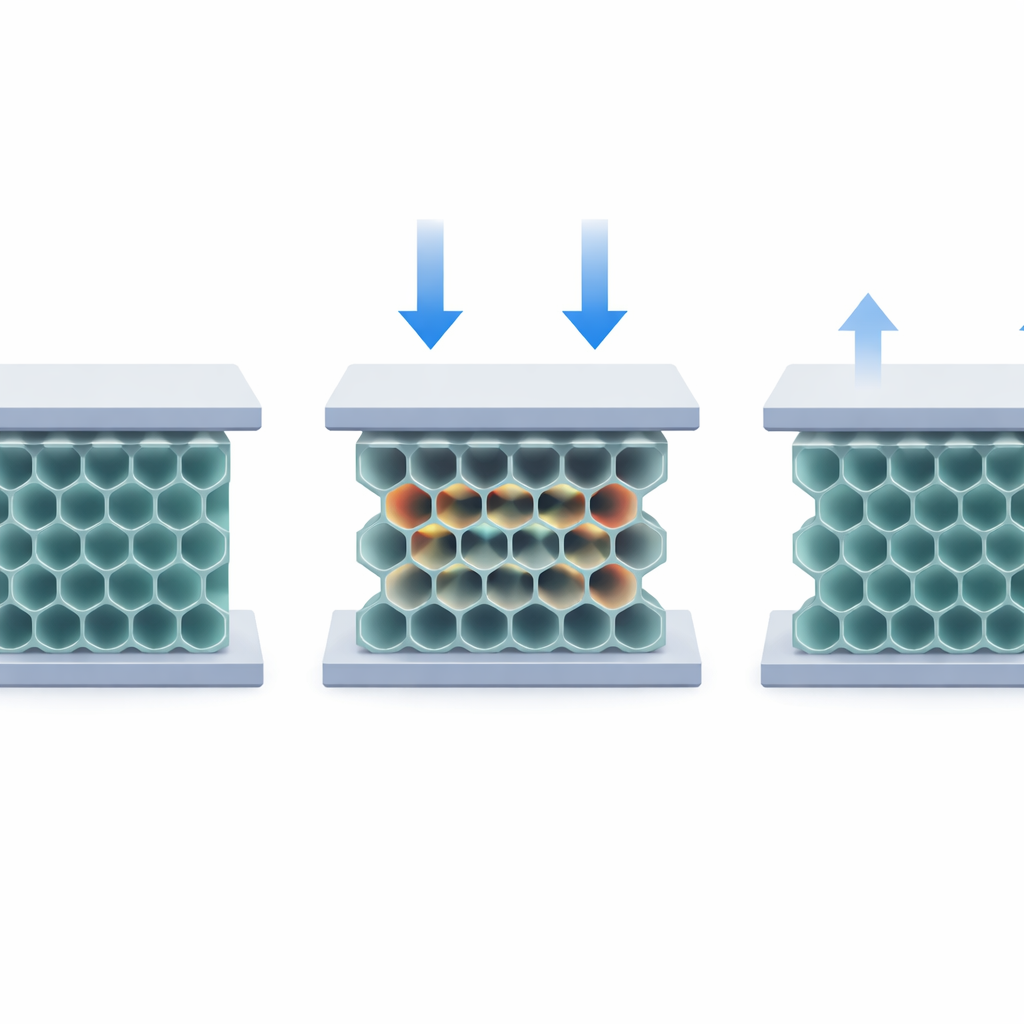
Balancing Cushioning and Bounce-Back
Two designs stood out. A uniform pattern with small cells delivered the highest total energy absorption, forming wide buckled regions that soaked up strong impacts. However, a graded design—where cell sizes shrank gradually from one face to the other and were tied together by beams—offered the best overall trade-off. It combined high energy per unit weight, strong recovery of its original shape, and stable stiffness over repeated cycles. By contrast, the lattice without beams had the lowest energy absorption, the highest permanent deformation, and rapid stiffness loss, making it unsuitable for long-life protective parts.
What This Means for Everyday Technology
For non-specialists, the key message is that the internal pattern of a soft, 3D-printed plastic can be as important as the material itself. Carefully arranging cell size, gradation, and reinforcing beams lets engineers build landing pads and vibration dampers that both cushion hard hits and spring back ready for the next one. The study shows that graded TPU lattices, in particular, can keep drones more stable when landing on rough or unpredictable terrain, potentially improving safety and extending service life. The same design ideas could be applied to footwear, helmets, packaging, and vehicle components wherever smart, reusable cushioning is needed.
Citation: Wu, Y., Wang, L., Yi, Z. et al. Energy absorption and rebound behavior of 3D-printed TPU lattice structures. Sci Rep 16, 9072 (2026). https://doi.org/10.1038/s41598-026-36271-1
Keywords: 3D printed lattices, TPU shock absorbers, drone landing gear, energy absorbing materials, vibration damping