Clear Sky Science · en
Florescence based analytical assessment of plasma neopterin and its clinical relevance in hypertension
Why a blood marker for high blood pressure matters
High blood pressure is often called the “silent killer” because damage to the heart and blood vessels can build up for years before symptoms appear. Doctors usually rely on blood pressure readings alone to judge risk, but those numbers say little about the hidden inflammation simmering inside the arteries. This study explores a small molecule in the blood, neopterin, that could act as an early warning signal of this hidden damage, and describes a simple light-based test to measure it.
A small molecule with a big message
Neopterin is a natural substance released by certain white blood cells when the immune system is activated. Its levels rise in many conditions where inflammation and oxidative stress play a role, including infections, autoimmune diseases, heart disease, and cancer. Because high blood pressure is now known to involve low-grade, long-lasting inflammation of blood vessels, the authors asked whether measuring neopterin in blood plasma could help reveal this process in people with hypertension. If so, it might offer a convenient way to track vascular inflammation and refine cardiovascular risk.
Turning chemistry into a bright signal
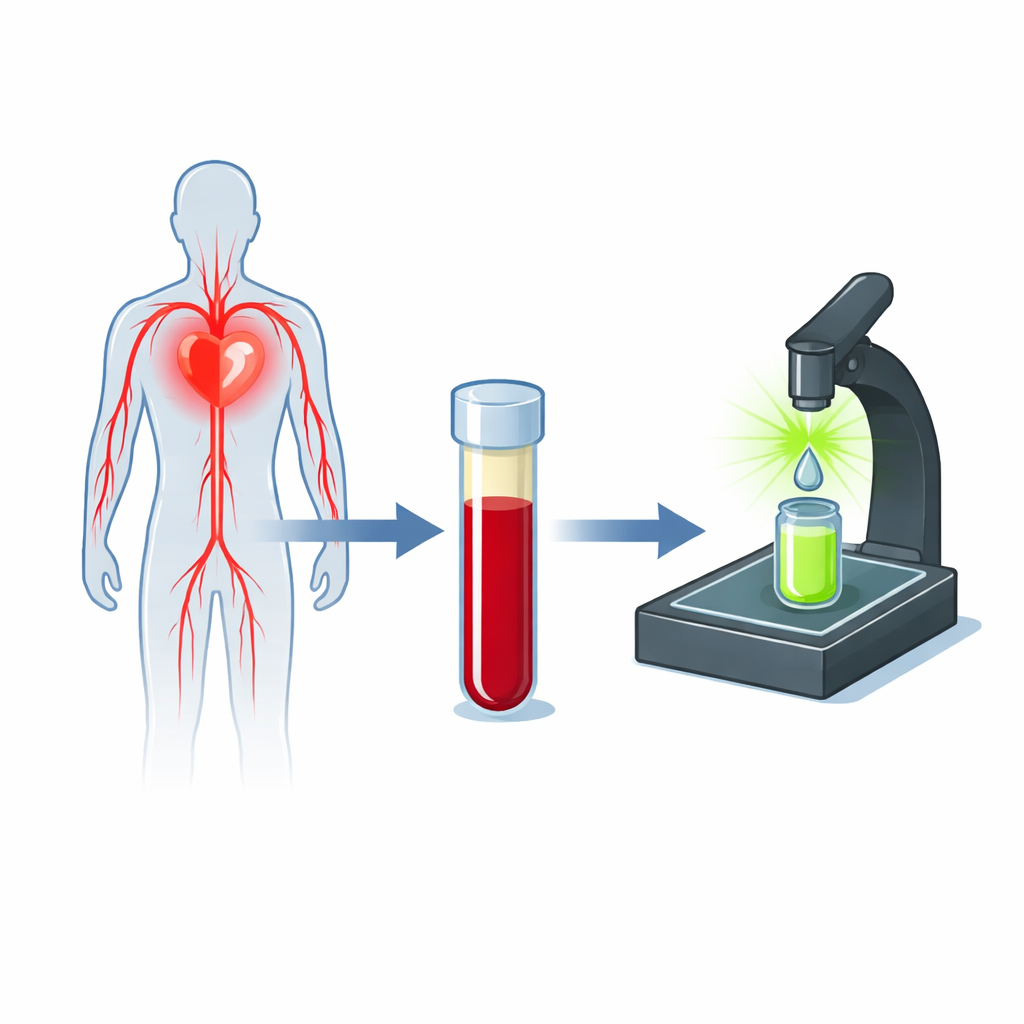
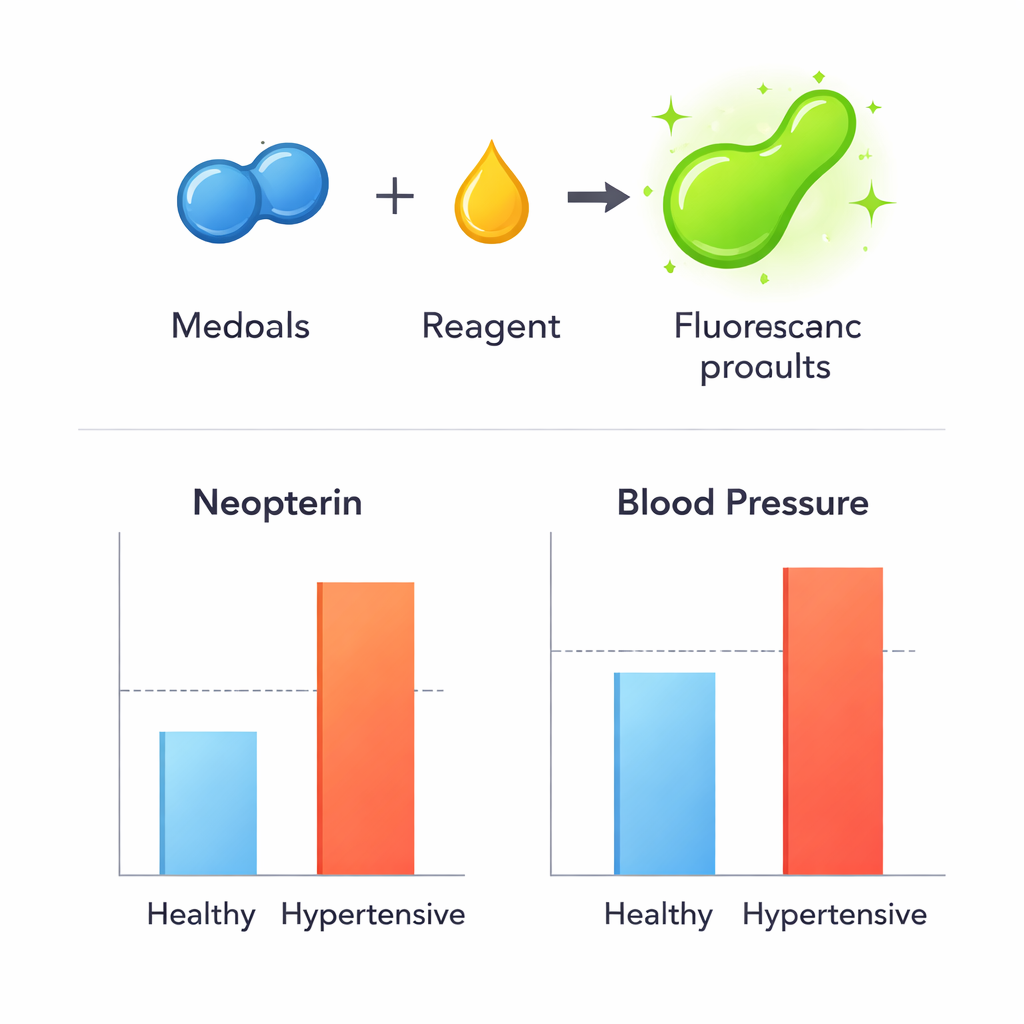
Measuring neopterin in blood is technically challenging because it circulates at very low concentrations and blood plasma is a complex mixture of many similar molecules. Sophisticated instruments like high‑performance liquid chromatography and mass spectrometry can do the job, but they are expensive, slow, and require specialist staff. In this work, the researchers developed a fluorescence-based test: they chemically “tagged” neopterin with a reagent called NBD-F that makes it glow much more strongly when exposed to certain colors of light. By carefully adjusting conditions such as acidity, temperature, and reaction time, they created a stable, bright product whose light output rises in a straight line as neopterin concentration increases.
How accurate and selective is the new test?
To be useful in clinics, the test had to be sensitive, reliable, and specific. The team showed that the glowing product had a quantum yield, a measure of efficiency of light emission, about three times higher than native neopterin. The assay could reliably detect amounts well below those typically found in healthy people, and repeated measurements on the same samples gave nearly identical results. Just as important, closely related compounds found in blood, such as other pteridines and vitamins, produced less than 4% of the signal that neopterin did under the same conditions. This means spurious “false positive” readings from look‑alike molecules are unlikely, an essential feature for any diagnostic test.
What the study found in patients
After validating the method in the lab, the researchers applied it to a group of 52 adults: 26 with established high blood pressure and 26 healthy volunteers matched for age and sex. Neopterin levels were clearly higher in the hypertensive group, averaging about 3.0 nanograms per milliliter of plasma compared with 1.8 in the healthy group. Statistical analysis showed that these differences were highly unlikely to be due to chance. Moreover, individuals with higher neopterin tended to have higher systolic and diastolic blood pressure values, suggesting a link between immune activation, vascular stress, and the severity of hypertension.
What this means for everyday care
The study concludes that this fluorescence-based approach offers a sensitive and relatively simple way to measure neopterin in blood, and that raised neopterin levels are associated with high blood pressure and higher pressure readings. For a layperson, this means that in the future, blood tests may not only tell doctors about cholesterol and sugar, but also about “hidden inflammation” in the arteries. While the method still needs confirmation in larger and more diverse groups, and may require some streamlining for routine use, it points toward a practical lab tool that could help identify people whose blood vessels are under immune attack long before serious complications occur.
Citation: Imam, M.S., Alharthi, R.M.A., Saati, K.F. et al. Florescence based analytical assessment of plasma neopterin and its clinical relevance in hypertension. Sci Rep 16, 3718 (2026). https://doi.org/10.1038/s41598-026-36264-0
Keywords: neopterin, hypertension, vascular inflammation, fluorescence assay, cardiovascular risk