Clear Sky Science · en
Data-driven optimization and pressuremeter modulus prediction using response surface methodology for smarter geotechnical design
Why Smarter Soil Testing Matters
Before any building, bridge, or road is constructed, engineers must know how strongly the ground will push back when it is loaded. If this is underestimated, foundations can settle or fail; if it is overestimated, projects become unnecessarily expensive. This paper explores a modern, data-driven way to predict how stiff the ground is, using a field test called the pressuremeter test and statistical tools that squeeze much more insight out of a limited number of measurements.
Measuring How the Ground “Springs Back”
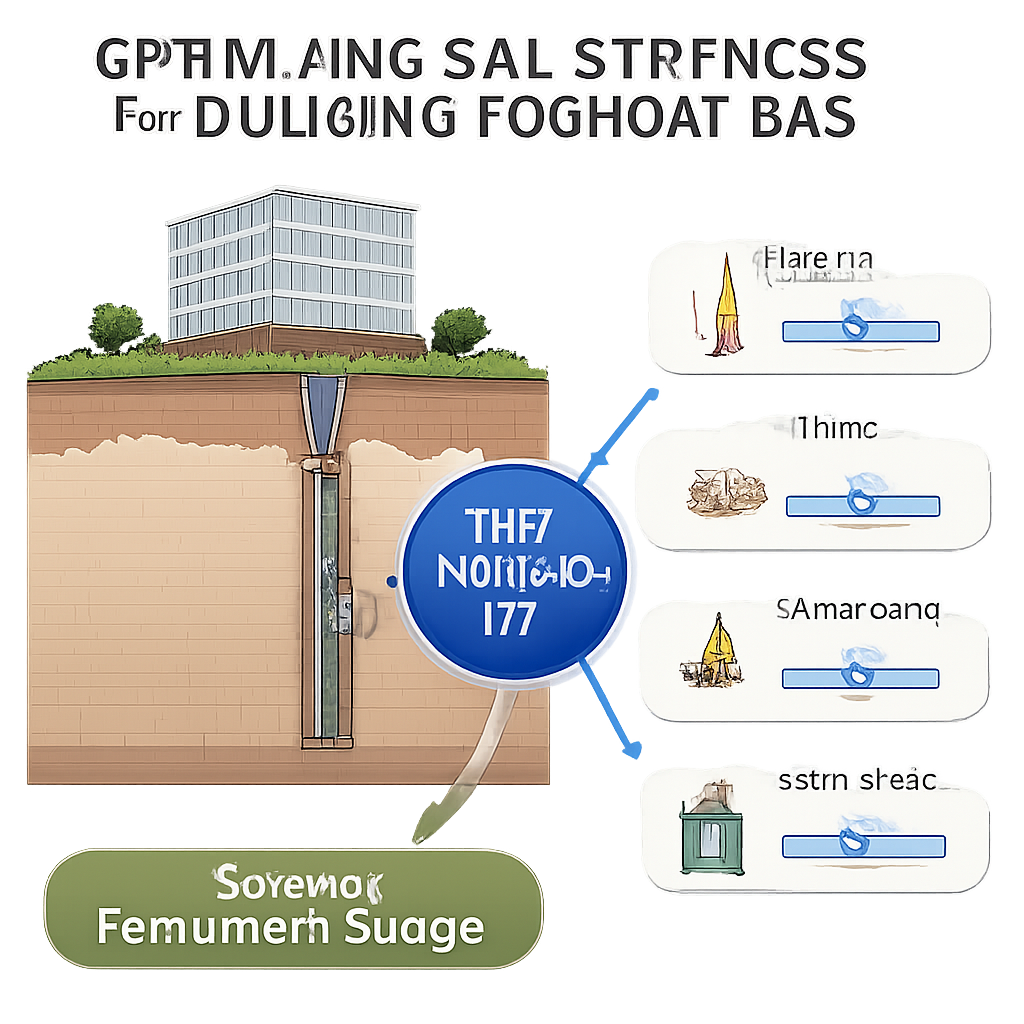
In the field, engineers often lower a cylindrical probe into a narrow borehole and slowly inflate it against the surrounding soil. By recording how much the probe volume increases for a given increase in pressure, they can calculate the pressuremeter modulus, Ep, a measure of how stiff the soil is. Ep strongly influences how much foundations will compress under load. Traditional ways to estimate Ep rely either on simple formulas or many repeated tests, both of which can be costly, time-consuming, and uncertain. The authors ask whether a carefully designed set of tests, coupled with modern statistics, can predict Ep more accurately while reducing effort in the field.
Using Fewer Tests, but Smarter Ones
The study focuses on four soil properties that are known to shape ground stiffness: how deep the test is carried out, how sticky the soil is (cohesion), how well grains resist sliding past each other (internal friction angle), and how heavy the soil is per unit volume (unit weight). Instead of testing every possible combination, the researchers use an approach called response surface methodology. They design 35 targeted test cases that systematically vary these four properties over realistic ranges. With this design, each test run plays a double role: it provides a direct Ep value and, together with the others, helps map how Ep changes across the full range of conditions.
Finding Patterns in a Four-Dimensional Landscape
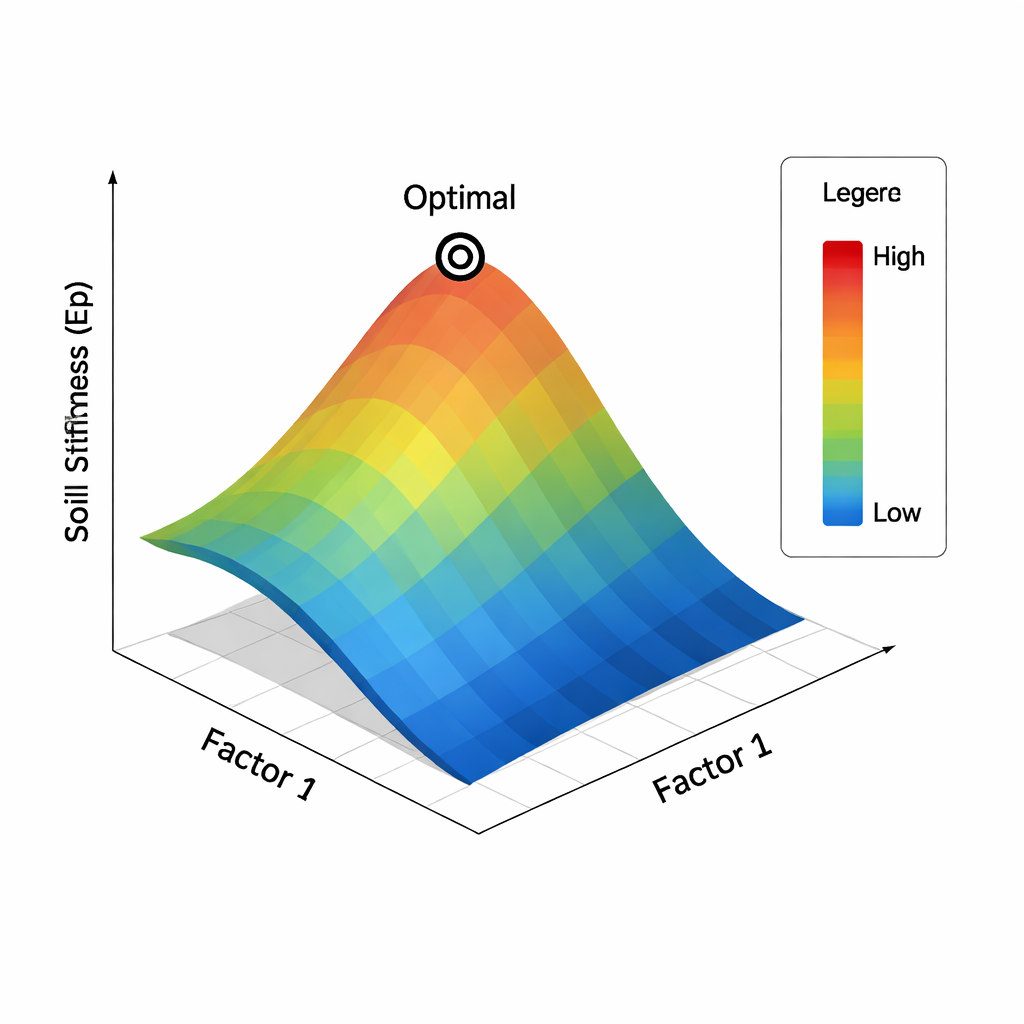
From the 35 tests, the authors build a mathematical surface that links the four input properties to Ep. They then check how well this surface matches the measurements using standard statistical checks. The model explains about 96.5% of the observed variation in Ep, meaning the predicted values line up closely with the field results. The analysis shows that two factors—cohesion and unit weight—dominate the behavior: soils that are more cohesive and denser tend to be much stiffer. The friction angle also matters, but less strongly, while depth within the studied range has only a modest direct effect. The team also uncovers important combinations, such as how unit weight, when paired with cohesion or friction angle, can strongly raise or lower Ep, revealing that these properties do not act in isolation.
Hunting for the Best Soil Conditions
To turn this understanding into practical guidance, the researchers apply an optimization technique known as the desirability function. In simple terms, they tell the computer to “search” within realistic soil conditions for combinations that maximize Ep while respecting engineering limits. The result is not just one perfect point but a broad zone of favorable combinations where Ep is high and the model’s predictions are reliable. This is reassuring for practice: it means that small variations in field conditions still produce strong ground performance, and engineers have flexibility in choosing foundation depths or accepting a range of soil improvements to reach safe stiffness levels.
What This Means for Real-World Foundations
For non-specialists, the key message is that we can now get more reliable information about how the ground will behave under a building without dramatically increasing time or cost. By combining a well-established field test with smart experimental planning and statistical modeling, this work shows how to predict soil stiffness from a relatively small dataset and highlight which soil traits matter most. In practice, that means safer foundations, better targeted site investigations, and reduced uncertainty, especially on projects where full-scale testing or large data collections are not feasible.
Citation: Boukhatem, G., Bencheikh, M., Bekkouche, S.R. et al. Data-driven optimization and pressuremeter modulus prediction using response surface methodology for smarter geotechnical design. Sci Rep 16, 5679 (2026). https://doi.org/10.1038/s41598-026-36262-2
Keywords: soil stiffness, foundation design, pressuremeter test, statistical modeling, geotechnical optimization