Clear Sky Science · en
Isorhamnetin inhibits mechanical stress-induced chondrocyte apoptosis through activation of the ROS/SRC/FOXO1 signaling pathway
Why spine wear-and-tear matters
Pain in the neck and upper back is one of the most common reasons people visit a doctor, especially as they get older or spend long hours looking down at phones and computers. Much of this discomfort traces back to gradual damage in the small, shock-absorbing cushions between the bones of the spine, known as intervertebral discs. When these discs break down, the process is called intervertebral disc degeneration, and current treatments mostly focus on pain relief or surgery rather than stopping the damage itself. This study explores whether a natural plant compound, isorhamnetin, can protect the tiny cartilage cells in these discs from the harmful effects of long‑term mechanical stress.
How everyday forces strain the spine
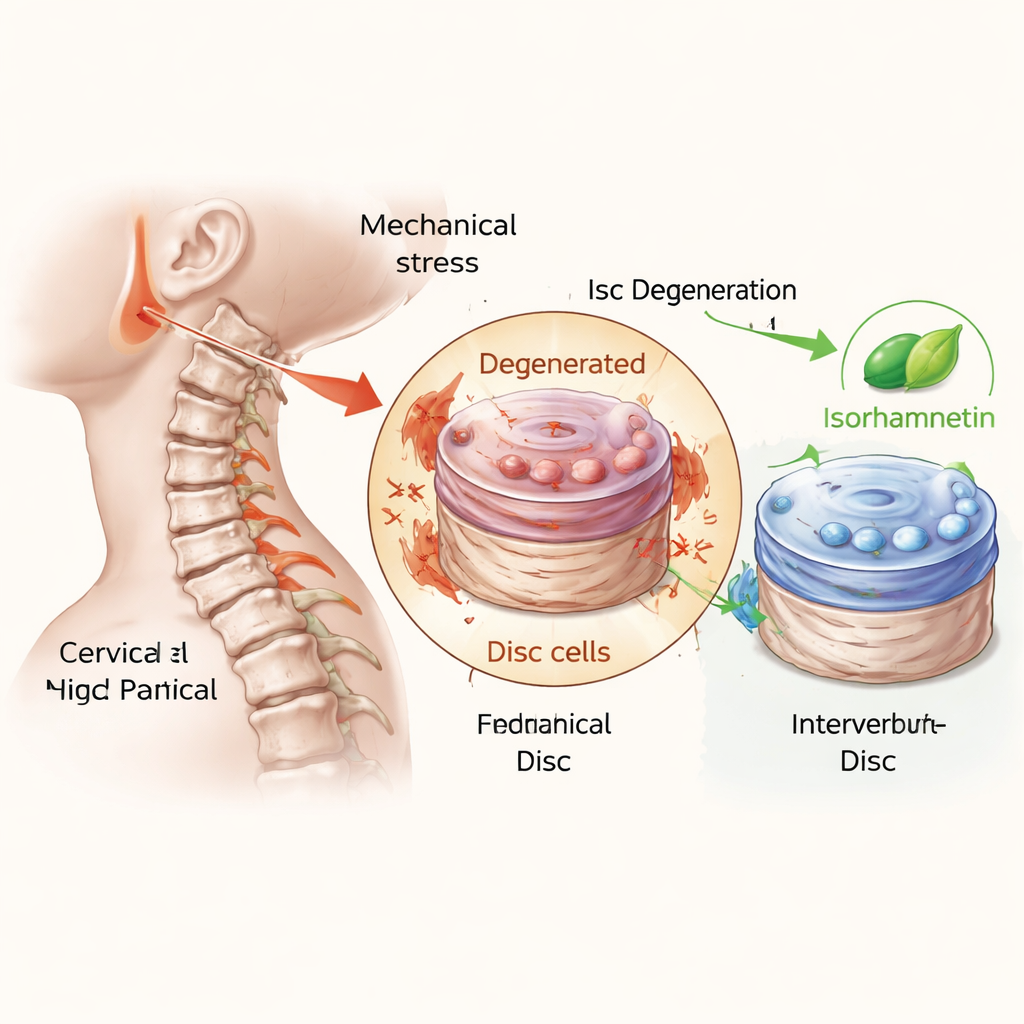
Every time we bend, twist, or hold our heads forward, we change how weight and pressure travel through the spine. Under healthy conditions, gentle, well-distributed forces help keep the discs nourished and working properly. But when pressure is too strong, too frequent, or applied in awkward positions, it can damage the cartilage endplate—the thin layer of cartilage that helps feed and support each disc. The authors show that excessive mechanical loading, similar to what occurs with chronic forward head posture, triggers higher rates of programmed cell death (apoptosis) in these cartilage cells. Over time, the loss of these cells weakens the disc, setting the stage for pain, stiffness, and loss of normal neck curve.
A plant molecule with protective potential
Isorhamnetin is a flavonoid, a class of plant-based molecules found in herbs such as Astragalus that are known for their anti-inflammatory and antioxidant properties. Earlier work suggested that isorhamnetin can protect joint cartilage in osteoarthritis. In this study, the researchers asked whether it could also shield disc cartilage cells from the damaging effects of mechanical strain. They used a bipedal rat model that forces the animals to stand upright, increasing the load on their neck discs, along with cultured human-like cartilage cells grown under controlled pressure in the lab. Rats given isorhamnetin by mouth showed fewer dying cartilage cells and less structural damage in their cervical discs. In cell culture, modest doses of isorhamnetin improved cell survival under pressure without being toxic on their own.
Following the chemical signals inside stressed cells
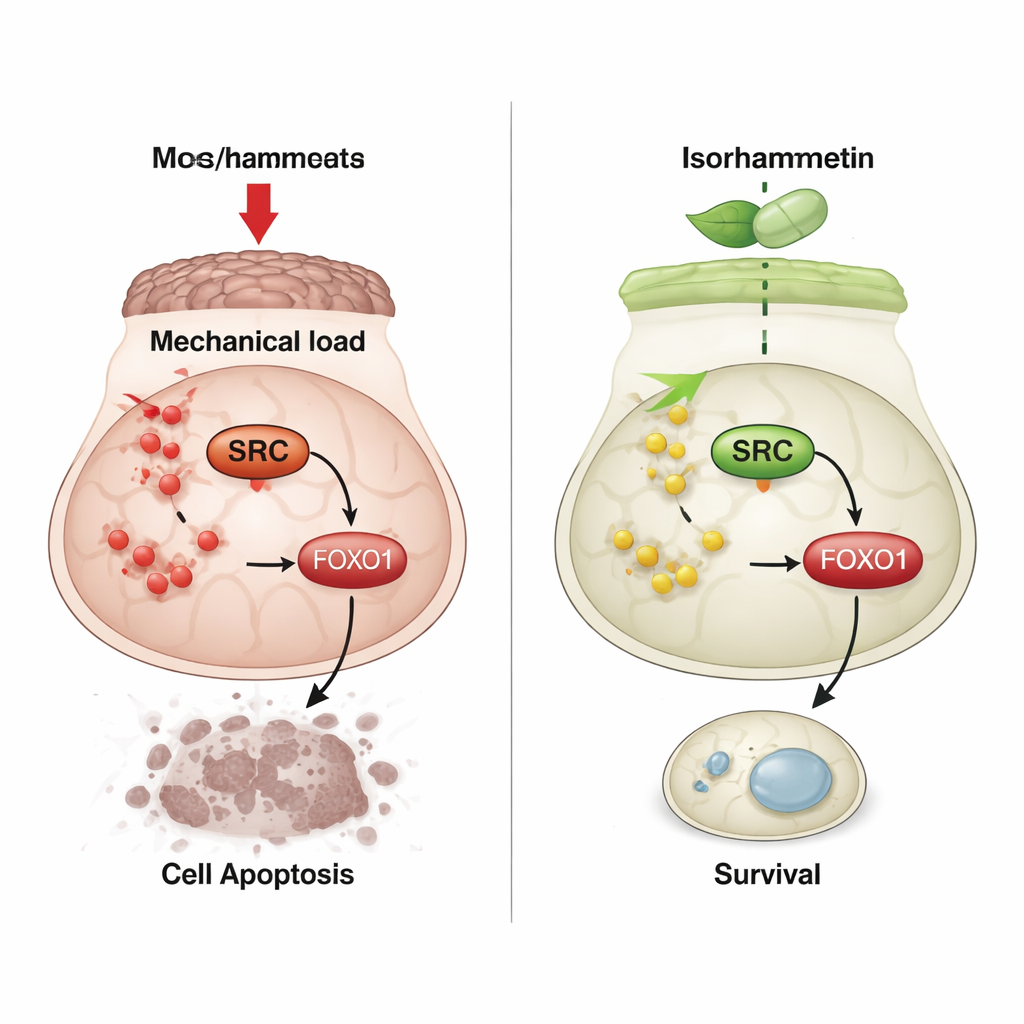
To understand how isorhamnetin works, the team traced the chemical “conversation” occurring inside overloaded cartilage cells. They focused on a chain of events involving reactive oxygen species (ROS), tiny oxygen-based molecules that rise when cells are under stress; SRC, a signaling protein that responds to oxidative stress; and FOXO1, a protein that helps control genes involved in cell survival and antioxidant defenses. Under harmful mechanical loading, ROS levels climbed, SRC became more active, FOXO1’s protective function was reduced, and markers of cell death increased. Isorhamnetin reversed many of these changes: it lowered stress signals, shifted the balance toward survival proteins, and reduced activation of the machinery that cuts cells apart during apoptosis.
Testing the limits of protection
The researchers then deliberately re‑activated the stress pathway to see whether they could undo isorhamnetin’s benefits. They used a small peptide that turns SRC back on, and hydrogen peroxide to raise ROS levels. Both interventions weakened the protective effects of isorhamnetin in pressured cells, restoring higher rates of cell death and damaging changes in key proteins. These experiments support the idea that isorhamnetin’s main action is to interrupt the ROS–SRC–FOXO1 signaling route that links mechanical overload to cartilage cell loss.
What this could mean for sore necks
For people living with neck pain from worn spinal discs, this research does not yet offer a ready‑made cure, but it does point to a promising direction. By showing that a natural compound can reduce pressure‑induced loss of disc cells in animals and in lab-grown cells—and by mapping the key stress pathway involved—the study suggests that future drugs or refined plant-based treatments might slow disc degeneration rather than only mask symptoms. The work also reinforces a practical message: limiting prolonged forward head posture and other sources of excessive spinal loading may help protect the same vulnerable cartilage cells that isorhamnetin aims to defend.
Citation: Lai, J., Yin, G., Zhu, F. et al. Isorhamnetin inhibits mechanical stress-induced chondrocyte apoptosis through activation of the ROS/SRC/FOXO1 signaling pathway. Sci Rep 16, 5106 (2026). https://doi.org/10.1038/s41598-026-36249-z
Keywords: neck pain, intervertebral disc degeneration, cartilage cells, mechanical stress, isorhamnetin