Clear Sky Science · en
Research on coupling coordination of new quality productive forces and innovation resource allocation based on MLP neural networks
Why the Future of Growth Depends on Smarter Innovation
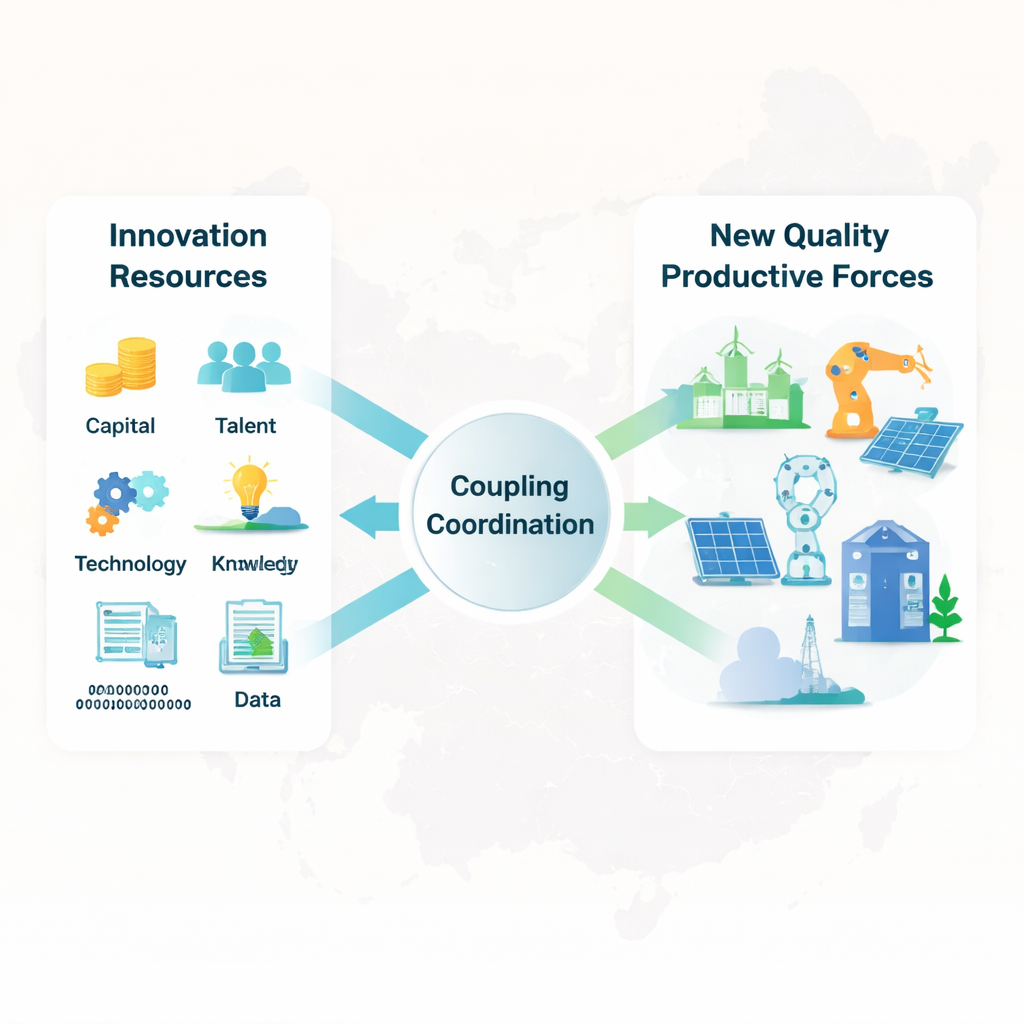
As economies race to stay competitive and sustainable, governments are searching for growth that is not just bigger, but better—more innovative, more digital, and more climate‑friendly. This study looks at how well China is lining up its innovation resources—money, talent, data, and technology—with what the country calls "new quality productive forces": advanced, green, and intelligent ways of producing goods and services. By uncovering how tightly these two sides move together, the research offers clues about which regions are poised to thrive in the next wave of economic transformation—and which risk being left behind.
New Engines of Growth, Not Just More of the Same
Traditional economic growth often meant using more labor, land, and energy to churn out more products. New quality productive forces flip that script. They emphasize smarter workers, intelligent tools, digital infrastructure, and cleaner energy—aiming for higher value with fewer resources. In this study, these new forces are broken into three parts: new laborers (better educated, more innovative workers), new labor materials (robots, artificial intelligence firms, digital platforms, and communication networks), and new labor objects (clean energy, advanced materials, and ecological protection). Together, they form a picture of an economy that relies less on smokestacks and more on chips, code, and carbon‑saving technologies.
Innovation Resources: The Fuel Behind the Machine
On the other side of the equation lies the innovation system itself: the capital, people, technologies, knowledge, and data that make advanced growth possible. The researchers build a detailed scoreboard of these resources across 30 Chinese provinces from 2012 to 2022. They track research and development spending, full‑time R&D staff, high‑tech firms and laboratories, knowledge creation and acquisition, and the digital backbone of websites, data platforms, and e‑commerce activity. The core question is not just how much of these resources exist, but how effectively they are directed toward building those new, high‑quality productive forces—how well the fuel matches the engine.
A Neural Network to Read the Hidden Patterns
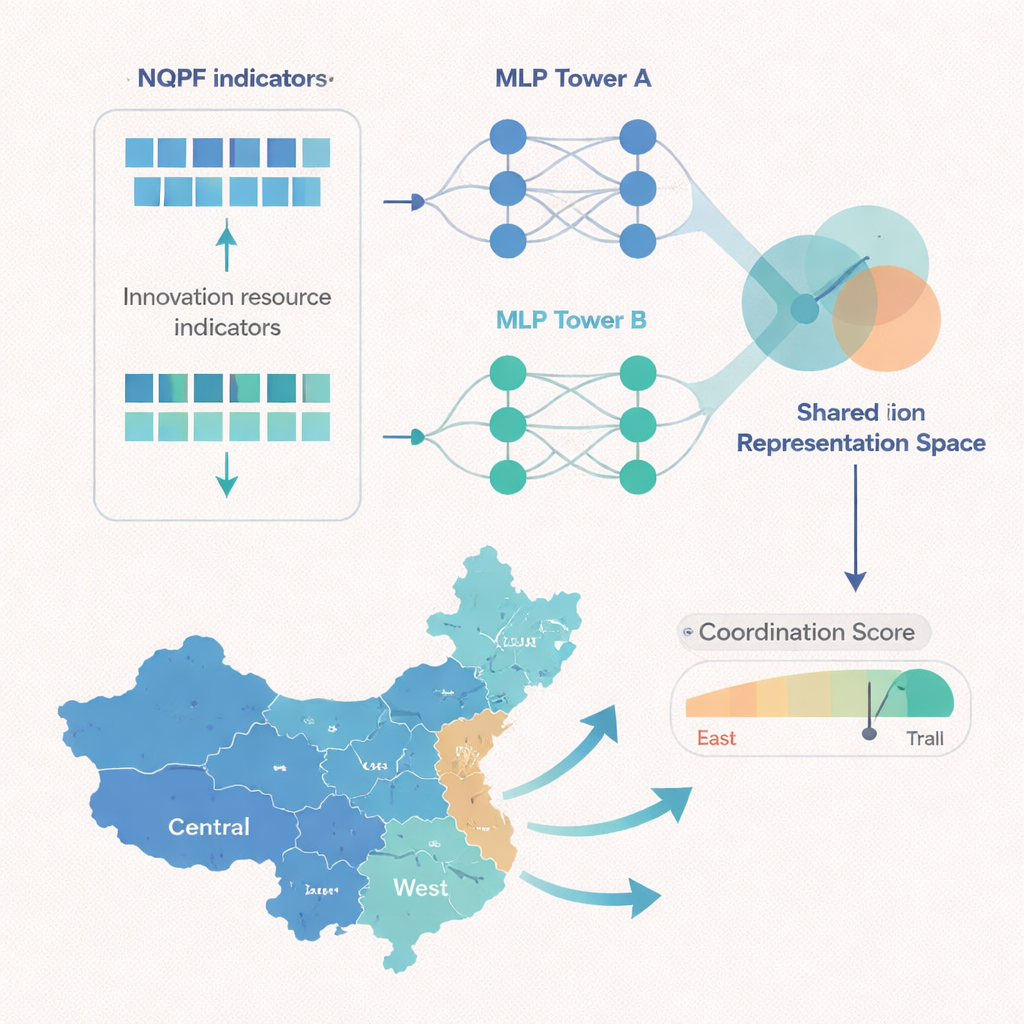
Measuring that match turns out to be tricky. Earlier methods relied on simple formulas that treated each indicator as a linearly weighted piece of a larger score. These could miss subtle, nonlinear relationships—for example, the way innovation benefits might suddenly accelerate once a region passes a certain threshold of talent or digital infrastructure. To overcome this, the authors use a dual‑tower multilayer perceptron, a type of neural network. One "tower" ingests the indicators for new quality productive forces, the other ingests the innovation resource indicators. The network then learns to align these two complex patterns without needing pre‑labeled answers, effectively discovering how closely the two systems move together and producing a coordination score between zero and one.
Where Regions Are Advancing—and Where They Lag
The neural‑network‑based scores show that, while China as a whole is still in an early stage of aligning innovation with advanced production, coordination has been steadily improving over the past decade. Yet the map is far from even. Eastern coastal provinces such as Beijing, Shanghai, and Guangdong form high‑level clusters, where concentrated innovation resources and strong digital and green industries reinforce each other, producing what the authors call a "synergy premium." Central provinces are catching up gradually, helped by industrial upgrading. Western regions, however, often remain stuck at lower levels of coordination, with only a few bright spots. Spatial analysis reveals clear clustering: high‑coordination regions tend to lift their neighbors, while low‑coordination areas risk falling into a pattern where "the strong get stronger and the weak get weaker."
How the Future Might Unfold
By tracing how provinces move between low, medium, high, and very high coordination levels over time, the study finds that change is possible but slow. Regions usually stay in their current category; big jumps are rare. Those already in the top tier are especially likely to remain there, benefiting from self‑reinforcing advantages in infrastructure, talent, and policy support. When a province is surrounded by high‑performing neighbors, its chances of improving rise, thanks to knowledge spillovers, shared supply chains, and imitation of successful policies. This suggests that cross‑regional cooperation—rather than isolated, province‑by‑province efforts—will be essential for spreading the benefits of the new growth model.
What It All Means for Ordinary People
For a layperson, the main takeaway is that the quality of future jobs, incomes, and local environments depends on how well innovation resources are woven into everyday economic activity. Provinces that succeed in pairing research spending, skilled workers, and digital tools with clean, advanced industries are likely to see more resilient growth and greener cities. Those that fail to coordinate these elements risk being locked into low‑value, high‑pollution paths. By using modern artificial intelligence to detect where coordination is strong, weak, or just emerging, this study provides a kind of early‑warning system. It points policymakers toward targeted investments—in digital infrastructure, cross‑regional partnerships, and smarter resource allocation—that can help more regions share in the gains of a high‑quality, innovation‑driven economy.
Citation: Liu, Y., Wang, L., Chen, B. et al. Research on coupling coordination of new quality productive forces and innovation resource allocation based on MLP neural networks. Sci Rep 16, 5196 (2026). https://doi.org/10.1038/s41598-026-36247-1
Keywords: innovation policy, regional development, machine learning in economics, digital economy, sustainable growth