Clear Sky Science · en
Environmental pollutants associated with blood glucose levels in healthy individuals
Everyday chemicals and your blood sugar
Many of us try to avoid too much sugar on our plates, but we rarely think about the invisible chemicals around us that may also nudge our blood sugar upward. This study asks a simple but important question: can common pollutants found in air, consumer products, and personal care items quietly influence blood sugar even in people who do not have diabetes? The answer matters because small, early shifts in blood sugar can set the stage for diabetes years before it is diagnosed.
Why early changes in blood sugar matter
Type 2 diabetes is one of the fastest growing health problems worldwide, and China now carries a large share of the global burden. Classic risk factors like excess weight, family history, and lack of exercise explain only about half of all cases. That gap has led scientists to look closely at the wider environment. Earlier research linked air pollution and several industrial chemicals to diabetes, mostly by studying people who already had the disease. The new work focuses instead on adults whose fasting blood sugar is still in the normal range, to see whether pollution is already linked to subtle elevations that could foreshadow trouble.
Taking a chemical fingerprint of everyday life
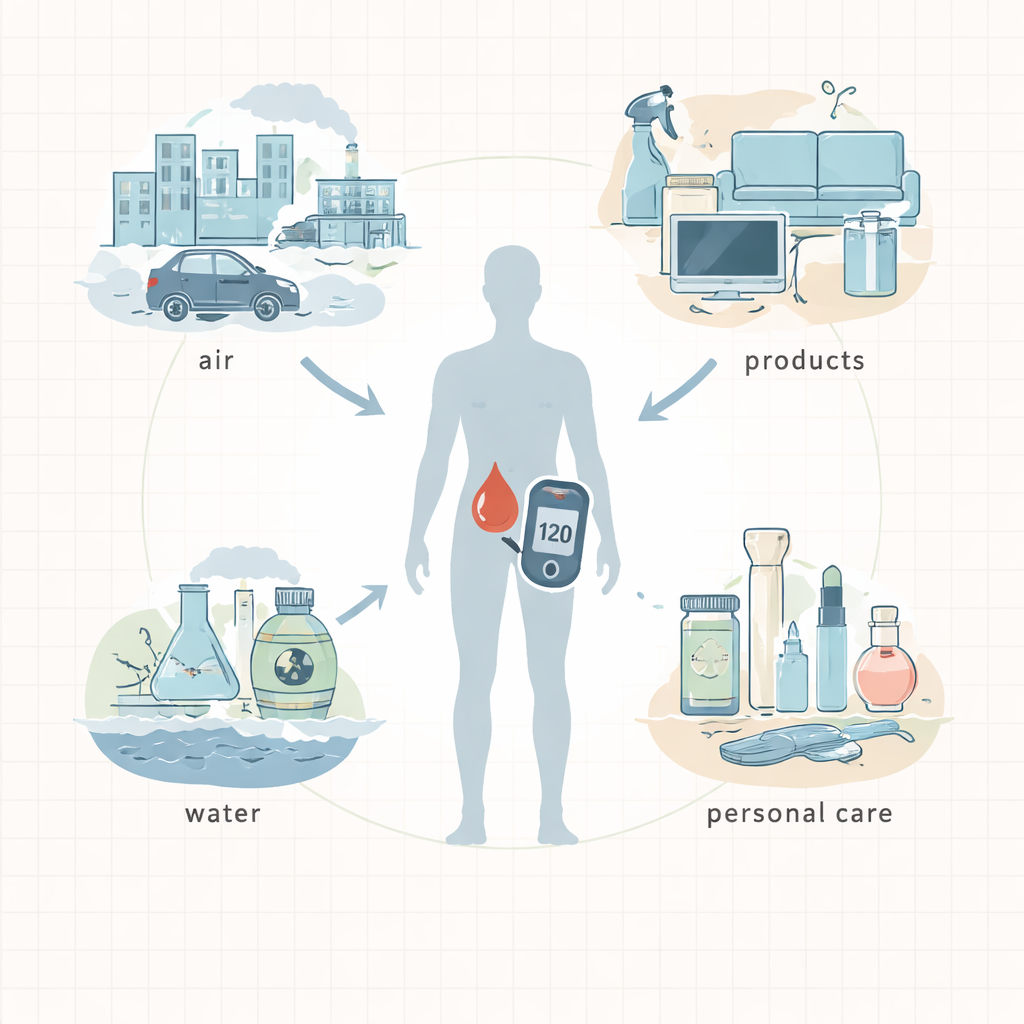
Researchers in northern China recruited 307 adults who came for routine health checkups and had no history of diabetes, high blood pressure, or cancer. After an overnight fast, participants gave blood samples and had their height, weight, and blood pressure measured. One part of each blood sample was used to measure fasting blood sugar and fats such as cholesterol; another part was carefully prepared and frozen so that scientists could scan it for traces of 203 different pollutants. Using a highly sensitive technique called mass spectrometry, they captured a kind of chemical fingerprint for each person, spanning substances from vehicle exhaust, plastics, flame retardants in furniture and electronics, pesticides, and ingredients of cosmetics and sunscreens.
Six key pollutants that track with blood sugar
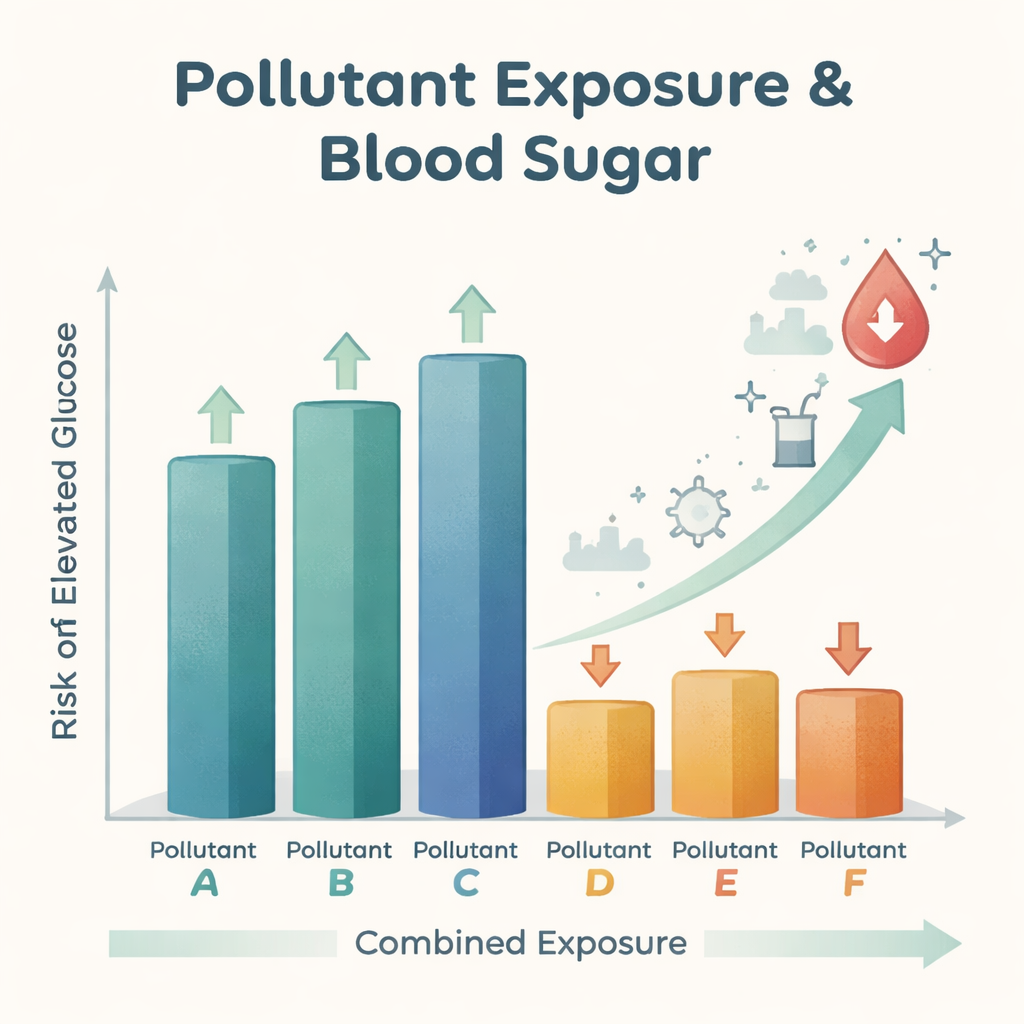
The team split people into two groups: 230 with lower fasting blood sugar and 77 with higher but still non‑diabetic levels. They then compared the chemical fingerprints between these groups. Most pollutants did not differ much, but six stood out. Three chemicals—known by their technical names benzil, α‑HBCD (a brominated flame retardant), and 4‑MBC (a common UV filter in sunscreens and cosmetics)—were found at higher levels in people with higher blood sugar. Even after accounting for age, sex, weight, blood pressure, and cholesterol, people with more of these three substances in their blood were more likely to fall into the higher‑glucose group. By contrast, three other chemicals (IPPD, PES, and TDCIPP) appeared more often in people with lower blood sugar, a pattern that previous studies do not fully explain and that may reflect complex, dose‑dependent body responses rather than true protection.
The power of mixtures, not just single chemicals
Real life exposure rarely involves one chemical at a time, so the researchers also asked how the six pollutants behave as a mixture. Using advanced statistical methods designed to handle many exposures at once, they created a combined score that reflected a person’s overall burden of these substances. As this score rose, so did the odds of having elevated fasting blood sugar. A modest increase in the combined exposure was linked to a marked jump in risk, and models that allowed for non‑linear relationships suggested that moving from typical to somewhat higher exposure could multiply the chance of higher blood sugar several fold. Among the six chemicals, the sunscreen ingredient 4‑MBC and the flame retardant α‑HBCD carried the greatest weight in driving this combined effect.
What this means for everyday health
While the study cannot prove cause and effect—because it took a single snapshot in time and involved a few hundred people—it does show that common pollutants, already present in the blood of healthy adults, tend to move in step with fasting blood sugar. The findings hint that long before diabetes is diagnosed, our bodies may be quietly responding to a chemical mix from the products we use, the air we breathe, and the materials that surround us. For the general public, this work underscores the value of policies and personal choices that limit unnecessary chemical exposures, and it suggests that preventing diabetes may require thinking not only about food and exercise but also about the hidden chemistry of modern life.
Citation: Liu, X., Peng, G., Lin, Y. et al. Environmental pollutants associated with blood glucose levels in healthy individuals. Sci Rep 16, 5592 (2026). https://doi.org/10.1038/s41598-026-36243-5
Keywords: environmental pollutants, blood sugar, diabetes risk, chemical exposure, endocrine disruptors