Clear Sky Science · en
The effect of dopamine D2-like receptor blockade on human motor performance and skill acquisition
Why a brain chemical matters for everyday movements
Whether we are learning to play the piano, type on a keyboard, or button a shirt after an injury, our brains must turn clumsy first attempts into smooth, automatic actions. This study asks how one specific brain chemical signal, carried by dopamine D2-like receptors, shapes that process. By briefly blocking these receptors in healthy adults, the researchers could observe how much this system matters for learning and performing a new hand skill, with direct implications for conditions like Parkinson’s disease and for motor rehabilitation.
Testing learning with a squeeze-based video game
To probe motor learning, the team recruited 23 young adults to perform a demanding hand task that mimicked real-world precision movements. Participants pinched a small sensor between thumb and finger to steer a cursor across a computer screen through five colored targets as quickly and accurately as possible, following a fixed color sequence. The task was intentionally tricky: the link between squeeze force and cursor movement was warped in different ways across two versions of the task, so people had to discover not only the correct order of targets but also how hard to squeeze. This combination of “what to do” and “how to do it” reflects the kind of complex learning needed in everyday skills. 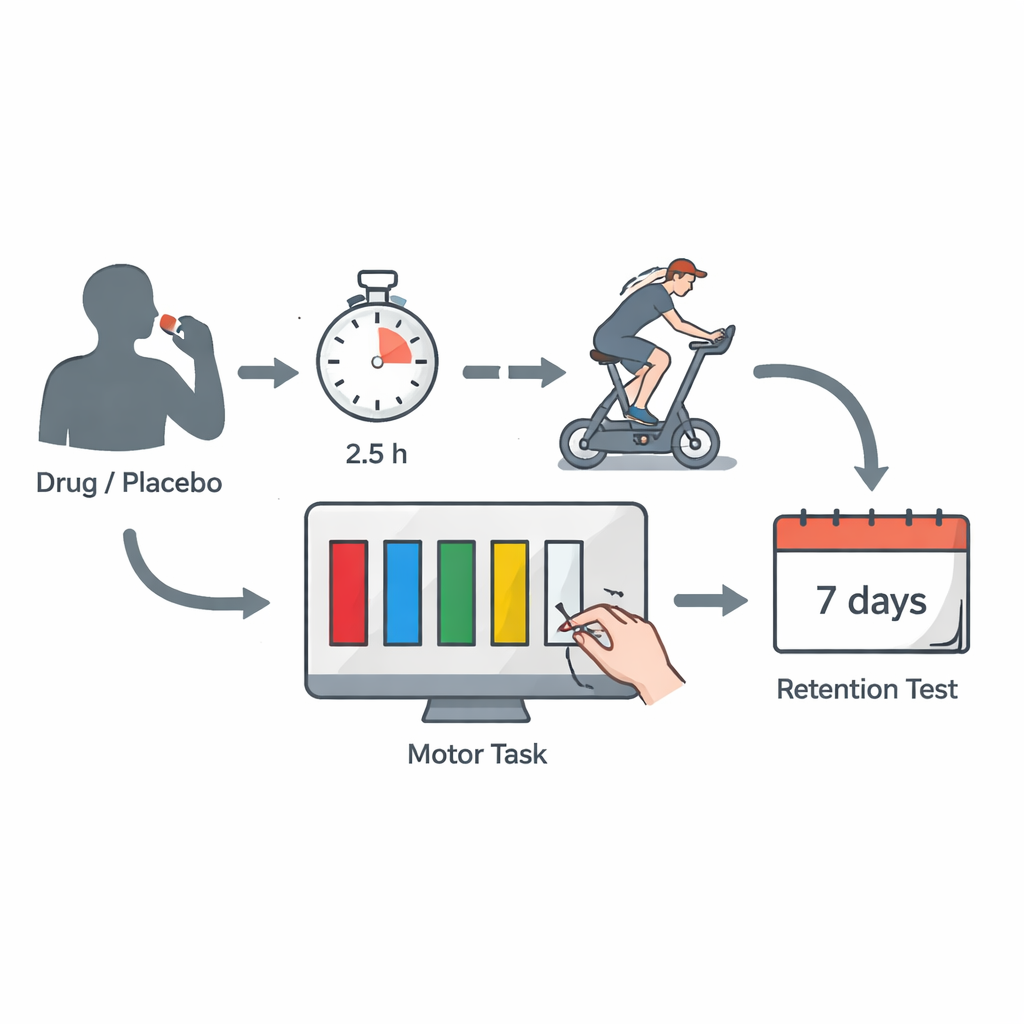
Carefully controlled drug and exercise schedule
Each participant attended two long laboratory sessions plus follow-ups. In one session they swallowed an 800 mg capsule of sulpiride, a drug that selectively blocks dopamine D2-like receptors; in the other they took a look‑alike placebo, with the order randomized and double-blinded so neither participants nor experimenters knew which was which at the time. About two and a half hours later—when drug levels were expected to peak—they completed 20 minutes of high‑intensity interval cycling, designed both to boost learning and counter mild drowsiness from the drug. Roughly three hours after ingestion, they trained on one version of the hand task for 12 blocks of trials. A week later they returned drug‑free to perform a shorter “retention” test on the same task, revealing how well the skill had been stored.
Blocking D2-like receptors hurt early performance but not long-term memory
During the initial learning session, participants improved over time in both the drug and placebo conditions—but with a key difference. When D2-like receptors were blocked by sulpiride, gains in overall skill were smaller in the first session: people squeezed less accurately, even though their speed and basic strength were unchanged. Under placebo, accuracy improved more steeply across practice. However, by the time of the retention test a week later, when no drug was present, overall skill levels were similar regardless of whether sulpiride or placebo had been taken during original training. This suggests that the drug mainly impaired how well people could perform the skill while learning, rather than their ability to form a lasting memory trace of it.
Different trade-offs between speed and precision
A closer look revealed a subtle shift in strategy. For tasks learned during the first session, those who had trained under placebo tended to come back a week later and perform the task faster, accepting a modest drop in accuracy—as if increased confidence allowed them to move more boldly. In contrast, participants who had trained under sulpiride returned and performed more accurately but more slowly, as though compensating for earlier difficulty by playing it safe. These patterns highlight that dopamine D2-like signalling not only supports accurate execution of a new movement sequence, but may also influence how people balance speed against precision once the skill is familiar. 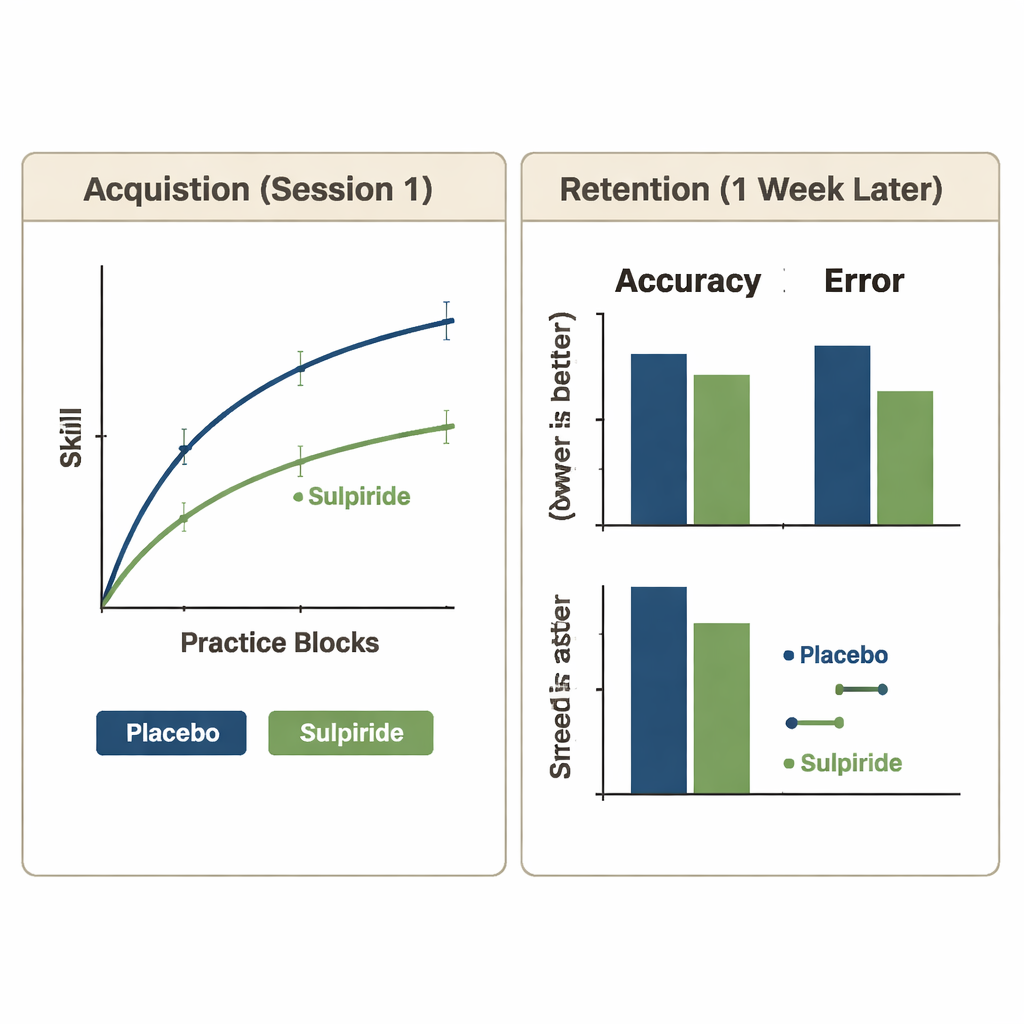
What this means for patients and recovery
For non-specialists, the takeaway is that one branch of the brain’s dopamine system, acting through D2-like receptors, seems particularly important when we first encounter a new motor challenge. Temporarily dampening this signal made people less accurate during early learning and nudged them toward slower, more cautious performance later on, even though they ultimately stored the skill about as well. In practical terms, conditions that reduce dopamine transmission—such as Parkinson’s disease or some medications—may especially hinder the first stages of relearning everyday actions after injury or illness, and may slow how confidently those actions are later carried out. Understanding this balance between performance and memory could help clinicians tailor rehabilitation strategies, for example by adjusting task difficulty, feedback, or medication timing to support both accurate practice and long‑term recovery of fine motor skills.
Citation: Taylor, E.M., Curtin, D., Chong, T.TJ. et al. The effect of dopamine D2-like receptor blockade on human motor performance and skill acquisition. Sci Rep 16, 5857 (2026). https://doi.org/10.1038/s41598-026-36241-7
Keywords: dopamine, motor learning, skill acquisition, exercise, Parkinson’s disease