Clear Sky Science · en
Adsorption of 2 chlorophenol from water using magnetic activated carbon attained palm fibers and its isotherm and kinetic insight
Turning Farm Waste into Clean Water Helpers
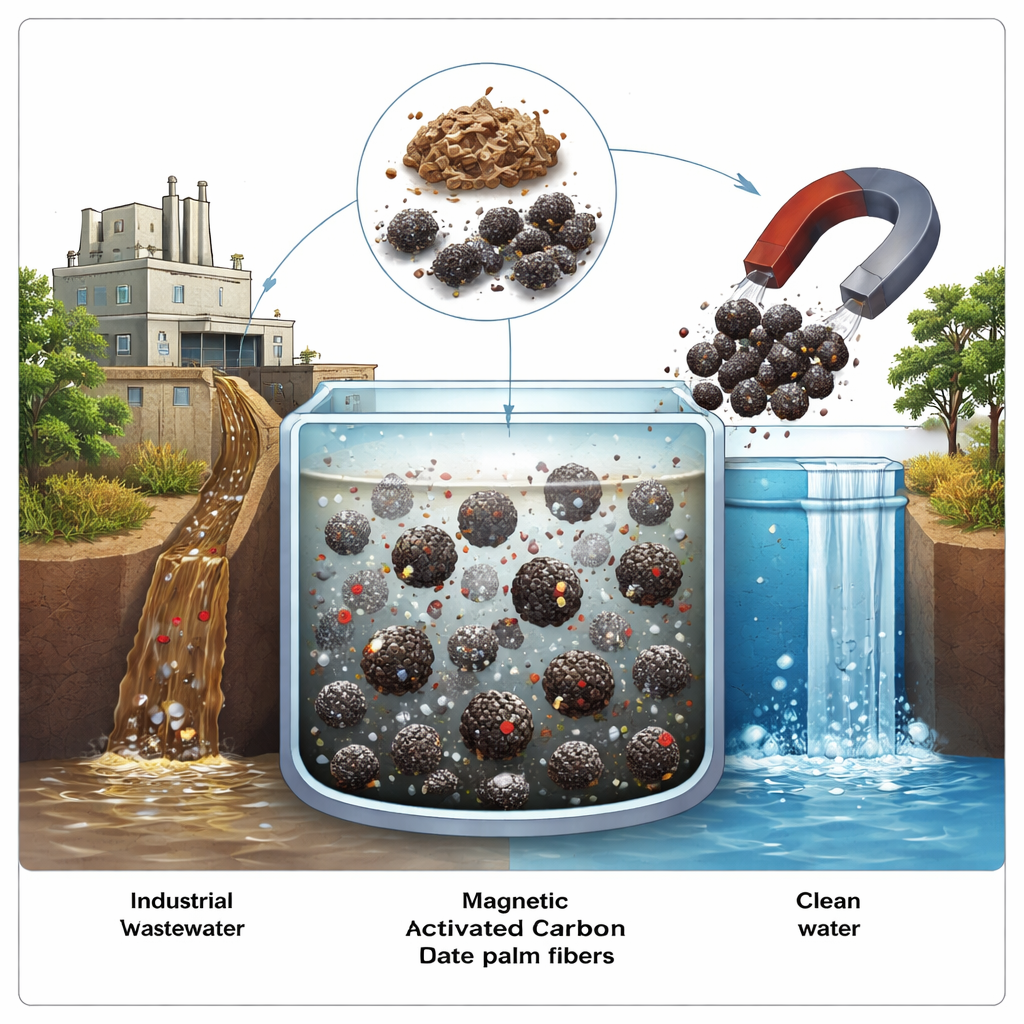
Many regions struggle with water supplies polluted by stubborn industrial chemicals that are hard to break down and can harm human health. This study explores a surprisingly simple idea with big potential: transforming waste fibers from date palm trees into tiny magnetic sponges that pull a toxic pollutant called 2-chlorophenol out of water. Because the material is cheap, made from agricultural leftovers, and easy to recover with a magnet, it points toward more affordable and sustainable ways to make dirty water safer.
A Hidden Threat in Everyday Water
Chlorophenols are a family of man-made chemicals used in pesticides, antiseptics, and various chemical industries. One member of this family, 2-chlorophenol, can also form unintentionally when water containing certain contaminants is disinfected with chlorine. These compounds are toxic, have strong tastes and odors, and do not break down easily in the environment, so even small releases can contaminate rivers, lakes, and groundwater. Before wastewater is discharged, 2-chlorophenol needs to be removed to protect both ecosystems and people who rely on these water sources.
From Date Palm Fibers to Magnetic Sponges
The researchers focused on turning an abundant local waste material—fibers from date palm trees in southern Iran—into a powerful cleaning tool. First, they heated the fibers in the absence of air to create a porous charcoal-like material known as activated carbon. Then they attached tiny iron oxide particles to its surface, making the grains magnetic. This composite, called magnetic activated carbon from palm fibers (MAC-PF), combines a very large internal surface area for trapping pollutants with the convenience of being pulled out of water using a magnet instead of cumbersome filtration.
How Well the Material Cleans Polluted Water
To test performance, the team mixed the magnetic carbon with water containing known amounts of 2-chlorophenol and varied conditions such as acidity (pH), contact time, pollutant concentration, and the amount of adsorbent added. At a mildly acidic to neutral pH of 6, using 1 gram of MAC-PF per liter of water with 150 milligrams per liter of 2-chlorophenol, more than 90 percent of the pollutant was removed within an hour. Detailed measurements showed that the material could hold up to about 303 milligrams of 2-chlorophenol per gram of adsorbent, placing it among the stronger performers compared with many similar materials reported in other studies.
What Happens on the Surface
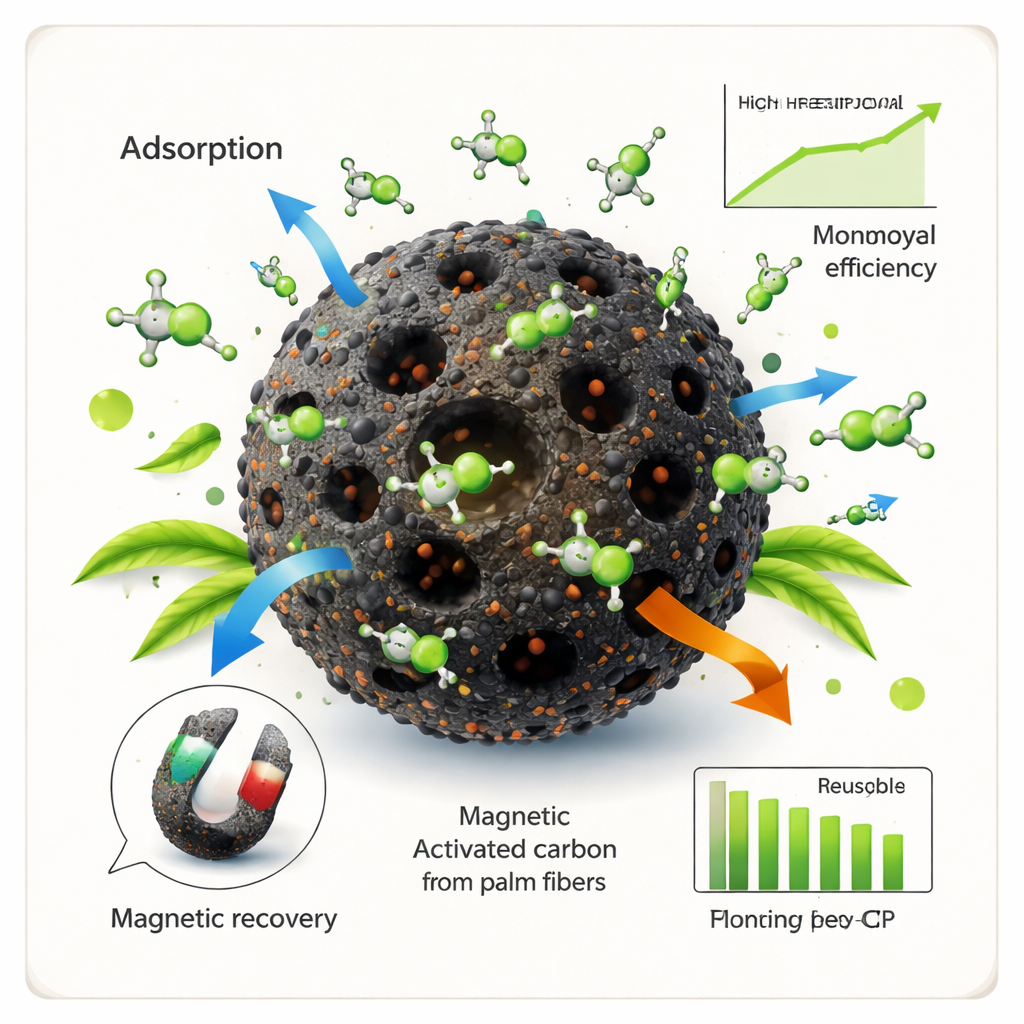
Measurements using techniques such as infrared spectroscopy, electron microscopy, and surface-area analysis revealed why the material works so efficiently. The palm-fiber carbon becomes highly porous, with pores mostly in the tiny "micropore" range that provide a huge internal area for molecules to stick to. The iron oxide nanoparticles are well distributed on the surface, giving the grains magnetic behavior without blocking the pores. By analyzing how quickly 2-chlorophenol disappears from the water and how much the surface can hold at different concentrations, the researchers concluded that the pollutant forms a single, orderly layer on the carbon surface and that the process is governed mainly by chemical bonding rather than just physical sticking.
Reusing the Same Material Again and Again
A practical water treatment material must be reusable; otherwise, it simply trades one waste problem for another. After each cleaning cycle, the team washed the magnetic carbon, dried it, and used it again. Over five cycles, removal efficiency dropped only modestly—from about 90.5 percent to 82.9 percent—showing that the material keeps most of its cleaning power. Salt in the water reduced performance somewhat, but the system still worked reasonably well, suggesting it could handle realistic wastewater conditions where other dissolved substances are present.
What This Means for Safer Water
For a non-specialist, the key takeaway is that an agricultural by-product—date palm fibers that might otherwise be burned or discarded—can be turned into a high-performance, magnetically retrievable filter for a toxic industrial chemical. The material removes 2-chlorophenol efficiently, works best under mild conditions that are easy to achieve in real treatment plants, and can be reused several times without major loss of effectiveness. This approach offers a promising, lower-cost path toward cleaning up hazardous chemicals in water, and similar magnetic carbons from other plant wastes could be adapted to tackle a wide range of pollutants.
Citation: Rahmani, M.A., Jafari, K., Tadayoni, N.S. et al. Adsorption of 2 chlorophenol from water using magnetic activated carbon attained palm fibers and its isotherm and kinetic insight. Sci Rep 16, 6187 (2026). https://doi.org/10.1038/s41598-026-36239-1
Keywords: water purification, wastewater treatment, activated carbon, chlorophenol pollution, biomass adsorbent