Clear Sky Science · en
Origin of giant dielectric permittivity and localized polaron-supported electrical conduction in CaCu3Ti4O12 for extreme environment energy storage applications
Why super-capacitor ceramics matter
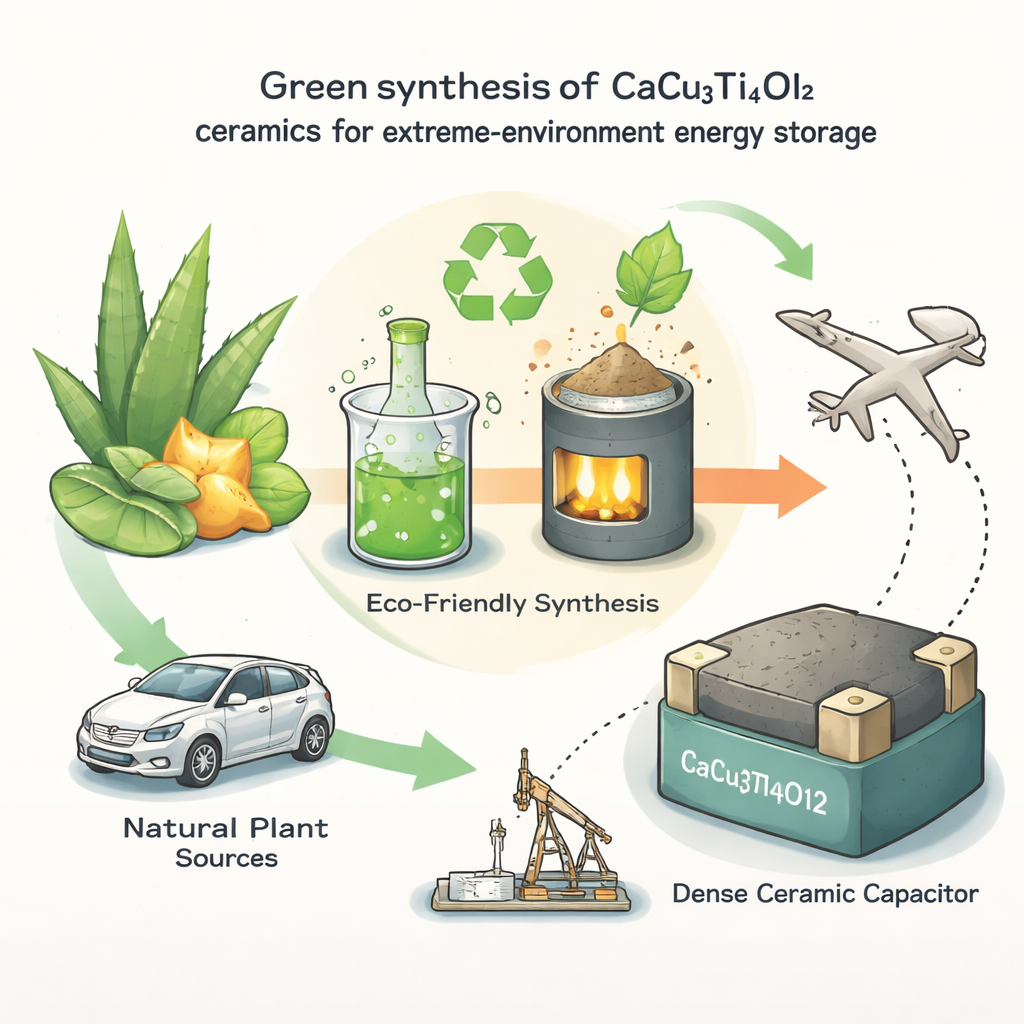
Modern electronics—from electric cars to aircraft and deep-well sensors—need components that can safely store and release electrical energy even when temperatures soar. This study explores a special ceramic, CaCu3Ti4O12 (often shortened to CCTO), that shows an unusually large ability to store electric charge while still working at temperatures far above those encountered in everyday devices. The researchers also show how this material can be made in a more environmentally friendly way, using plant extracts instead of toxic chemicals.
Turning fruit juice into high-tech material
Instead of relying on conventional chemical routes that often use harsh solvents and high energy, the team prepared CCTO using a "green" synthesis. They mixed common metal salts with a blend of aloe vera gel and star fruit juice, whose natural acids and jelly-like texture help form a uniform gel. When gently heated and then fired in a furnace, this gel turns into a fine ceramic powder that can be pressed into dense pellets. X-ray and Raman measurements confirmed that the resulting material has the correct crystal structure and composition, without unwanted impurity phases—crucial for consistent electrical performance.
What the ceramic looks like inside
Microscope images revealed that the green-synthesized CCTO forms a tightly packed network of grains with very little porosity, a sign of good sintering. Chemical analysis showed the elements calcium, copper, titanium and oxygen present in the ideal 1:3:4:12 ratio. In this material, the metal atoms sit in a highly ordered three-dimensional framework of oxygen, with copper atoms in a somewhat distorted square environment and titanium atoms in octahedra. These distortions and tilts in the atomic arrangement are not just structural details—they are intimately tied to how the material polarizes and conducts when an electric field is applied.
How it stores charge at extreme temperatures
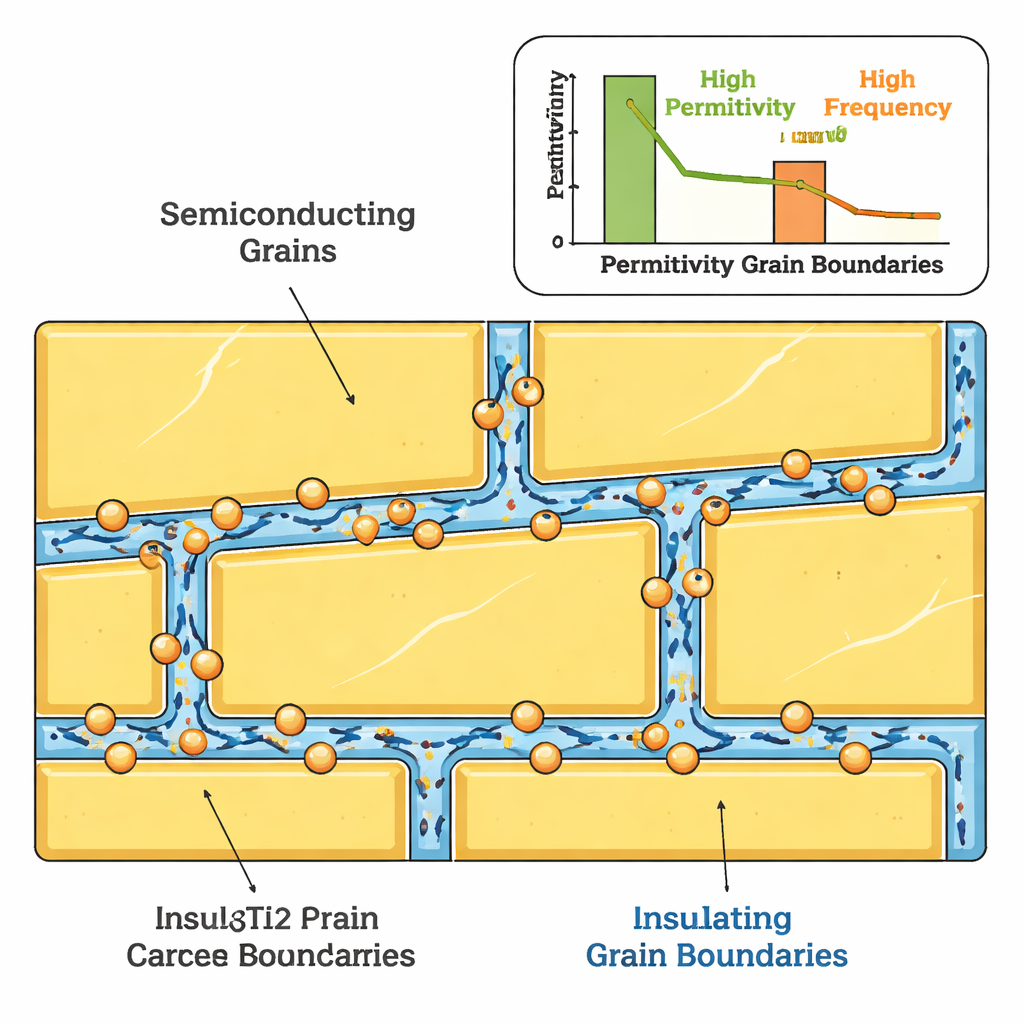
To understand performance under real-world conditions, the authors measured how the material responds to alternating electric fields over a wide range of frequencies (from 100 Hz to 1 MHz) and temperatures (from about 35 °C up to 500 °C). They found that CCTO exhibits a giant dielectric constant—around 9,500 at room temperature and low frequency—which means it can store vastly more charge than common capacitor materials. This value rises even further at higher temperatures. The key lies in the microstructure: the interior of each grain is relatively conducting, while the thin regions between grains act as good insulators. Together they behave like a stack of tiny capacitors, an effect known as an internal barrier layer. As charges pile up at these internal barriers, they create a huge overall capacitance with relatively modest energy loss, especially at lower temperatures and frequencies.
Hidden charge motion: hopping and relaxation
Beyond simple charge storage, the study probes how charges actually move through the ceramic. By analyzing how resistance and capacitance change with temperature, the team concludes that small, localized charges—known as polarons—hop between slightly different atomic sites, such as between different oxidation states of copper and titanium. At lower temperatures, quantum tunneling allows charges to move with little thermal energy. At higher temperatures, a different process dominates, in which charges hop over energy barriers in a correlated way. The material’s impedance and “modulus” spectra, which separate grain and grain-boundary effects, show that this hopping motion and the blocking action of grain boundaries together produce both the giant dielectric constant and the temperature-dependent conduction. Importantly, the dielectric behavior remains stable over a broad temperature range, even as the details of the hopping mechanism evolve.
What this means for future devices
Put in simple terms, this work demonstrates a ceramic that behaves like a dense forest of built‑in capacitors, created using plant-based chemistry rather than harsh industrial processes. The material can hold large amounts of electric charge, loses relatively little energy as heat, and maintains these properties at temperatures where many conventional materials would fail. By linking the atomic structure, microstructure and charge-hopping processes, the authors show why CCTO is a promising candidate for compact, reliable capacitors in electric vehicle power systems, aerospace electronics and sensors that operate in hot, demanding environments.
Citation: Karmakar, S., Ashok, K., Basha, N.H. et al. Origin of giant dielectric permittivity and localized polaron-supported electrical conduction in CaCu3Ti4O12 for extreme environment energy storage applications. Sci Rep 16, 6994 (2026). https://doi.org/10.1038/s41598-026-36234-6
Keywords: high-k dielectrics, energy storage ceramics, green synthesis, grain boundary effects, polaron hopping