Clear Sky Science · en
Experimental study on reinforcement treatment of coastal silty soft soil
Stronger Ground for Coastal Cities
Along many coasts, the land looks solid but behaves more like pudding than rock. In Ningbo Qianwan, a fast-growing industrial area on China’s shoreline, the upper layer of soil is a watery silt that squashes and shifts under weight. This study asks a practical question with global relevance: can we turn this weak, muddy ground into a safe base for roads and factories by mixing in a carefully designed chemical blend—made largely from industrial waste—rather than hauling in huge amounts of stone and sand?
Why Muddy Shores Are Hard to Build On
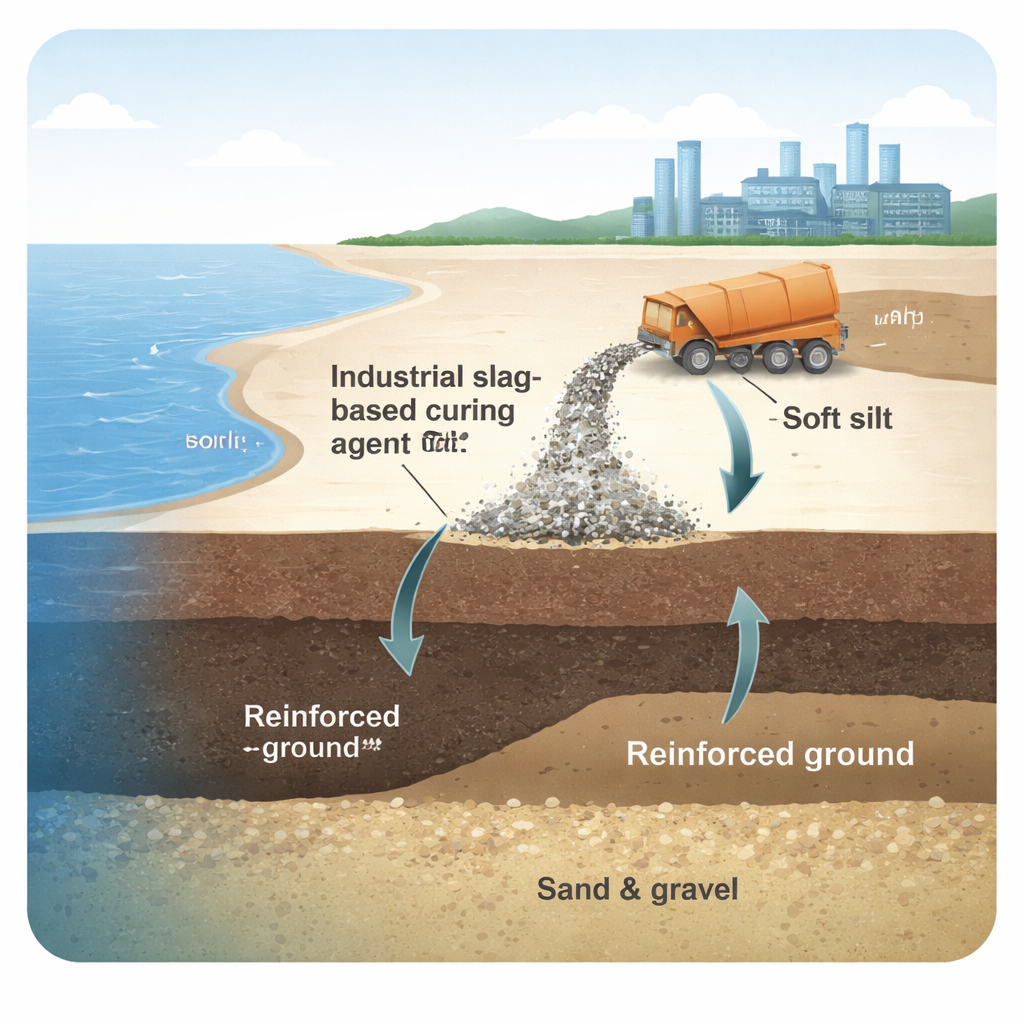
Ningbo Qianwan is attractive for development because it offers deep water for ships and room to create new land by filling in the shallows. But the surface layer, only about one to three meters thick, is soft silt with high water content and lots of empty space between grains. When roads or buildings are placed on top, this layer compresses unevenly, causing serious settling and deformation. Traditional fixes have been to dump rock to squeeze the mud aside or to pump in fine sand. In Qianwan, both approaches turned out to be expensive, difficult to control at depth, and potentially damaging to nearby waterways, while still leaving a risky, unstable foundation.
Turning Waste Slag into a Helpful Ingredient
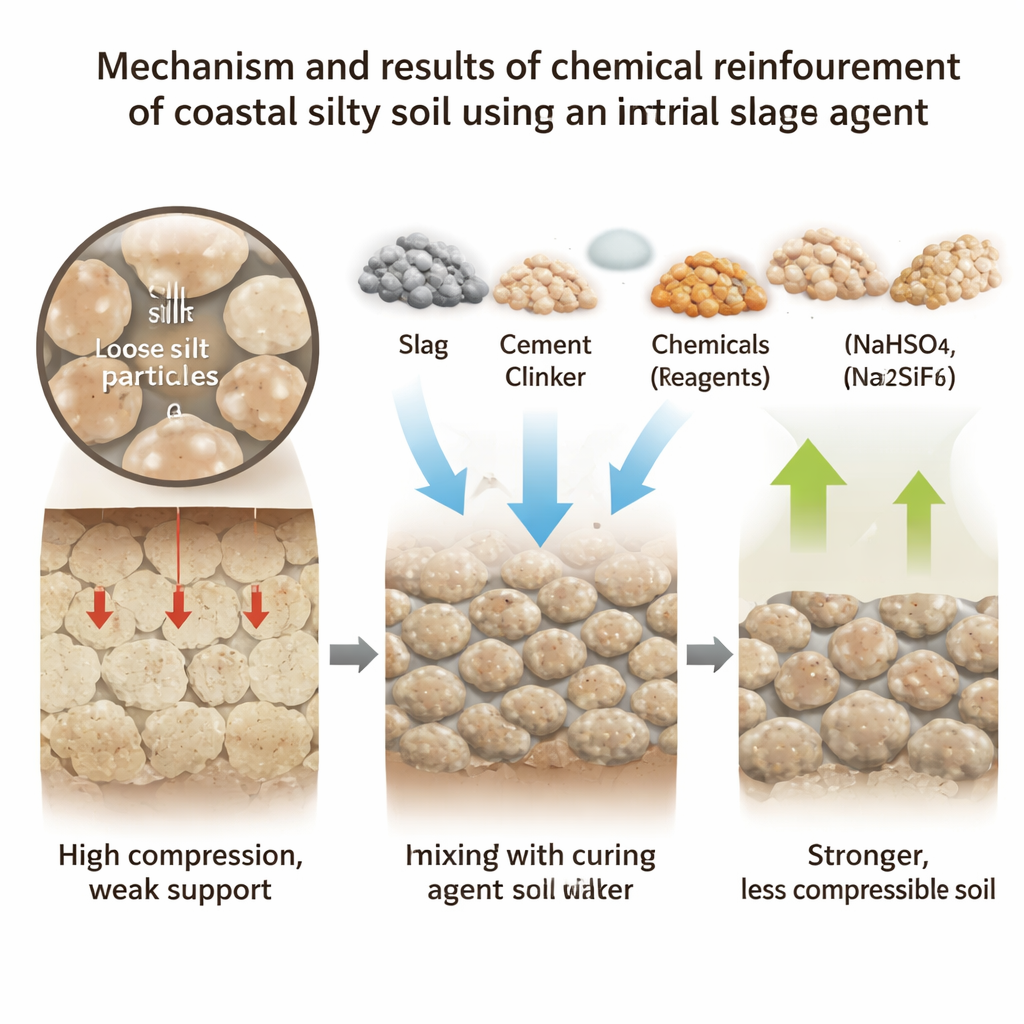
The researchers explored a different route: mixing a “curing agent” directly into the silt to harden it in place. The core ingredient is water‑quenched steel slag, a by‑product from the local steel plant that would otherwise be waste. This slag contains calcium, silicon, aluminum, and magnesium—elements that can form cement‑like bonds when properly activated. To wake up this potential, the team blended in small amounts of cement clinker and two chemical salts (NaHSO4 and Na2SiF6). Together in an alkaline, moist environment, these ingredients react to create glue‑like gels that fill the gaps between soil particles and tie them together into a stronger mass.
Designing the Best Recipe in the Lab
Rather than testing countless mixtures at random, the team used an “orthogonal” experimental design—a structured way of trying many combinations with relatively few samples. They systematically varied three factors: the amounts of clinker, NaHSO4, and Na2SiF6, at four levels each, across 16 test specimens made from real Qianwan silt. After mixing and molding these samples, they were kept in a humid environment for 28 days to allow the chemical reactions to develop. The researchers then measured how easily each sample compressed under load, an indicator of how much a treated foundation would settle in the field.
How Much Stronger the Treated Soil Became
The compression tests showed that chemically treated silt behaved like a medium‑ to low‑compressibility soil, close to what engineers aim for in practical foundations. Statistical analysis of the results pinpointed an “optimal” blend: 20% clinker, 4% NaHSO4, and 1% Na2SiF6 in the curing agent. To check that this recipe truly improved strength, the team compared three types of samples: one with the optimal recipe, one with the highest overall dosage they had tried, and one using only clinker without slag or salts. In unconfined compression tests, the optimal mix reached an average strength of 790 kilopascals, about 4.6 times higher than the clinker‑only sample. Even the heavier‑dosage mix did not perform as well, confirming that more additive is not always better—getting the proportions right matters more.
Practical Payoff for Coastal Development
For non‑specialists, the key takeaway is that the right chemical recipe can turn soft coastal mud into a much firmer, more reliable ground using mostly local industrial waste, rather than truckloads of imported stone. In Ningbo Qianwan’s case, a slag‑based curing agent with carefully tuned amounts of supporting chemicals significantly reduced how much the soil squashes and boosted its ability to carry weight. While future work is still needed to test how this treated soil behaves under long‑term traffic and environmental changes, the study offers a promising, more sustainable way to build stable foundations on muddy coasts—recycling waste while making new land safer to use.
Citation: Qin, P. Experimental study on reinforcement treatment of coastal silty soft soil. Sci Rep 16, 7688 (2026). https://doi.org/10.1038/s41598-026-36222-w
Keywords: coastal soft soil, soil stabilization, industrial slag reuse, foundation engineering, ground improvement