Clear Sky Science · en
Soil nitrous oxide and methane emissions in contrasting land use of the West African Sudanian savanna
Why soils in West Africa matter for the climate
The air above us is affected not only by factories and cars, but also by what happens quietly beneath our feet. In West Africa’s Sudanian savanna, farmers, herders and park rangers manage land in very different ways—from protected forests to rice paddies. This study asks how those choices change the amount of two powerful greenhouse gases, methane and nitrous oxide, that seep out of the soil into the atmosphere. Understanding these invisible exchanges can help guide farming and conservation practices that feed people while limiting their impact on the climate.
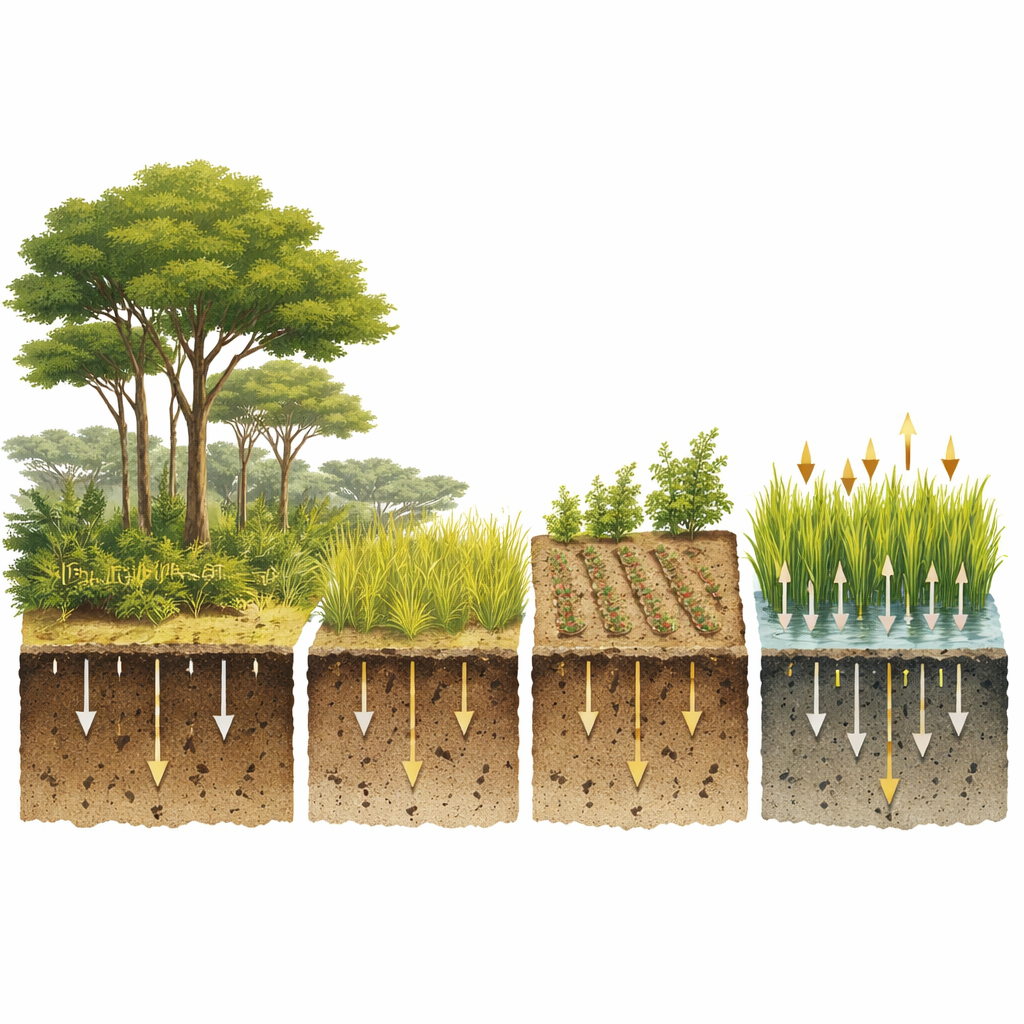
Four neighboring landscapes, four different stories
The researchers focused on four typical land uses in northern Ghana: a protected savanna forest, a grazed grassland, a mixed crop field, and a rainfed rice field in a low-lying area. All four sites lie within the same climate zone, with a single rainy season from May to October. That made it possible to compare how land use alone shapes greenhouse gas emissions. Over two rainy seasons (2023 and 2024), the team visited each site weekly and used closed chambers—small boxes placed over the ground—to trap and measure gases coming out of the soil. At the same time, they recorded soil moisture and temperature, and analyzed soil samples for carbon and nitrogen content.
Rice fields as hot spots, forests as quiet helpers
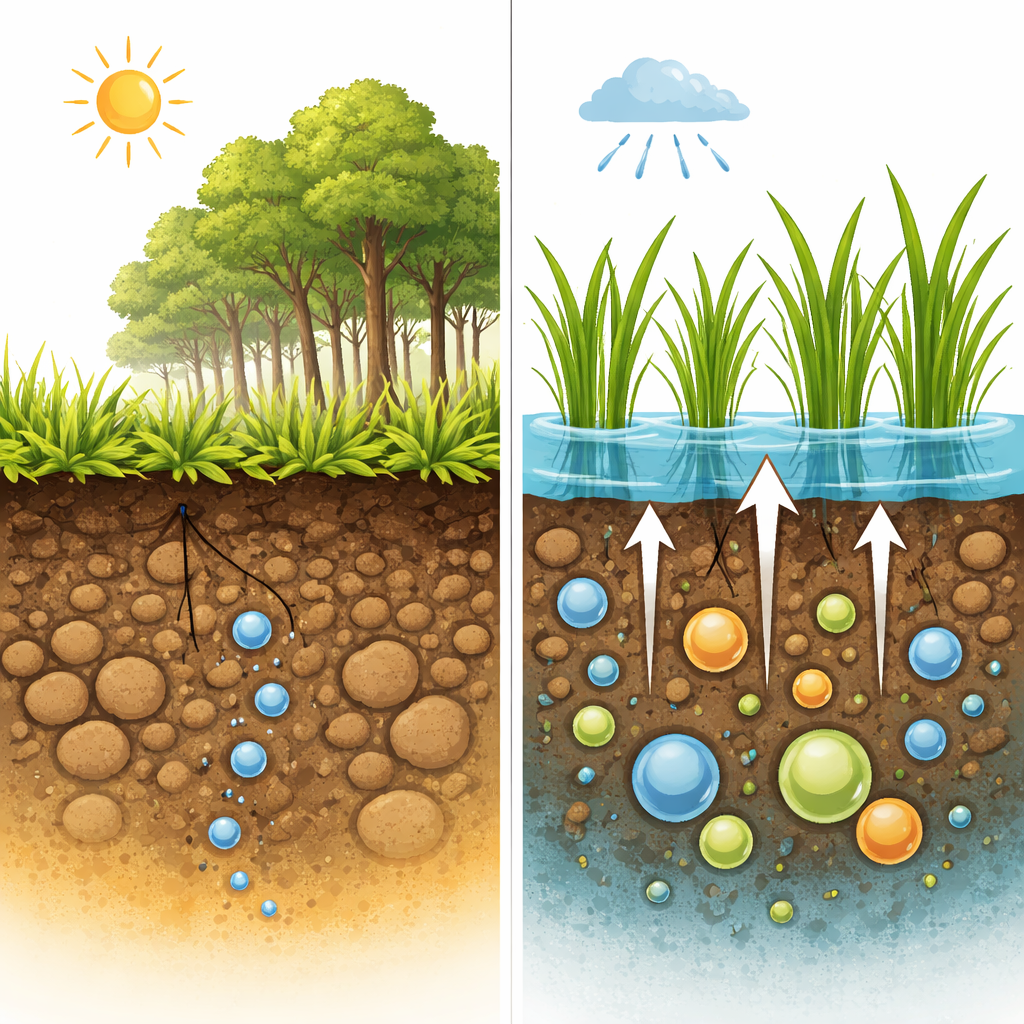
The measurements revealed striking contrasts in methane, a gas that traps much more heat per molecule than carbon dioxide. The rice field released by far the most methane over each season, especially later in the rains when the soil stayed saturated. In this waterlogged environment, oxygen becomes scarce in the soil and microbes switch to producing methane, which then escapes upward. At the opposite end of the spectrum, the forest reserve usually acted as a methane sink: its well-aerated soil actually consumed more methane from the air than it emitted. The grazed grassland tended to be a modest methane source, while the tilled cropland hovered near neutral or slightly absorbing methane, likely because ploughing and other disturbances break up the soil and reduce the stable, oxygen-poor pockets where methane-forming microbes thrive.
Another gas with a quieter but serious impact
Nitrous oxide told a subtler story. All four sites, from forest to rice field, were overall sources of this gas, but the amounts were small and surprisingly similar from place to place and year to year. Nitrous oxide arises from soil microbes as they transform nitrogen, particularly when fertilizers or manure add extra nutrients. In this region, however, nitrogen levels in the soil were generally low and fertilizer use modest, which seems to limit nitrous oxide production. Bursts of rain at the start of the wet season sometimes triggered short-lived spikes as long-dry soils suddenly rewetted, but these pulses did not add up to large seasonal differences among the land uses.
Water and warmth as hidden controls
By comparing gas measurements with soil conditions, the researchers could see which environmental factors mattered most. For methane, soil water content stood out as a key control, especially in the rice field and grassland. As soils became wetter during the rainy season, methane emissions generally rose, up to a point where long-lasting saturation allowed strong production. Soil temperature also played a role, but in an opposite direction: warmer soils tended to reduce methane uptake in drier sites and amplify emissions in wetter ones. In contrast, nitrous oxide fluxes showed only weak links to either soil moisture or temperature, reinforcing the idea that the limited nitrogen supply, rather than climate alone, keeps emissions muted.
What this means for farming and forests
To a non-specialist, the key message is that the same rain falling on different types of fields can lead to very different climate impacts. In this part of West Africa, rainfed rice paddies are important sources of methane, while intact savanna forests quietly remove some methane from the air. Grasslands and crop fields sit in between, contributing smaller amounts of methane but still releasing nitrous oxide. Although nitrous oxide is emitted in tiny quantities, it is extremely potent, so even modest losses from low-nitrogen soils matter when converted into carbon-dioxide equivalents. The study suggests that protecting forests, carefully managing water in rice fields, and avoiding unnecessary soil degradation could all help limit greenhouse gas emissions from the Sudanian savanna while maintaining food production and livelihoods.
Citation: Oussou, F.E., Kiese, R., Sy, S. et al. Soil nitrous oxide and methane emissions in contrasting land use of the West African Sudanian savanna. Sci Rep 16, 11398 (2026). https://doi.org/10.1038/s41598-026-36221-x
Keywords: savanna soils, methane emissions, nitrous oxide, West African agriculture, land use change