Clear Sky Science · en
The contributions of biological maturity and experience to fine motor development in adolescence
Why teen hand skills matter
From tying shoelaces and playing instruments to typing and gaming, teenagers constantly rely on quick, precise hand movements. These skills do not simply appear overnight—they are shaped by the body’s biological growth and by years of practice. This study asks a simple but powerful question: during adolescence, are nimble fingers mainly a matter of “how old you are,” “how mature your body is,” or “how much you’ve practiced” specific skills such as playing a musical instrument?
Looking inside growing bodies
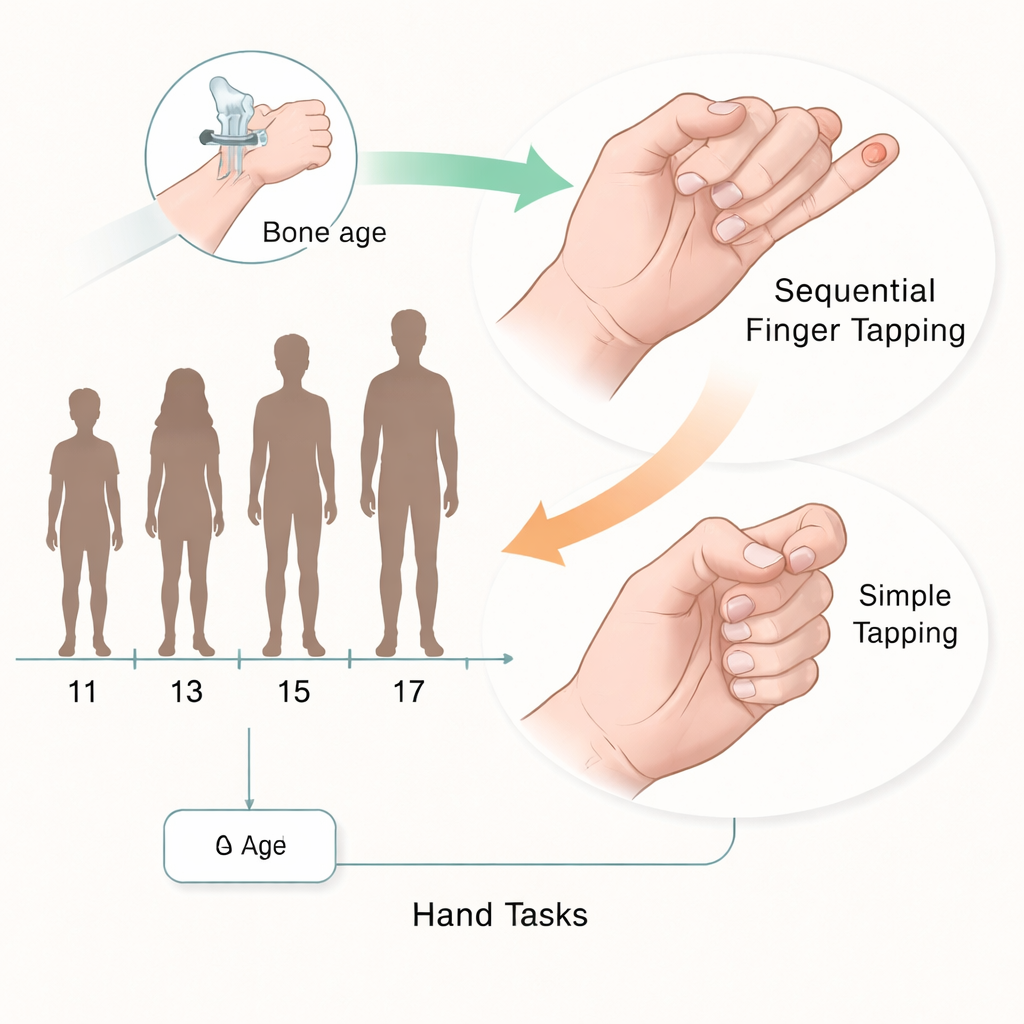
To separate these influences, researchers studied 225 adolescents aged roughly 11 to 17 years. Instead of judging puberty from outward signs alone, they used an ultrasound scan of the wrist to estimate bone age—a measure of how far along the skeleton is in its maturation. Bone age can be ahead of, behind, or in line with a teen’s calendar age, revealing early or late biological development. The team also recorded each participant’s chronological age, which reflects accumulated experience, and gathered detailed information about years of formal musical instrumental training, a well-defined form of intense hand practice.
Simple taps versus tricky sequences
The teens performed two kinds of finger tasks with both hands, eyes closed. In the simple task, they rapidly tapped the index finger against the thumb as fast as possible. This measured pure speed. In the more complex task, they had to carry out a four-step sequence—touching thumb to different fingers in a set order—both quickly and accurately. This tested not only speed but also planning and coordination. By comparing performance on these two tasks, the scientists could distinguish between basic motor speed and the more intricate control needed for sequences of movements.
Biology leads when practice is low
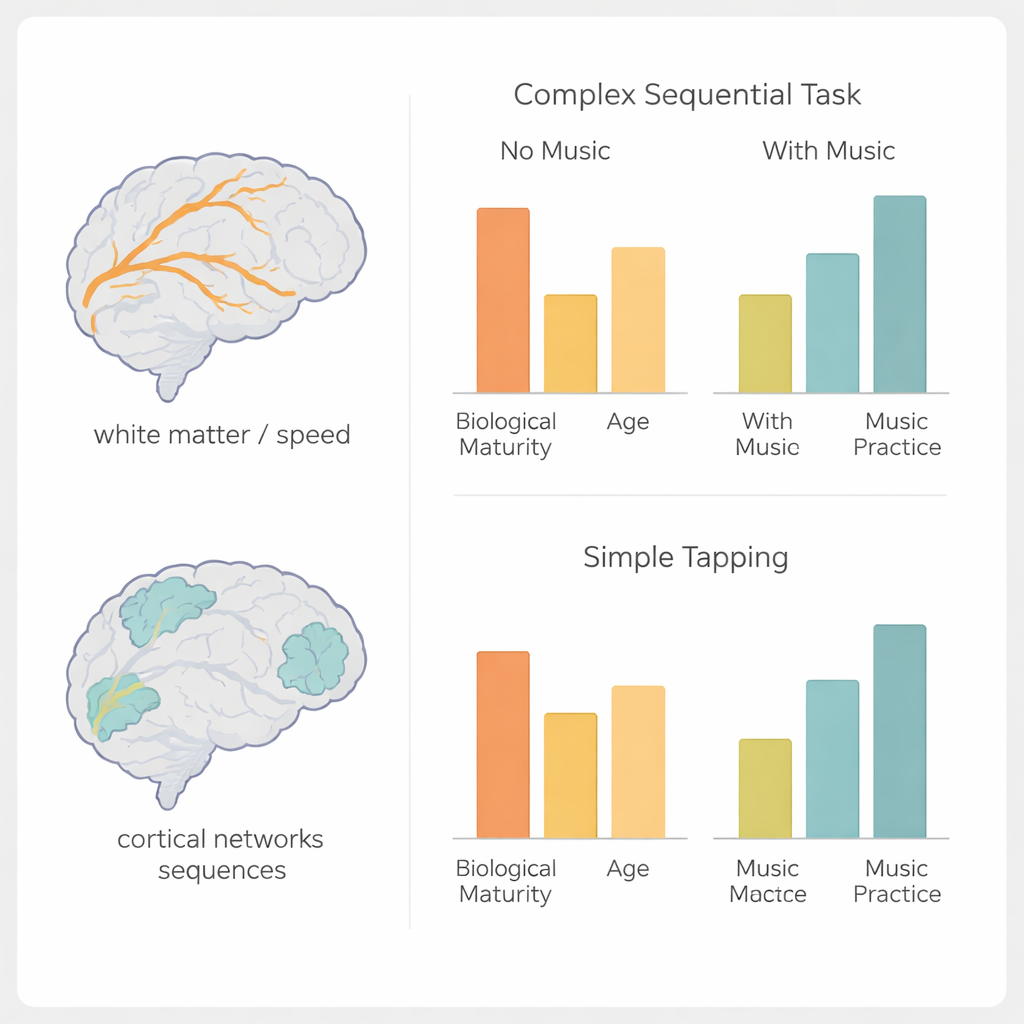
Among adolescents with little or no instrumental music training, biological maturity turned out to be crucial for complex finger sequences. Teens whose bones were more advanced for their age performed better on the sequential task, regardless of whether they were early or late on the calendar. In contrast, simple tapping speed was better predicted by chronological age than by bone age. This suggests that straightforward, repetitive speed benefits mainly from the sheer passage of time and ongoing growth of nerve pathways, while fine-grained, sequence-based control depends more strongly on where a teen stands in the internal timetable of puberty-related brain changes.
Practice can outweigh maturation
The picture changed in teens who had at least a year of instrumental musical training, sometimes up to eight years. In this group, the amount of musical practice was the dominant factor for performance on the complex finger sequence, for both the dominant and non-dominant hand. Here, how long they had been playing mattered more than either bone age or chronological age. Music practice also boosted simple tapping speed in the non-dominant hand, where everyday life provides less automatic practice. These findings fit with brain imaging work showing that long-term skill training reshapes motor networks and strengthens connections that support quick, precise movements.
What this means for teens and training
Put simply, the study shows that both nature and nurture matter for how teen hand skills develop—but in different ways. When there is little specialized practice, complex, coordinated finger movements track closely with the body’s internal maturation, while basic tapping speed mostly follows age. Once intensive, high-quality practice enters the picture, experience can rival or even overshadow biological timing, becoming the main driver of performance. For parents, educators, and coaches, this suggests that structured training—such as music lessons—can harness the brain’s natural plasticity during adolescence, helping young people build refined motor skills regardless of whether they mature a bit earlier or later than their peers.
Citation: Berencsi, A., Gombos, F., Fehér, L.J. et al. The contributions of biological maturity and experience to fine motor development in adolescence. Sci Rep 16, 5917 (2026). https://doi.org/10.1038/s41598-026-36220-y
Keywords: adolescent motor development, fine motor skills, bone age, musical training, hand dexterity