Clear Sky Science · en
Emotional intelligence training improves stress regulation and performance in high-stress occupations
Why staying calm under fire matters
Most of us will never sprint up a tower in full combat gear or treat a wound while bullets fly overhead. Yet the pressures that elite soldiers face are an extreme version of something familiar: trying to think clearly, make good decisions, and protect our health when stress spikes. This study looks at whether emotional intelligence training—learning to notice, understand, and manage emotions—can help people not only feel calmer, but actually perform better when it counts. 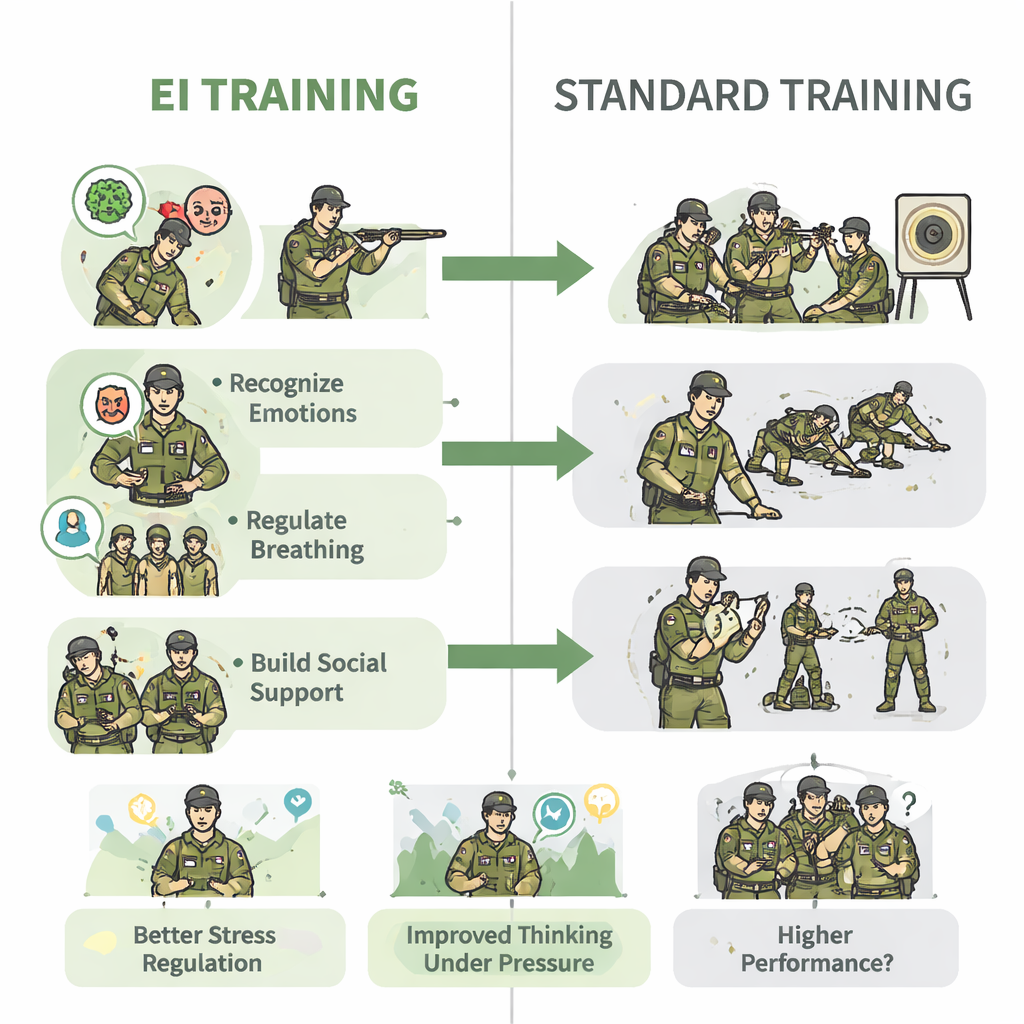
Teaching soldiers to work with their emotions
The researchers worked with Australian Special Forces soldiers, a group already selected for exceptional physical fitness and mental toughness. Sixty-six commandos were randomly assigned to two groups. One group received 15 hours of emotional intelligence (EI) training spread over several days. The other group spent the same amount of time on technical and physical training that did not focus on emotions. Random assignment meant any later differences in stress or performance could be traced back more confidently to the kind of training they received, not to pre-existing differences between soldiers.
Inside the emotional intelligence course
The EI course was built around four main skills: noticing emotions in others (such as facial expressions and tone of voice), noticing emotions in oneself (like early signs of tension or fear), understanding what those emotions mean, and deliberately guiding emotions to be useful rather than overwhelming. Soldiers practiced identifying their own stress signals, labeling what they felt, and using slow, regular “resonant” breathing to steady their bodies. They also discussed real combat stories where good or poor emotional control had serious consequences. The goal was not to eliminate stress, but to help soldiers reach a productive level of arousal—alert and focused, but not flooded.
Putting skills to the test under real pressure
Six weeks after training, both groups faced three realistic, high-stress drills: a rapid stair climb followed by a split-second friend-or-foe shooting decision, a “self-care under fire” scenario applying a tourniquet while under simulated gunfire, and a fast rappel from a tall tower with their own improvised harness. During these events, researchers repeatedly measured the hormone cortisol in saliva, a biological marker of stress. They also tested thinking and behavior under pressure: solving a hard math problem while breathless, remembering critical radio information, hitting the correct targets, and keeping an arm in icy water as long as possible. 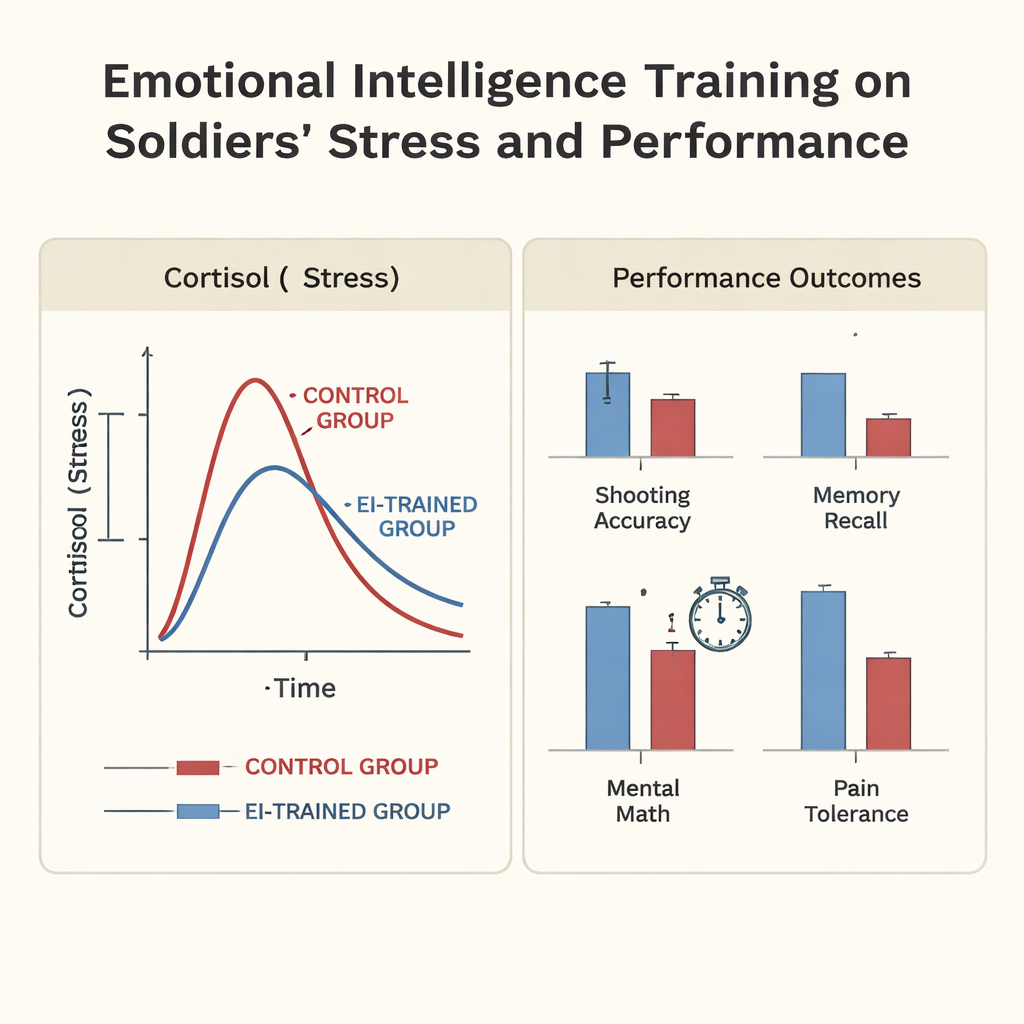
Stress down, performance up
Although both groups started with similar stress levels, the EI-trained soldiers showed a different pattern once the heat was on. Before and during the stressful drills, their cortisol levels were consistently lower than those of the control group, suggesting a more controlled stress response rather than total shutdown. At the same time, they outperformed their peers across the board. Nearly all EI-trained soldiers hit the correct targets in the shooting task, compared with just over half of the others. They remembered more mission-critical details from the radio report, solved difficult math problems under pressure far more often, and kept their arms in freezing water about 72% longer. Two weeks after the final stress activity, their resting cortisol had dropped more than in the control group, hinting at better recovery as well as better moment-to-moment regulation.
What this means beyond the battlefield
For a general reader, the central message is straightforward: learning to work with your emotions can change how your body reacts to stress and how well you perform when the stakes are high. In this extreme setting, emotional intelligence training helped already tough soldiers become more precise, more resilient, and less biologically strained. The authors argue that similar training could help people in other high-pressure roles—such as emergency responders, doctors, executives, and students facing demanding exams—manage their stress and avoid burnout. Rather than treating stress problems after they appear, building emotional skills in advance may be a practical way to keep both health and performance on target.
Citation: King, J.B., Li, Y., Gillespie, N.A. et al. Emotional intelligence training improves stress regulation and performance in high-stress occupations. Sci Rep 16, 6673 (2026). https://doi.org/10.1038/s41598-026-36216-8
Keywords: emotional intelligence, stress management, military training, performance under pressure, cortisol