Clear Sky Science · en
Postural stability during a longitudinal expedition in an isolated and confined Antarctic environment
Why balance in Antarctica matters
Life on an Antarctic research station may look like an icy adventure, but a simple slip on snow or ice can quickly turn serious when hospitals are thousands of kilometers away. This study followed a small group of scientists and technicians during a 49‑day mission to see how well they could keep their balance over time, and whether living in an isolated, extreme environment would quietly wear down this basic but vital ability. 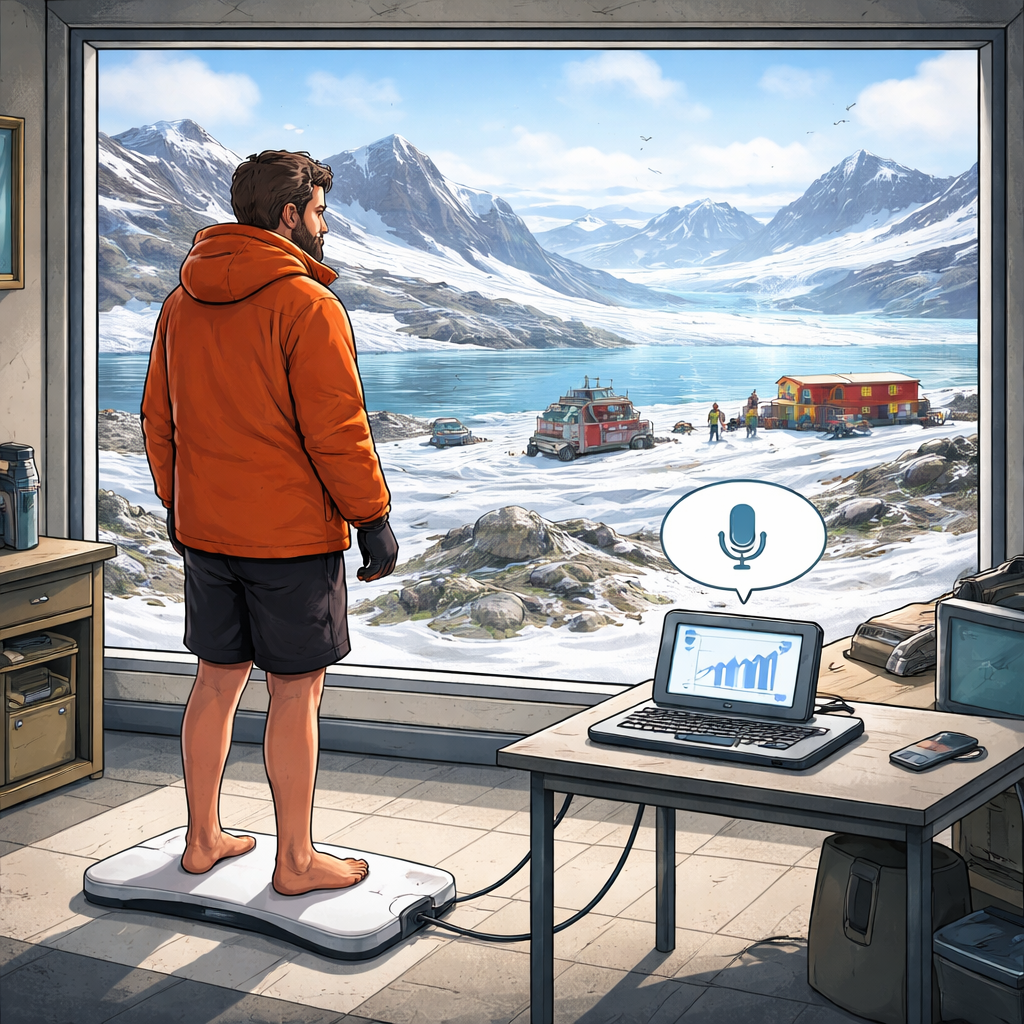
A harsh place to test the human body
The J. G. Mendel Station on James Ross Island sits in a polar desert of rock, snow, ice, and frozen ground. Even in summer, temperatures hover around freezing, the wind is strong, and the terrain is slippery and uneven. Earlier work has shown that such conditions change how people walk and can make them sway more when standing still. At the same time, Antarctic crews face mental strain: poor sleep, monotony, and social tension can sap attention and slow reaction times. Because steady posture depends on both the body’s sensors and the brain’s focus, the researchers suspected that this challenging setting might first worsen balance and then, with experience, trigger gradual adaptation.
A game console turned into a science tool
To track balance day after day without bulky lab gear, the team repurposed a Nintendo Wii Balance Board – a video‑game accessory with four pressure sensors – and paired it with a handheld computer and voice‑guided software. Thirteen healthy volunteers stood quietly for one minute at a time under four conditions: on the hard board or on a thick foam pad, and with eyes either open or closed. The foam pad made the ground feel unsteady, blurring information from the feet and legs, while closing the eyes removed visual cues. After a supervised training week, participants ran the tests on their own, with the system recording both pressure data and video to confirm they followed instructions. 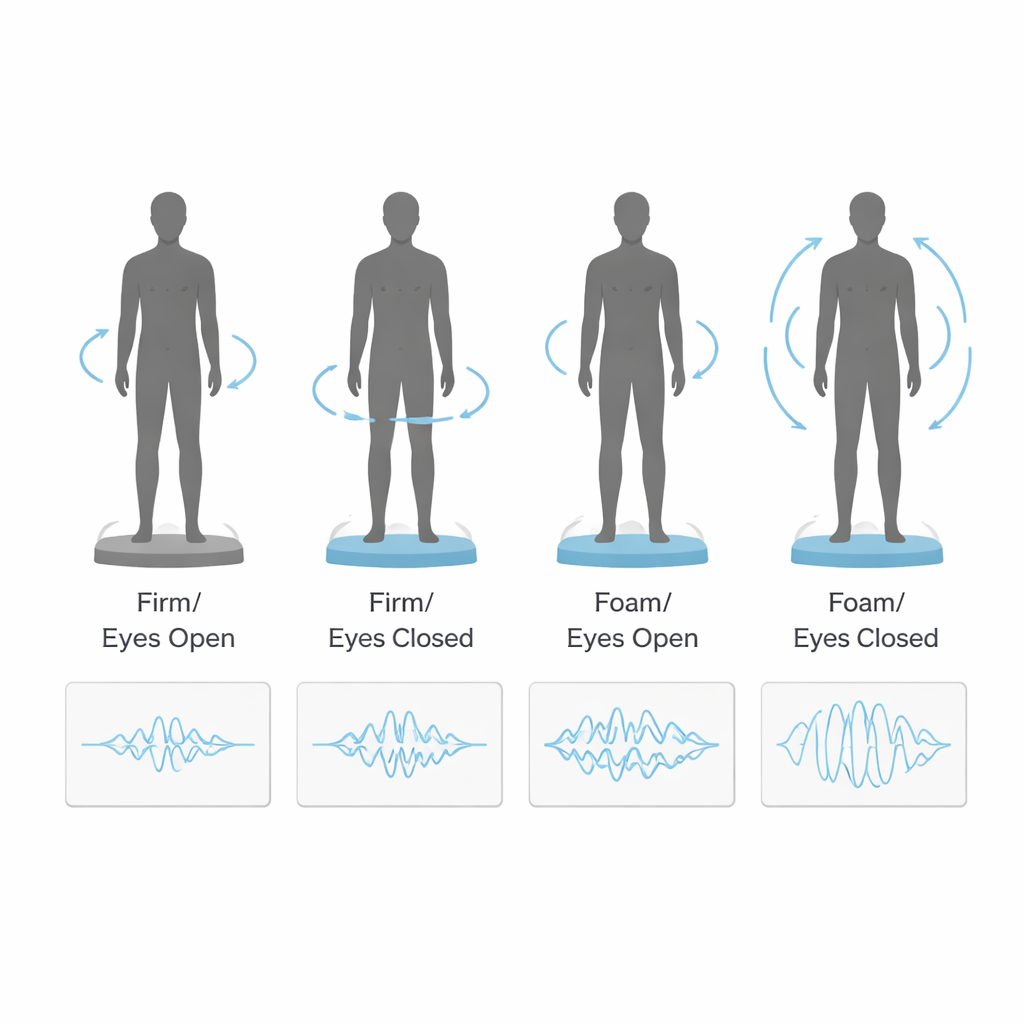
How the body copes when senses are taken away
When the scientists analyzed nearly 250 recordings, they found that balance strongly depended on which senses were available. On a firm surface with eyes open, people swayed only slightly. Closing the eyes made them move a bit more, especially forward and backward, showing that sight quietly helps fine‑tune stance even when the ground is stable. Standing on foam told a different story: with the feet less able to “feel” the surface, sway increased sharply, and taking away vision on top of that produced the largest, most erratic movements. More detailed signal analyses showed that under these harder conditions, the body shifted toward slower, larger corrections and less intricate movement patterns – a sign of a stiffer, less flexible control strategy that leans heavily on whatever reliable information remains, mainly vision.
Surprisingly steady over seven weeks
The researchers expected that, over the 49‑day mission, balance would first worsen under the stress and novelty of Antarctica and then improve as people adapted. Instead, when they used statistical models to compare results week by week, no clear trend emerged. Average performance stayed remarkably stable across the expedition. This could mean that the highly selected, physically fit crew adapted very quickly, before measurements began, or that deeper changes—good or bad—would only surface over much longer stays, like 14‑month winter‑over missions documented in other studies. It is also possible that the tests, which measured quiet standing indoors in light clothing, missed adaptations that are specific to moving outdoors in heavy boots and layered gear on real ice and rock.
What the findings mean for future explorers
From a lay perspective, the study delivers two main messages. First, when the ground feels unreliable—think of soft snow, loose gravel, or a thick foam pad—your brain leans strongly on your eyes to keep you upright; take vision away in those moments and even healthy people wobble much more. Second, at least over a medium‑length summer campaign, the balance of trained Antarctic personnel seems robust rather than gradually crumbling under isolation and cold. The work also shows that a low‑cost, largely automated system can monitor such subtle aspects of physical function far from any hospital, offering a practical way to screen for fall risk in polar expeditions and, potentially, in other remote or home‑based settings.
Citation: Volf, P., Sokol, M., Leová, L. et al. Postural stability during a longitudinal expedition in an isolated and confined Antarctic environment. Sci Rep 16, 6005 (2026). https://doi.org/10.1038/s41598-026-36215-9
Keywords: Antarctica, postural stability, balance control, isolated environments, fall prevention