Clear Sky Science · en
Response of free-headed segmental piles with mechanical joints to lateral loading
Why split foundations matter for real-world structures
Many bridges, ports and high‑rise buildings stand on deep foundations called piles, long columns driven into the ground. A newer type, the mechanically‑jointed pile, is built from prefabricated segments that lock together on site, saving time and materials. But when wind, waves or earthquakes push these piles sideways, the joints can open slightly and change how the whole foundation behaves. This study asks a practical question: can these segmented piles safely resist sideways forces, and how do they differ from traditional one‑piece piles?
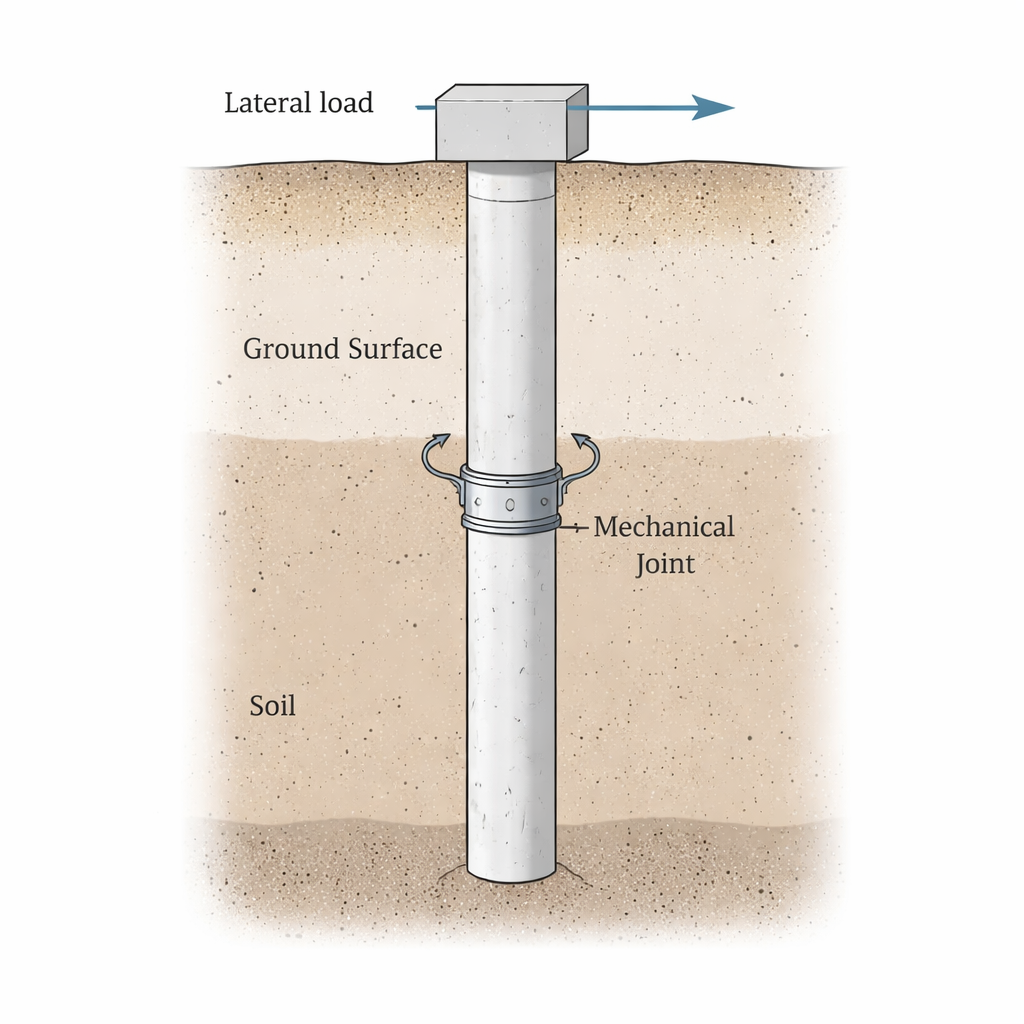
A new kind of stackable foundation
Mechanically‑jointed piles are assembled from shorter pieces that connect using steel connectors and pre‑formed holes. This modular approach makes transport and construction easier and can reduce waste. Under straight‑down vertical loads, earlier work showed that these piles act much like solid, one‑piece piles, as long as the joint stays intact. Sideways loading is different. When the pile head is pushed, the mechanical joint can rotate a little, creating a tiny gap between segments. That extra rotation breaks the smooth deformation found in a solid pile and can concentrate movement and forces at the joint. Yet current design rules say little about how such segmented piles behave when their bases are not firmly fixed in the ground—a common situation in soft soils or scour‑prone riverbeds.
Turning complex soil–pile behavior into solvable math
To tackle this, the authors extend a widely used design approach called the m-method, which treats the pile as a flexible beam supported by springs that represent the surrounding soil. Within this framework, they represent the soil’s sideways support as increasing with depth, and they solve the resulting equations using a mathematical power‑series technique. The key innovation is to embed a rotational “hinge” at the mechanical joint with a preset rotation limit. As lateral load grows, the pile passes through three stages: first the upper segment rotates while the lower one stays almost still; then a critical state is reached when the joint rotation hits its limit; finally, both segments bend together and share forces once the joint “closes” and starts to transmit bending more fully.
Checking theory against computer models
The researchers then build a detailed three‑dimensional computer model using the finite element method to test whether their simplified equations capture real behavior. They simulate a concrete pile made of two segments joined by a rotational connector in uniform soil, pushed sideways at the top. Comparing the extended m-method with the numerical results, they find that the predicted sideways displacement of the pile head and its rotation differ by less than about 5–10 percent. Shear forces along the pile also match well. The largest mismatch—about 25 percent—occurs in the peak bending moment, a quantity that is highly sensitive to local stress concentrations near the joint. The authors argue that this level of accuracy is acceptable for preliminary design and for understanding trends, while detailed checks near the joint should still rely on richer numerical models or experiments.
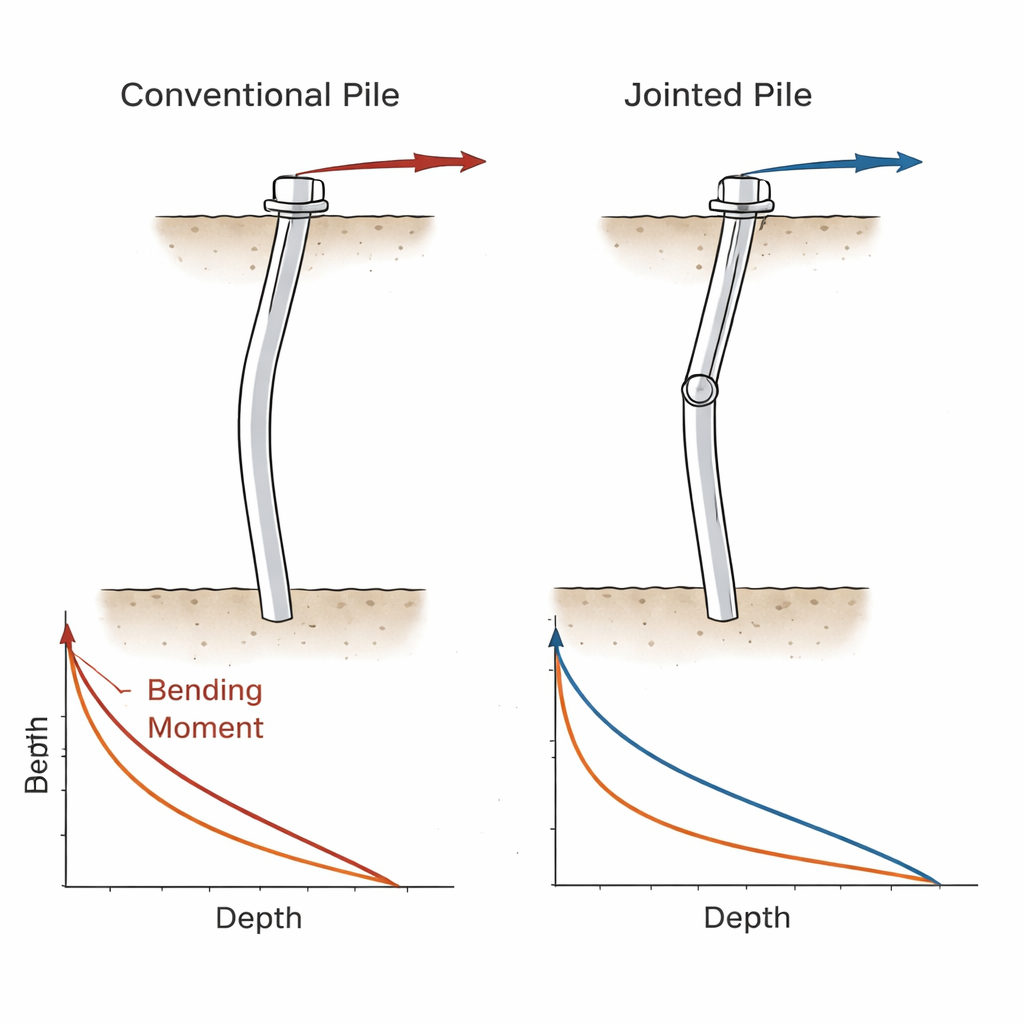
How segmented piles differ from solid piles
Using their analytical model, the authors compare a mechanically‑jointed pile with a conventional single pile of the same length and diameter, both with free heads and identical soil conditions. Under the same sideways load, the jointed pile’s head moves about 30 percent more and rotates about 55 percent more than the solid pile. In everyday terms, the structure on top would lean further. At the same time, the maximum bending moment in the jointed pile is roughly 20 percent lower, while the maximum shear force is about 17 percent higher, and both peaks shift closer to the ground surface. This means the jointed pile is less stiff overall, but the bending stress in its shaft can be reduced, potentially allowing slimmer or less heavily reinforced sections if shear and joint performance are carefully designed.
What this means for safer, greener foundations
For engineers, the work provides a practical formula‑based tool for estimating how free‑headed, mechanically‑jointed piles will deform and share loads with the soil when pushed sideways. For non‑specialists, the message is that stackable, prefabricated foundations can work reliably, but they flex more and shift where stresses concentrate. This extra flexibility may help cut bending stresses but increases the demands on shear strength and on the mechanical joint itself. The authors stress that their model is best suited to modest deformations and uniform soils, and they call for physical tests and more advanced soil models to refine future designs. Still, the study is a step toward foundations that are not only easier and cleaner to build but are also better understood under the sideways forces that real structures must withstand.
Citation: Liu, T., Zhang, Q., Sun, C. et al. Response of free-headed segmental piles with mechanical joints to lateral loading. Sci Rep 16, 5991 (2026). https://doi.org/10.1038/s41598-026-36214-w
Keywords: segmental piles, mechanical joints, lateral loading, soil–structure interaction, foundation design