Clear Sky Science · en
Epidemic spread with asymptomatic infectious period in contact adaptive networks
Why hidden infections matter to everyone
Some of the most dangerous disease carriers are the ones who look perfectly healthy. These “silent spreaders” can keep meeting friends, commuting, and going to work, all while unknowingly passing on an infection. At the same time, people often change their social habits when they see someone is clearly sick, by cancelling visits or keeping their distance. This article asks a simple but vital question: what happens to an outbreak when both of these forces — invisible infections and changing social contacts — act together in the same network of people?
A new way to think about getting sick
The authors introduce a mathematical framework they call the SIaIsS model, which splits the population into three groups: people who are still healthy but can catch the disease (Susceptible), people who are infected but show no symptoms (Asymptomatic Infected), and people who are infected and clearly ill (Symptomatic Infected). Unlike many classic epidemic models that only track whether someone is infected or not, this model keeps track of whether their infection is visible to others. That extra detail allows the model to describe how our behavior changes: we may avoid someone who is visibly sick, but we keep normal contact with someone who appears well, even if they are infectious. 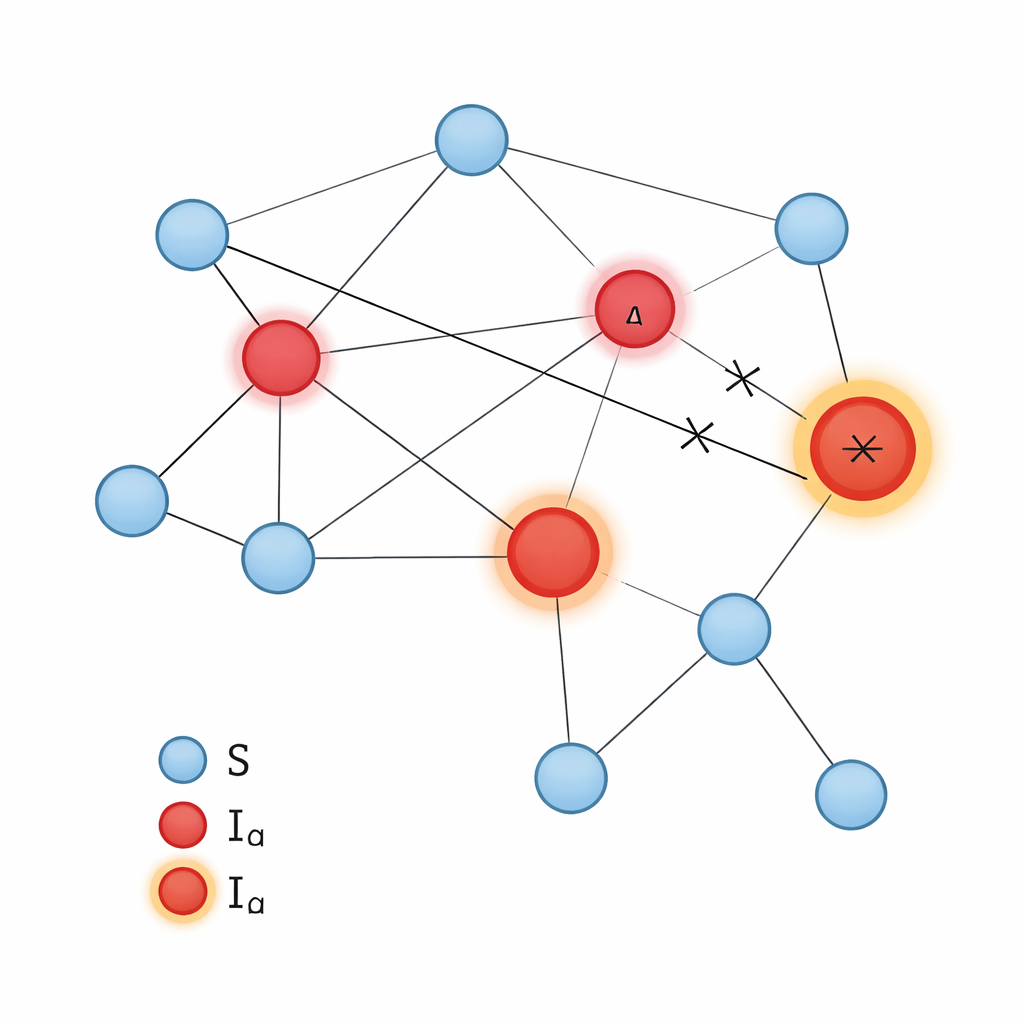
Following both people and their connections
To capture these effects, the researchers represent society as a network where each person is a node and each regular contact (such as a friend, co-worker, or family member) is a link. They use tools from probability theory to describe how individuals move between the three health states over time, and how links between them are broken or restored. If a healthy or symptom-free person is linked to someone who becomes visibly sick, they may cut that connection; if the sick person recovers, the link can be re‑established. Because exactly simulating every possible combination of states in a large population would be impossibly complex, the authors employ a standard approximation technique that tracks average behaviors across the network while still preserving who is connected to whom.
Silent spreaders tilt the odds
The first set of results examines disease spread when the contact network is fixed. Here, the SIaIsS model can be compared to the familiar SIS model, which does not distinguish between symptom-free and symptomatic infections. The authors compute the “basic reproduction number” — essentially, how many new cases one infectious person causes in an otherwise healthy population. They show that, for the same disease strength and recovery speed, the reproduction number is always higher when silent spreaders are present. In practical terms, this means that a disease with an asymptomatic period will start to spread at lower infection rates and will infect a larger share of the population than a disease that becomes visible immediately, even if all other features are the same.
When people adapt their contacts
The second part of the study allows the network itself to evolve. As people notice symptoms in their contacts, they may break links to avoid infection; later, once symptoms disappear, they may reconnect. The model tracks how often links are broken and re‑created and how this changes the course of the epidemic. Simulations reveal that, in principle, breaking links to sick individuals lowers the share of people who are infected at any given time. But as the proportion of silent spreaders grows, this self‑protection mechanism weakens: because asymptomatic carriers look healthy, others keep their links to them, so the overall web of contacts remains dense. The result is that the disease reaches more people and does so more easily. 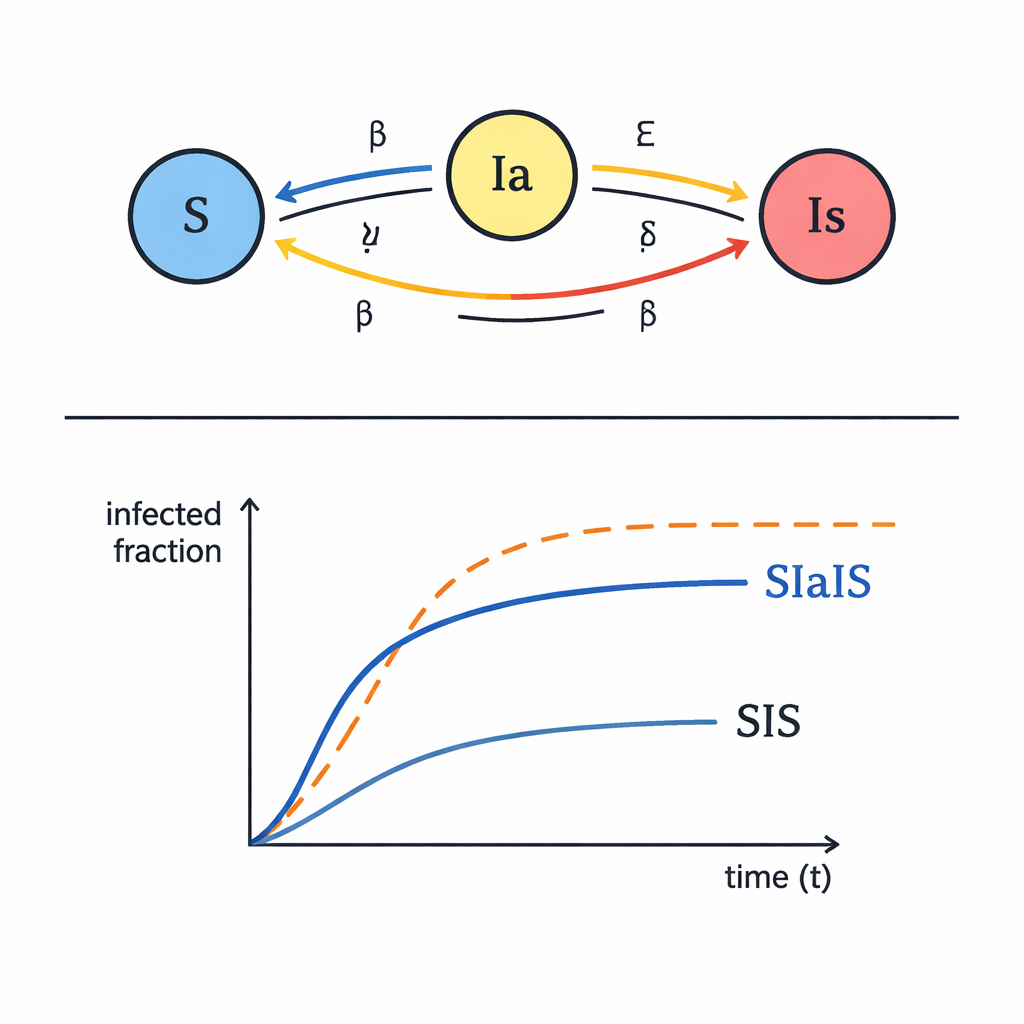
Networks, structure, and tipping points
The authors also explore how different kinds of networks affect spread. Dense networks, in which people have many contacts, allow the infection to race through the population but also create many opportunities for link-breaking once symptoms appear. Networks with a few highly connected hubs, similar to social media or workplace hierarchies, show rapid initial spread but may end up with lower long‑term infection levels because many links are cut when these hubs become symptomatic. Across many scenarios, the study finds that the critical point at which an epidemic takes off depends not only on how contagious the disease is, but also on how many infections are silent and how aggressively people cut ties to visibly ill contacts.
What this means for real outbreaks
In plain terms, the study reinforces a sobering message: when a disease has a significant symptom‑free infectious period, it is much harder for everyday behavior changes, such as avoiding people who look sick, to keep the outbreak in check. Silent spreaders both extend the time people remain infectious and shield them from social avoidance, allowing the disease to exploit the very structure of our social networks. The work suggests that relying solely on visible symptoms to guide isolation and distancing will underestimate how widely such diseases can spread, whether in human populations or in computer networks compromised by hidden malware. Effective control, the authors argue, requires strategies that detect or reduce invisible transmission — such as regular testing, monitoring, or broad preventive measures — rather than reacting only once illness becomes obvious.
Citation: Chai, W.K., Karaliopoulos, M. Epidemic spread with asymptomatic infectious period in contact adaptive networks. Sci Rep 16, 6069 (2026). https://doi.org/10.1038/s41598-026-36212-y
Keywords: asymptomatic transmission, adaptive contact networks, silent spreaders, epidemic modeling, network epidemiology