Clear Sky Science · en
Experimental study on the effect of impact target distance on coal breaking efficiency of high-pressure gas–liquid two-phase jet
Breaking Coal with Smarter Water and Air Jets
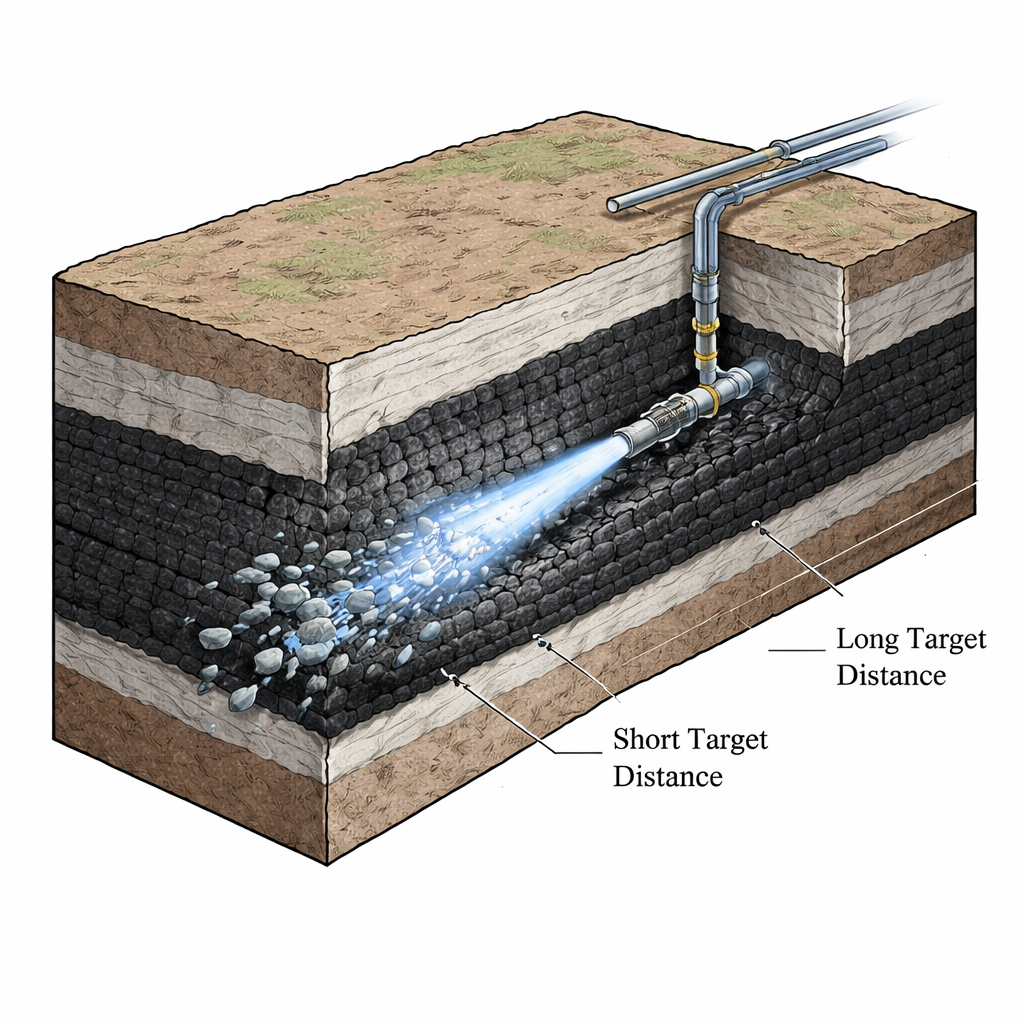
Deep coal mines face a double challenge: safely releasing trapped gas while keeping rock stable and production efficient. This study explores a promising tool for that job—a powerful jet made of both water and compressed air—and asks a simple but crucial question: how far should the coal be from the nozzle for the jet to break coal efficiently and help gas escape?
Why Coal Gas Matters Underground
Coal seams often hold large amounts of methane gas. If that gas is not drained in advance, it can leak suddenly into mine tunnels, threatening workers and disrupting operations. Current methods, such as hydraulic fracturing with high-pressure water, can improve gas flow but use a lot of water, struggle to clear broken rock from boreholes, and may not reach very far into the coal. Engineers are therefore looking for techniques that break coal more effectively, use less water, and help carry debris and gas out of the seam.
A New Kind of Jet for Tough Coal
The research focuses on a “gas–liquid two-phase jet,” where compressed air and high-pressure water are mixed and forced through a small nozzle toward a coal-like block. Compared with a pure water jet, this mixed jet has a larger impact area, lower water consumption, and strong ability to carry broken particles away. Earlier work suggested that this kind of jet can break rock and coal up to about one-and-a-half times more effectively than water alone. But a key unknown remained: at what distance from the nozzle does the jet work best for cracking coal and opening flow paths for gas?
Measuring How the Jet Hits and Erodes
To answer this, the author built a dedicated test system with powerful pumps for water and air, a mixing device and nozzle, and a test bench holding coal-like specimens. Dozens of pressure sensors recorded how the jet struck a flat target at distances of 10–30 centimeters, revealing how impact force and impact area changed over time. Then, at longer distances of 65–85 centimeters, the jet was fired at coal-like blocks for one minute at fixed pressures, and the resulting erosion pits were measured in depth, width, and volume. Additional tests varied jet pressure while keeping the distance fixed to see how much extra power actually translated into more coal removal.
Short Range for Deep Cracks, Long Range for Wide Paths
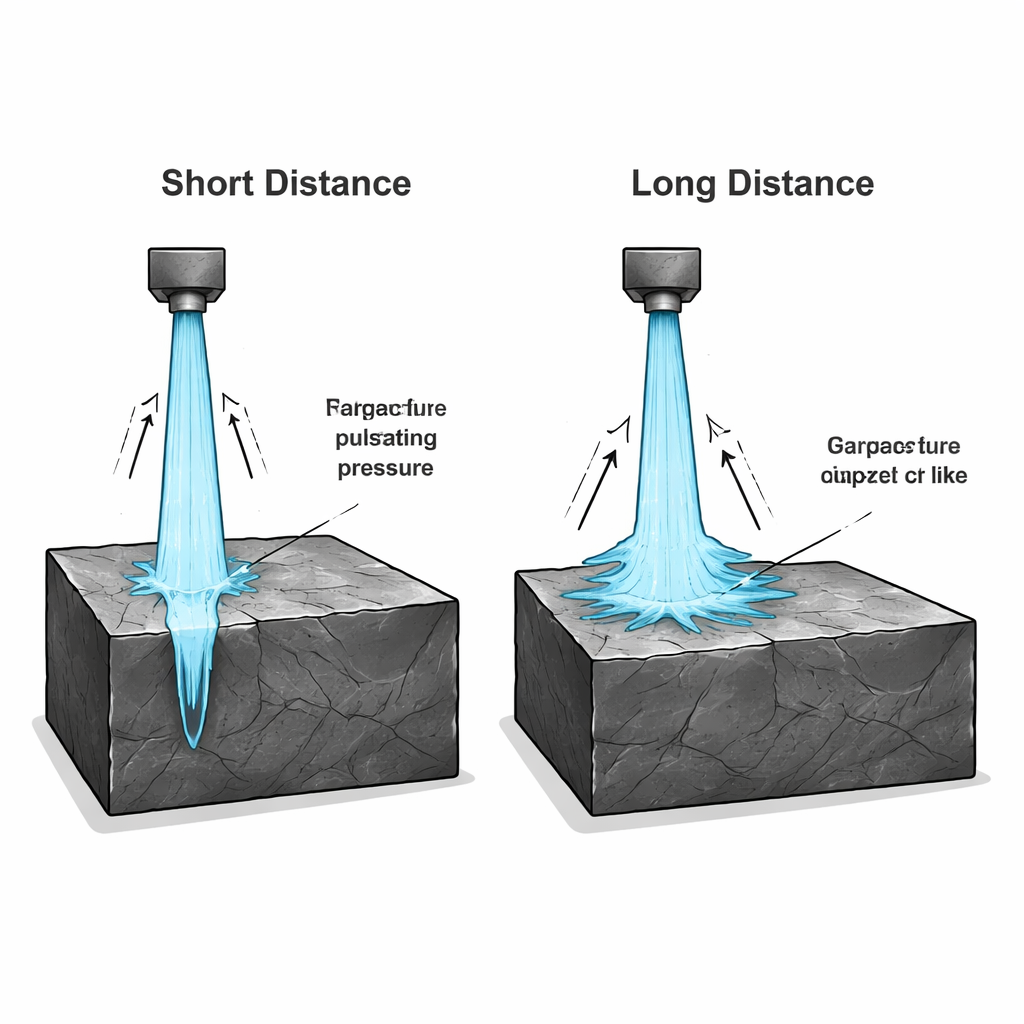
The experiments showed that adding air turns a steady water jet into a pulsating hammer: the pressure at the target rises and falls rapidly, but the rate of these pulses barely changes with distance. As the jet travels farther, air mixing and turbulence make the pressure fluctuate more strongly, yet the highest pressures remain similar within 10–30 centimeters. The water-only jet stays compact and focused, while the mixed jet spreads out, with its impact area growing sharply as distance increases. At longer ranges used in the erosion tests, the mixed jet still cuts noticeable holes in the coal-like blocks. However, as distance grows, the pits become shallower and smaller in volume, even as they become wider. The study also finds a sweet spot in the ratio of air to water pressure—too little air wastes potential, but too much makes the jet lose focus and erode less overall.
Designing Better Gas-Drainage Boreholes
From these patterns, the author proposes simple guidelines for field use. If the goal is to drive deep fractures into the coal so that gas has long, straight paths out, the nozzle should be kept relatively close to the coal face, around 65 centimeters in the tested setup. If, instead, the priority is to open up a broad damaged zone that improves overall permeability, a longer distance of about 80 centimeters gives a larger affected area, even though each point is eroded less intensely. Within this effective range, raising jet pressure significantly boosts the amount of coal removed, suggesting that the technology can be tuned for different coal types and mining needs.
What This Means for Safer, Cleaner Mining
In everyday terms, the study shows that mixing air into high-pressure water can turn a narrow "drill" of water into a pulsing chisel and broom combined—cracking coal, loosening it, and helping sweep gas and debris out of the seam. By carefully choosing how far the nozzle sits from the coal and how much air and water pressure to use, mine engineers can either dig deeper channels or create wider leak paths for gas. This understanding of distance and jet behavior gives practical rules for designing safer, more efficient gas-drainage systems in deep coal mines.
Citation: Li, Y. Experimental study on the effect of impact target distance on coal breaking efficiency of high-pressure gas–liquid two-phase jet. Sci Rep 16, 6307 (2026). https://doi.org/10.1038/s41598-026-36207-9
Keywords: coalbed methane, water jet, gas–liquid jet, underground mining, rock erosion