Clear Sky Science · en
Seed micromorphology and calcium oxalate crystal characterization as taxonomic traits in selected species of the genus Impatiens L.
Why tiny seeds matter
Garden balsams and jewelweeds, plants in the genus Impatiens, are famous for pods that explode at a touch, flinging seeds in all directions. Some of these species have become aggressive invaders along rivers and in forests. This study asks a deceptively simple question with big implications: if we look very closely at their seeds—down to the microscopic texture of the seed coat and the tiny crystals hidden inside—can we better tell species apart, understand how they spread, and predict which ones might become troublesome invaders?
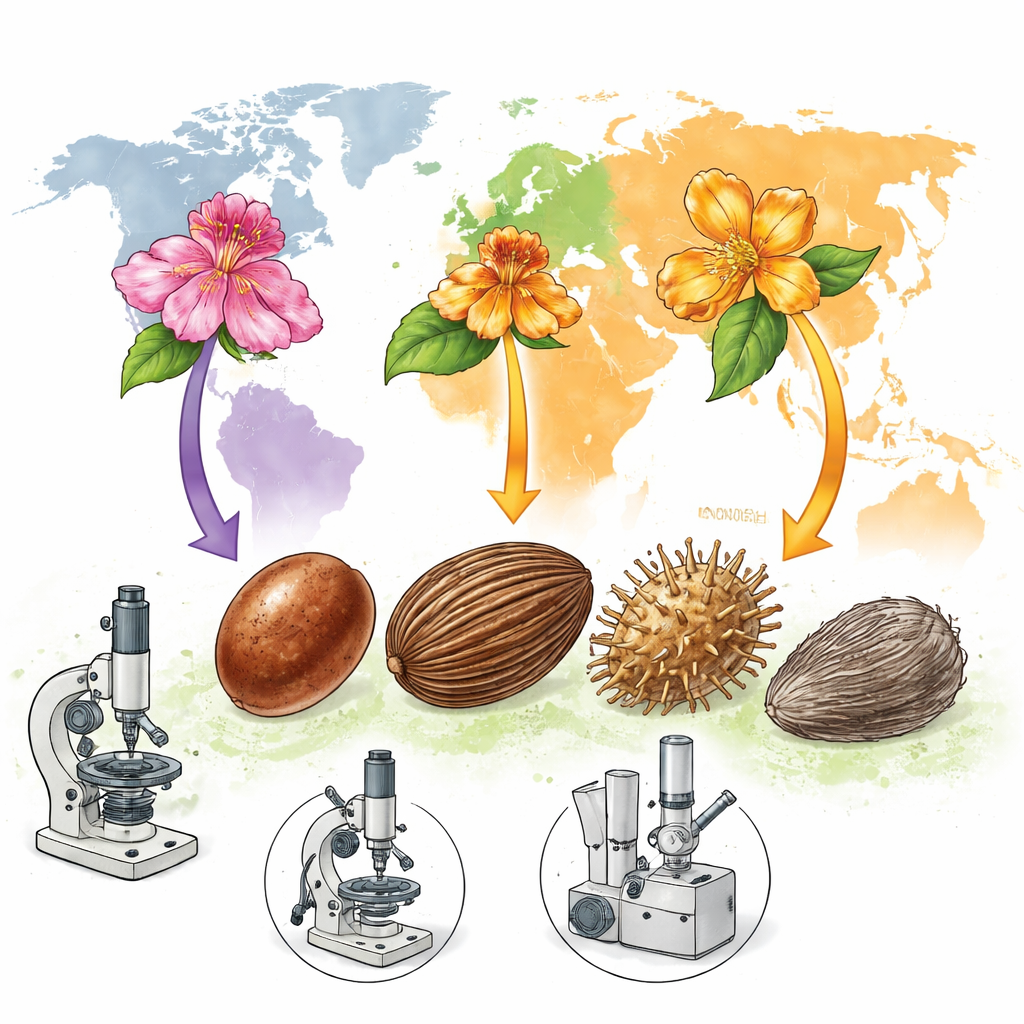
Looking under the plant’s “fingerprints”
The researchers examined seeds from twelve Impatiens species collected in Europe, Asia, and North America. Instead of relying only on what the naked eye sees—size, color, and general shape—they used a suite of imaging tools, including scanning electron microscopes, high‑quality light microscopes, and confocal microscopes that build up three‑dimensional pictures from thin optical slices. These techniques reveal the seed coat as a landscape of ridges, pits, and protruding cells that act like a microscopic fingerprint. For each species, the team also measured seed dimensions and carefully documented how seed‑coat cells are arranged and how their walls curve and connect.
Different skins for different lives
Although most seeds were roughly ellipsoid, the surfaces differed strikingly from species to species. Some had raised finger‑like bumps; others carried thread‑like outgrowths or a network of tiny ridges. A few species shared similar ribbed seeds, even though they were not close relatives, hinting that similar environments can drive unrelated plants toward comparable designs. In species such as Impatiens capensis, seeds carry four strong ribs and are known to float in water for months, suggesting that rougher or more strongly sculpted coats can help seeds travel along streams and rivers. By contrast, species with a thick, protective outer layer may be better equipped to resist physical damage or attack by microbes, trading long‑distance rafting for sturdier armor.
Hidden crystals with double duty
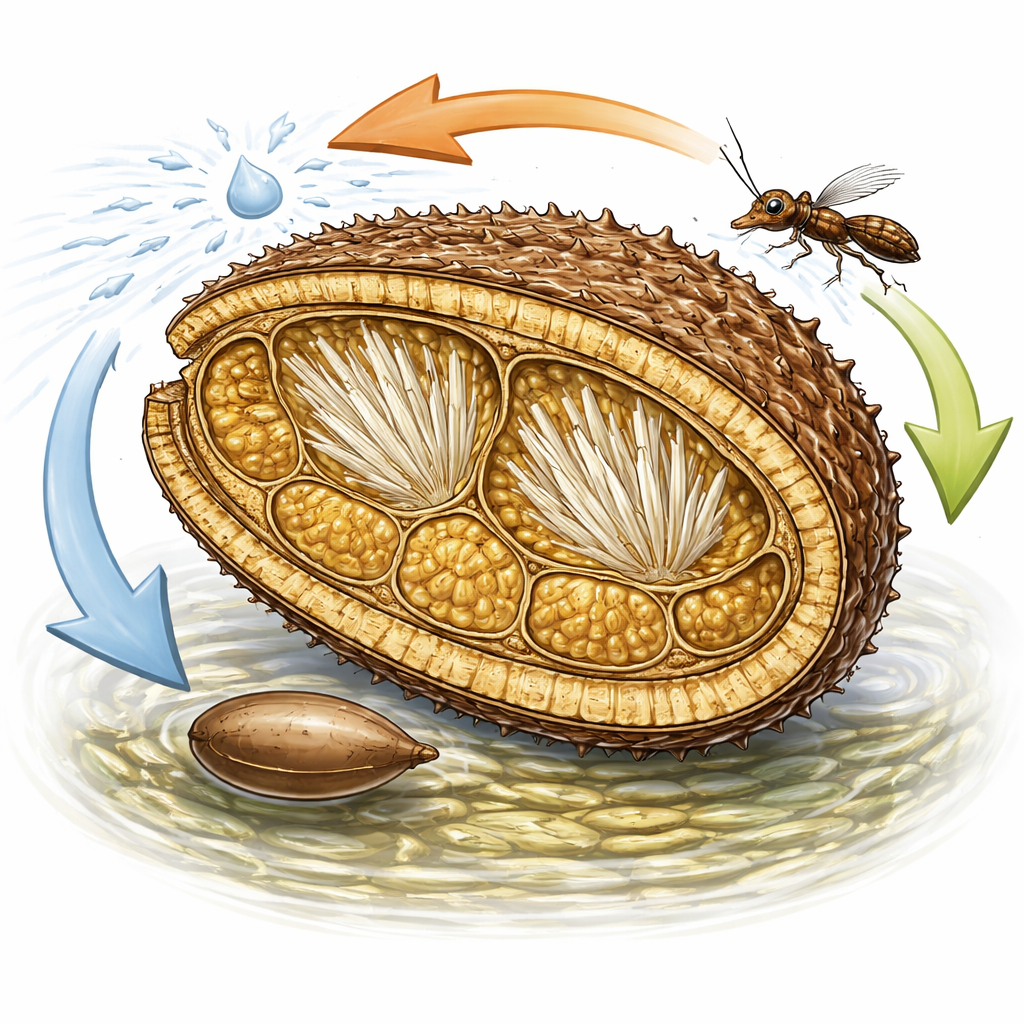
Inside the seed coats, the team consistently found bundles of calcium oxalate crystals shaped like fine needles, called raphides. These occurred in all twelve species, usually inside large, thick‑walled cells just beneath the outer surface. The crystals themselves looked the same across species, but their abundance and distribution varied. Some species, such as two tropical Thai balsams, were packed with crystals, while others, including the highly invasive Himalayan balsam (Impatiens glandulifera), had relatively few, clustered near one end of the seed. The crystals may serve several roles: storing excess calcium in a harmless form, stiffening the seed coat, helping it split open during germination, and deterring hungry insects or grazing animals by acting like microscopic needles.
Crystals, invaders, and spread
The pattern of crystal density did not line up neatly with the official family tree of Impatiens, so it is not a simple taxonomic marker. Instead, the authors suggest it reflects ecological fine‑tuning. For example, seeds with many sharp crystals may be unappealing to animals, limiting their transport inside guts but enhancing defense against being eaten. In contrast, the low‑crystal seeds of I. glandulifera may be palatable enough for sheep and other grazers to eat and spread over longer distances, aiding this species’ rapid invasion of European riverbanks. In floating specialists like I. capensis, crystal‑rich layers may help keep the seed coat rigid, reinforce ribs, and form a tighter, more buoyant shell that stays at the water’s surface.
What this means for readers and managers
By marrying high‑resolution imaging with careful measurement, this study shows that the outer and inner architecture of Impatiens seeds is both highly diverse and biologically meaningful. Seed‑coat patterns turn out to be reliable “ID cards” for distinguishing species, especially when flowers are absent. The calcium oxalate crystals, while not yet a precise taxonomic tool, reveal another layer of adaptation tied to how seeds move, survive, and colonize new habitats. For conservationists and land managers worried about invasive balsams, such microscopic details may help predict which species are likely to travel far by water or animals, and which are most likely to become the next fast‑spreading invader.
Citation: Rewicz, A., Polit, J., Monzalvo, R. et al. Seed micromorphology and calcium oxalate crystal characterization as taxonomic traits in selected species of the genus Impatiens L.. Sci Rep 16, 5884 (2026). https://doi.org/10.1038/s41598-026-36206-w
Keywords: Impatiens seeds, seed micromorphology, calcium oxalate crystals, plant invasion biology, balsam taxonomy