Clear Sky Science · en
Orientation modulated piezoelectric patches for active vibration reduction of thick plates using a singular value decomposition-based optimization
Silencing Shakes in Everyday Structures
From airplane wings and car bodies to bridges and factory machines, many familiar structures are constantly vibrating. While we rarely notice these tremors, they can shorten a structure’s life, add noise, and even threaten safety. This paper explores a smarter way to calm such vibrations by using tiny electrical patches glued onto a plate-shaped structure. The twist is that the authors show it is not enough to decide where to place these patches; the direction in which each patch is turned can make a surprisingly large difference in how well vibrations are tamed.
Smart Stickers That Feel and Fight Motion
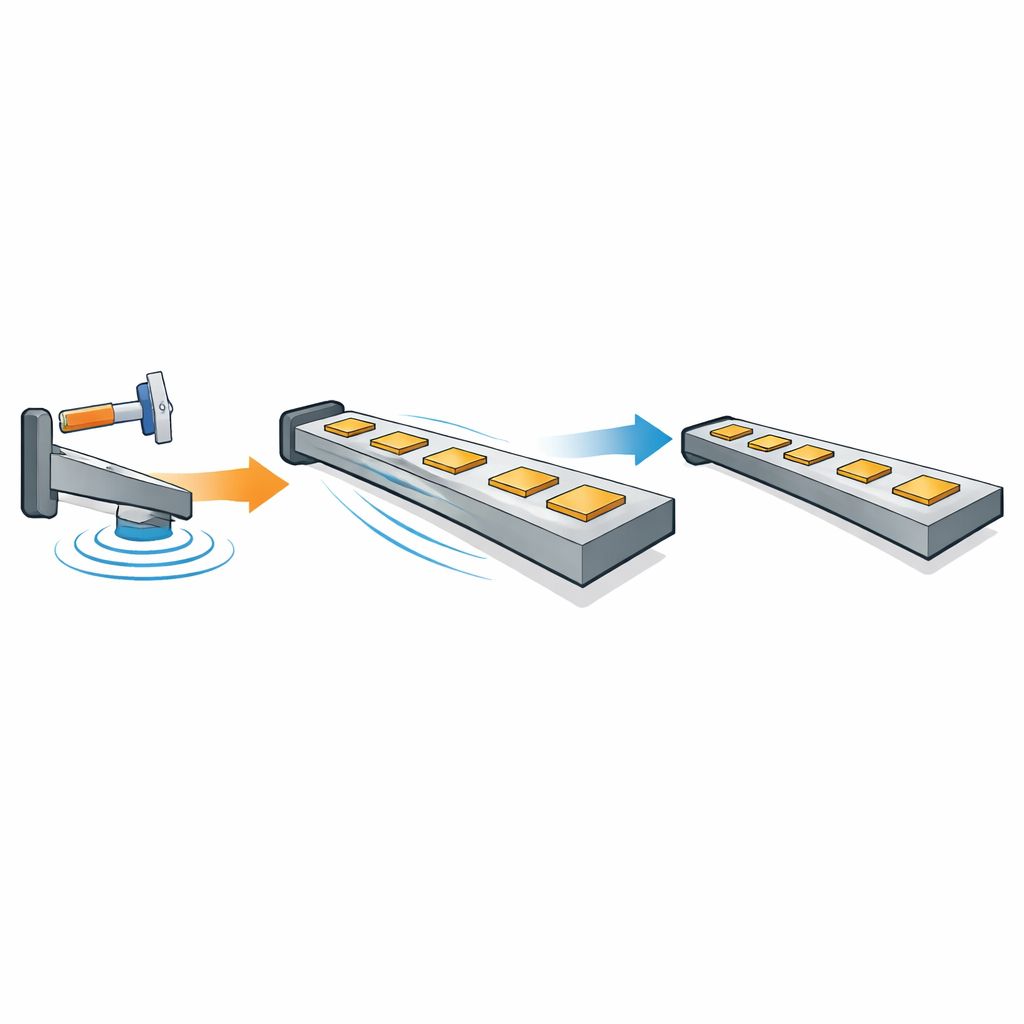
The study focuses on piezoelectric patches—thin, solid-state devices that act like both nerves and muscles for a structure. When a plate bends or shakes, these patches generate an electrical signal that tells a controller how the structure is moving. The controller then sends voltages back to selected patches so that they push or pull against the motion, actively cancelling out the vibration. This form of active vibration control is widely used when simple add-on dampers are not enough, especially in lightweight or flexible parts that vibrate strongly at low frequencies.
Why Direction Matters as Much as Location
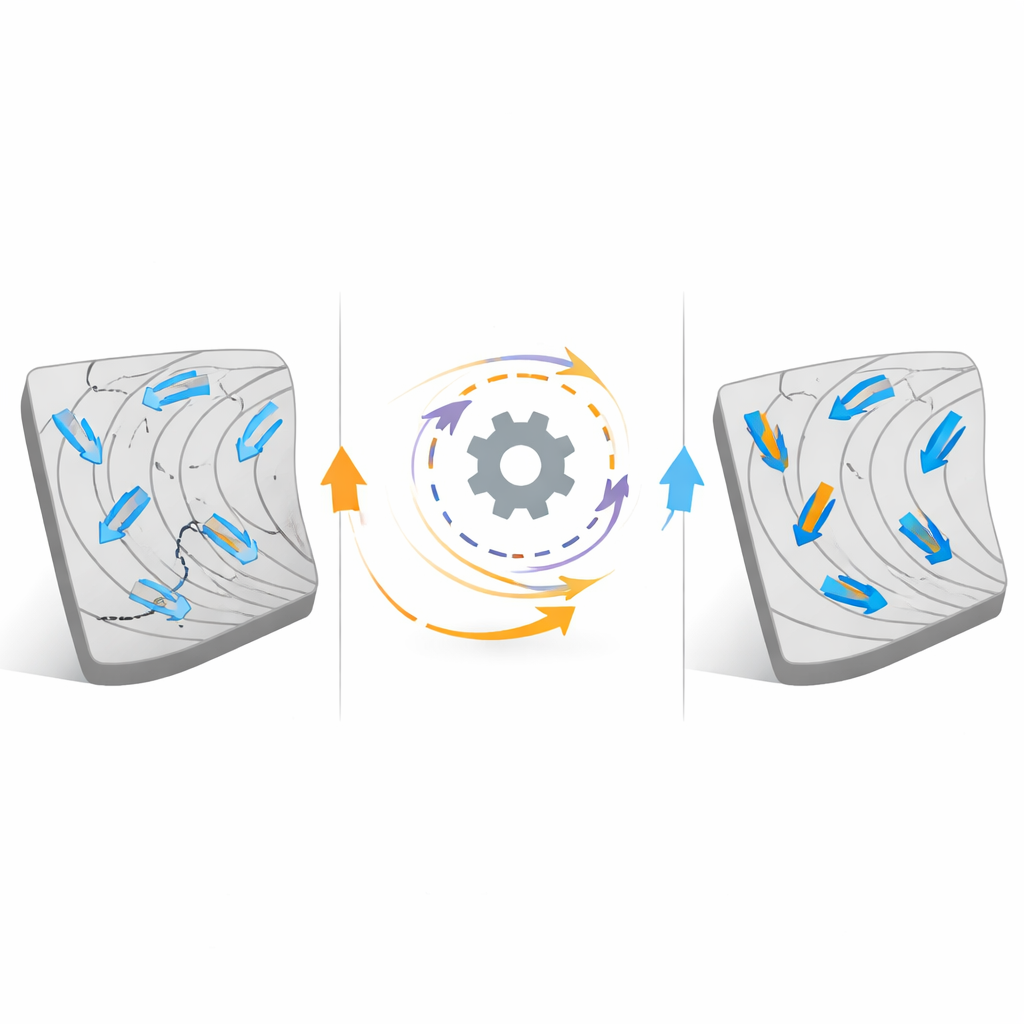
Previous research largely concentrated on deciding how many patches to use and where to put them, often assuming they were aligned neatly with the edges of the plate. However, the material inside a piezoelectric patch reacts more strongly in one direction than another, and the strains inside a thick plate do not necessarily run straight along its length or width. The authors argue that a patch that is perfectly placed but turned the wrong way “listens” and “pushes” poorly on the key bending patterns of the plate. By contrast, turning the same patch so its strongest axis is aligned with the local bending direction can greatly increase how efficiently it senses and controls the motion.
A Digital Test Bed for Vibration Control
To examine this idea, the researchers model a thick metal plate held fixed along one short edge—similar to a cantilevered machine base or support panel. They use a refined plate theory that accurately captures shear and rotary effects that appear in real, thick structures. The plate is chopped into a grid for numerical simulation, and ten pairs of sensor–actuator patches are added at previously optimized locations. The new ingredient is that each patch can now be rotated by a chosen angle. A genetic algorithm—an optimization method inspired by evolution—searches through many possible combinations of angles, scoring each candidate design by how much control authority it provides. This score is based on a mathematical tool called singular value decomposition, which measures how effectively the patches can influence the plate’s main vibration patterns.
How Better Alignment Cuts Motion
Once the best set of angles is found, the authors test how the system behaves when the plate is shaken by a brief, sinusoidal force. They use a standard feedback controller that adjusts the patch voltages to drive the measured motion toward zero. Compared with two alternatives—using only location optimization or simply choosing patch angles at random—the direction-optimized design consistently produces the greatest reduction in vibration level across a range of control settings. In terms of average vibration gain, the improvement over the already optimized location-only design can reach roughly a quarter, and it is far stronger than random configurations. Systems with patches more closely aligned to the local strain directions not only vibrate less but also need gentler control gains, meaning the controller can work effectively without having to “work as hard.”
What This Means for Future Quiet Designs
In everyday terms, the study shows that tilting these tiny smart patches just right can make a thick plate behave as if it were much better damped, without adding extra material. It suggests that engineers designing aircraft panels, ship decks, machine bases, or advanced smart surfaces should treat patch orientation as a key design choice, not an afterthought. Although the work is based on simulations and keeps the patch locations fixed, it points toward future tools that will optimize both where patches go and how they are turned, and eventually test these strategies in the lab. For anyone concerned with quieter, longer-lasting structures, the message is simple: when it comes to smart vibration control, direction really matters.
Citation: Nadi, A., Mahzoon, M. & Azadi Yazdi, E. Orientation modulated piezoelectric patches for active vibration reduction of thick plates using a singular value decomposition-based optimization. Sci Rep 16, 8026 (2026). https://doi.org/10.1038/s41598-026-36203-z
Keywords: active vibration control, piezoelectric patches, thick plates, structural health, genetic optimization