Clear Sky Science · en
Accessibility evaluation of public service facilities in affordable housing communities in Hangzhou, China
Why Where You Live Shapes Your Daily Life
Imagine being able to walk to your child’s school, a nearby clinic, a leafy park, and a bus or subway stop in just a few minutes. For many city dwellers, this is normal life; for others, these basic services lie frustratingly far away. This study looks at how fairly such everyday essentials are distributed across different kinds of housing in Hangzhou, a fast-growing Chinese city, and what that means for social fairness and quality of life.
Homes, Services, and the 15-Minute City
The researchers focus on a simple question: how easy is it for people in different neighborhoods to reach core public services on foot within about 15 minutes? They examine four types of facilities that shape daily well-being—schools, medical centers, parks and green spaces, and public transport. Using detailed location data for every housing community and public facility in Hangzhou’s main urban area, they calculate real walking routes with the Baidu Maps system rather than relying on straight-line distances. This allows them to test whether the popular “15-minute life circle” ideal—where residents can meet most basic needs with a short walk—actually holds up across richer and poorer parts of the city.
Who Lives Where in the City Map
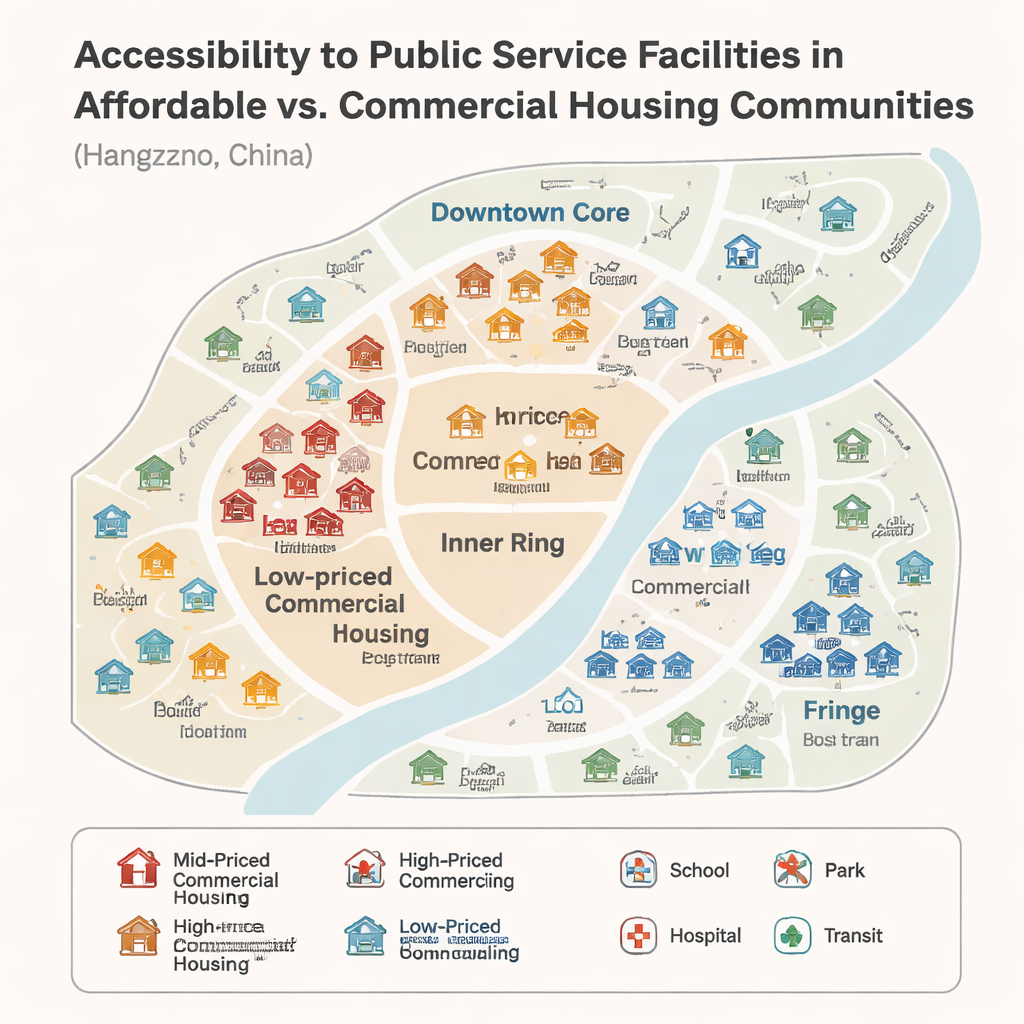
Hangzhou has both market-rate commercial housing and several kinds of government-supported homes for lower-income residents. The latter include public rental housing, blue-collar apartments for migrant workers, and affordable ownership housing sold at controlled prices. The study shows that these homes are not sprinkled evenly around the city. Mid- and high-priced commercial housing cluster in central, well-served districts, while affordable housing and low-priced commercial housing are more often grouped in outer or fringe areas. Public facilities are also uneven: top-tier hospitals, many schools, and popular parks tend to concentrate near the urban core, with fewer options toward the edges. Bus stops are more evenly spread, but rail transit still favors central zones.
Not All Market or "Affordable" Homes Are Equal
One striking finding is that commercial housing cannot simply be treated as the “advantaged” side of a rich–poor divide. When the team compares walking distances across housing types, mid-priced commercial communities almost always enjoy the best access to schools, hospitals, parks, and subway stations, followed by high-priced developments. Both affordable housing and low-priced commercial housing lag behind. In several cases, residents in the cheapest commercial units face the longest walks of all, performing even worse than people in policy-backed developments. This suggests that older, low-value private housing has become a new kind of “service desert,” where shrinking prices go hand-in-hand with weak public investment.
Hidden Gaps Inside Affordable Housing
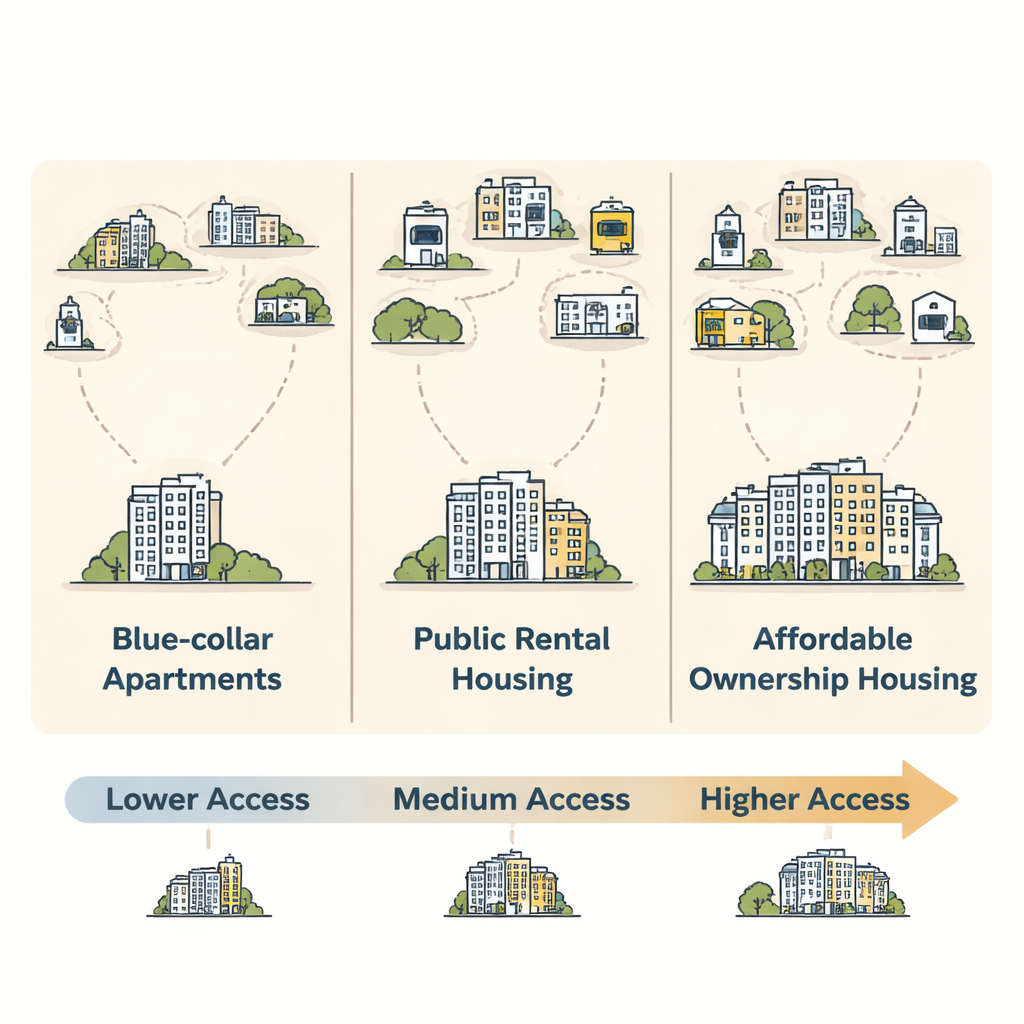
The study also overturns the idea that affordable housing is a single, uniform category. When the authors separate blue-collar apartments, public rental housing, and affordable ownership housing, clear internal gaps emerge. On average, affordable ownership housing has the best overall access to key services and the most even distribution across projects. Public rental housing sits in the middle. Blue-collar apartments—often converted from older industrial land or built quickly to house migrant workers near jobs—consistently come last. Residents there face especially poor access to kindergartens, primary schools, major hospitals, and even bus stops in some areas. A small but important share of these communities shows very low overall accessibility, highlighting pockets of residents who are particularly cut off from city resources.
What This Means for Fair and Livable Cities
For non-specialists, the message is clear: the promise of an equal “15-minute city” remains far from reality. Where you live in Hangzhou—whether in a mid-price downtown complex, a low-priced market flat, or a blue-collar apartment on the edge—strongly shapes how easily you can reach schools, doctors, parks, and trains. The authors argue that city planners and policymakers should look beyond simple labels like “affordable” or “commercial” and instead target the specific housing pockets where access is worst, especially low-priced commercial areas and blue-collar apartments. By carefully matching new housing with nearby public services and encouraging mixed-income neighborhoods that share facilities, cities can move closer to a fairer urban fabric in which basic opportunities truly lie within walking distance for everyone.
Citation: Wang, J., Zhou, J. & Fu, X. Accessibility evaluation of public service facilities in affordable housing communities in Hangzhou, China. Sci Rep 16, 5766 (2026). https://doi.org/10.1038/s41598-026-36201-1
Keywords: affordable housing, public services, spatial inequality, 15-minute city, urban planning