Clear Sky Science · en
Expression, transport, and storage of fetuin-B in human granulosa cells
Why a tiny fertility helper matters
Many couples struggling to conceive turn to in vitro fertilization (IVF) or intracytoplasmic sperm injection (ICSI). Success, however, hinges on an egg’s delicate surroundings inside the ovary. This study explores a little-known blood protein called fetuin-B, which helps sperm enter the egg, and asks: how is this protein handled by the egg’s helper cells in the ovary, and could that knowledge ultimately improve fertility treatments?
A gatekeeper for sperm entry
Before fertilization, the human egg is wrapped in a protective coat known as the zona pellucida. A sperm must pass through this coat to fuse with the egg, but once one sperm succeeds, the coat quickly hardens to block any others. Fetuin-B acts as a natural brake on this hardening by blocking an enzyme called ovastacin. In mice, the absence of fetuin-B leads to infertility because the egg coat becomes impenetrable too soon. In humans, higher blood levels of fetuin-B have been linked with better fertilization rates during IVF, suggesting that this protein could influence the chances of conception.
The egg’s support team
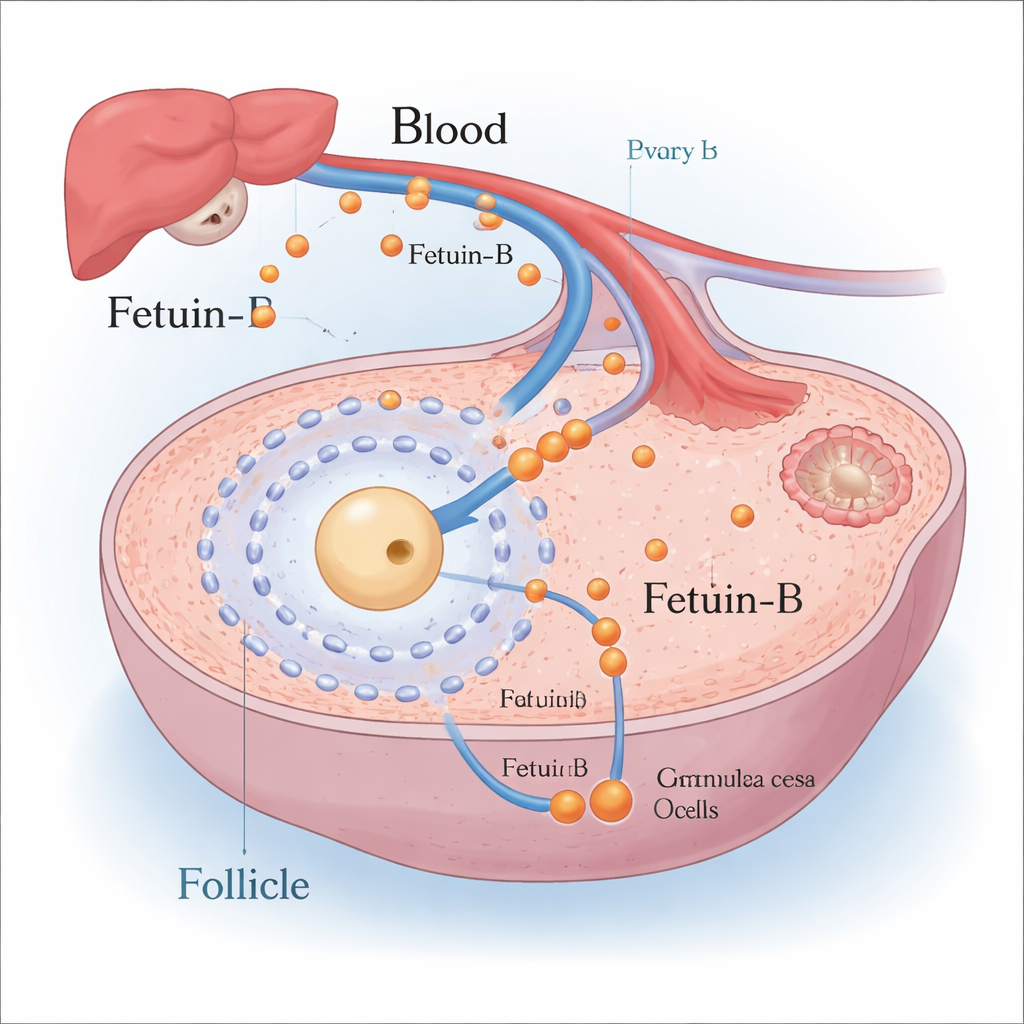
Inside the ovary, the egg is surrounded by granulosa cells, a layer of specialized support cells that feed the egg, control its environment, and produce the fluid that bathes it. Because fetuin-B is found in this follicular fluid as well as in the bloodstream, the authors set out to discover whether granulosa cells make fetuin-B themselves, and how they store and release it. They collected blood, follicular fluid, and granulosa cells from 45 women undergoing ICSI at a fertility clinic. The cells were grown in the lab, their genetic activity was measured, and fetuin-B levels were tracked both inside the cells and in the surrounding culture medium.
Stored, moved, but not made on site
When the team examined the genetic “blueprints” in granulosa cells, they found almost no activity from the gene that encodes fetuin-B. In contrast, liver-derived control cells showed strong gene activity, confirming that the test could pick up fetuin-B production when it occurred. This pointed to an important conclusion: granulosa cells do not meaningfully manufacture fetuin-B themselves. Instead, protein measurements revealed that fetuin-B levels were highest in blood serum, lower in follicular fluid, and surprisingly abundant inside granulosa cells. Using two independent methods, an ELISA assay and Western blotting, the researchers clearly detected fetuin-B protein within these cells despite the lack of gene expression.
How fetuin-B moves around the follicle
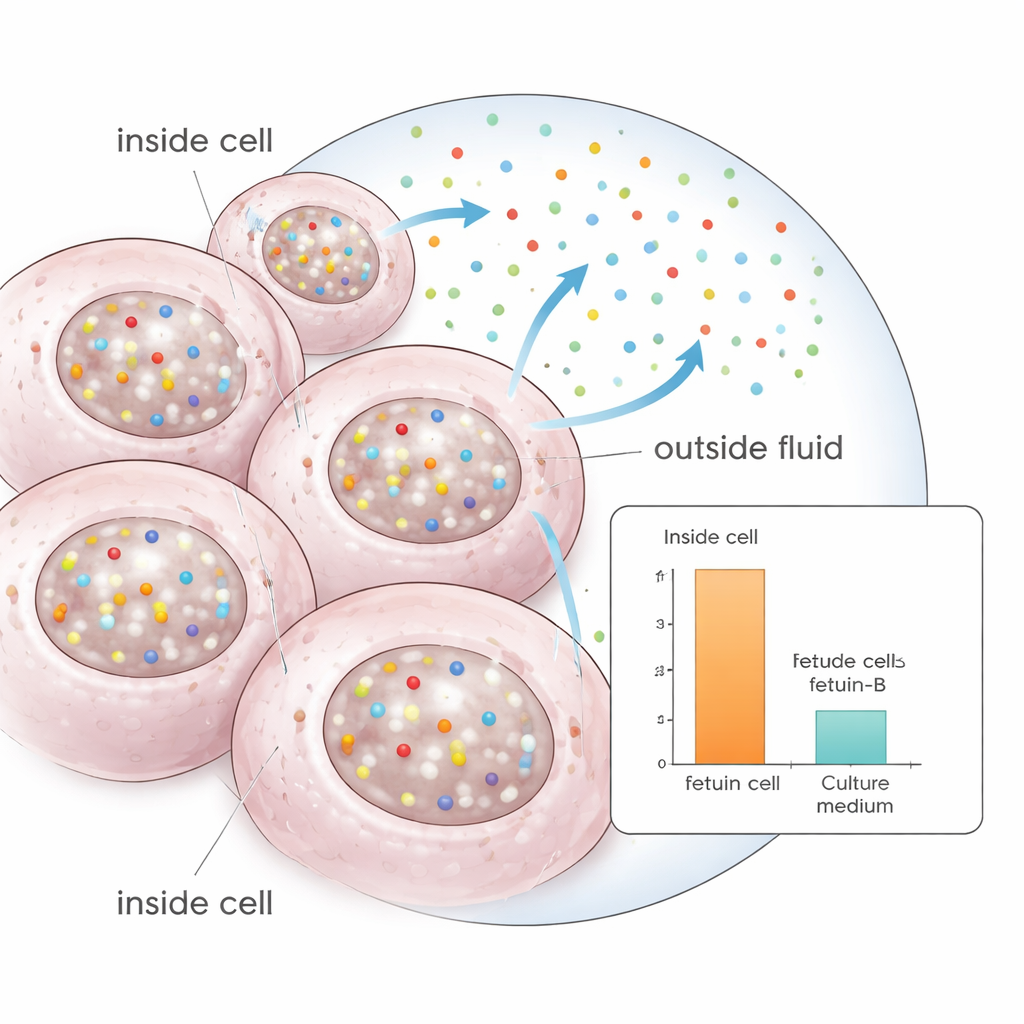
The pattern of fetuin-B suggested a circulation route. Fetuin-B appears to be produced mainly in the liver, released into the blood, then enters the follicular fluid and is taken up by granulosa cells. In cell culture, fetuin-B levels in the liquid around the cells were highest at the very start, when the cells were first washed off the eggs, and then dropped sharply and stayed low. Meanwhile, the concentration inside the cells remained much higher than outside. Under the microscope, fetuin-B was spread throughout the cell interior, with notable build-up in thin cell projections called filopodia, which may help shuttle the protein toward the egg. Together, these findings indicate that granulosa cells act as a reservoir: they store fetuin-B, release some of it into their surroundings, and may even take it back up again rather than simply leaking it out.
What this could mean for IVF
Because fetuin-B helps keep the egg’s outer coat receptive to sperm until the right moment, its availability near the egg is likely important for successful fertilization. The discovery that granulosa cells store but do not make fetuin-B suggests that their role is to position this protein exactly where it is needed—right next to the egg—rather than to produce it from scratch. For IVF and ICSI procedures, this work hints that how quickly eggs and their surrounding cells are transferred into fresh culture medium, and the amount of fetuin-B present there, could influence fertilization conditions. While more research is required before changing clinical practice, understanding this small protein’s journey from the liver to the egg offers a new angle on why some fertility treatments succeed while others fall short.
Citation: Linek, B., Meyer, AC., Schoppe, C. et al. Expression, transport, and storage of fetuin-B in human granulosa cells. Sci Rep 16, 3264 (2026). https://doi.org/10.1038/s41598-026-36199-6
Keywords: fertility, IVF, granulosa cells, fetuin-B, oocyte