Clear Sky Science · en
Assessing the relationships between capability, opportunity, and motivation in influencing self-isolation behaviour during pandemics
Why staying home is harder than it sounds
When a pandemic strikes, governments can tell people to stay at home, but whether they actually do is another matter. This study asks a simple but crucial question: what really drives people to self-isolate when they might have been exposed to COVID-19? By looking at thousands of survey responses from people across the United Kingdom during the first wave of the pandemic, the researchers tease apart how knowledge, social surroundings, and personal health concerns combine to shape one of the most important behaviours in a health crisis: choosing to shut your front door and stay inside.
Three everyday forces behind our choices
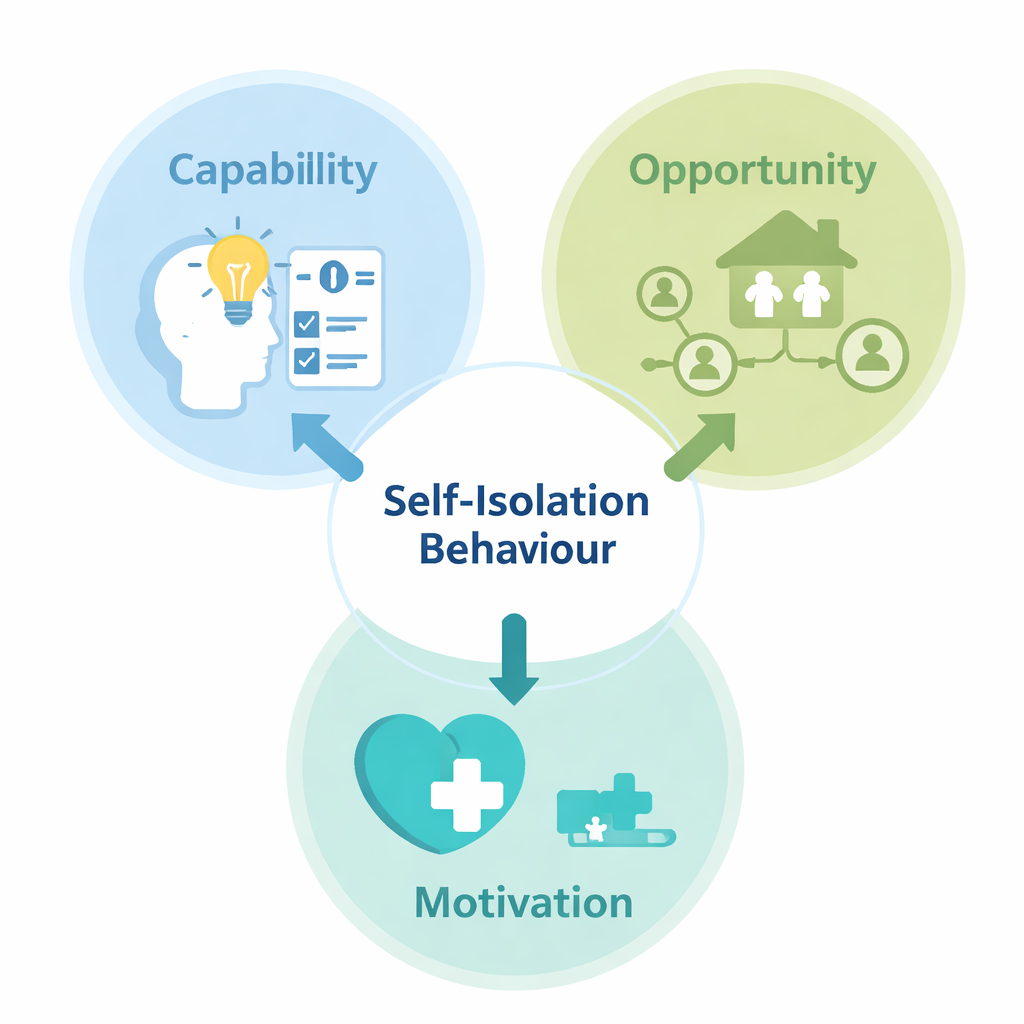
The researchers used a framework called COM-B, which breaks behaviour into three everyday forces: what you are able to do (capability), what your environment allows or encourages (opportunity), and what you feel driven to do (motivation). In the context of self-isolation, capability included whether people felt well-informed about how to protect themselves and about the government’s pandemic response, as well as their sense of loneliness. Opportunity reflected the social environment, especially whether anyone in their household, or someone they knew outside the home, had self-isolated. Motivation captured how people rated their own health, whether they had existing health problems, and how worried they were about COVID-19. Together, these ingredients were linked to a simple outcome: had the person self-isolated in the past week?
Mining national survey data for hidden patterns
Instead of running a new survey, the team repurposed data from the UK Office for National Statistics Opinions and Lifestyle Survey, collected weekly between March and May 2020. After excluding incomplete answers, they analysed responses from 1,656 adults. Using a statistical method called structural equation modelling, they checked how well the chosen questions represented the three COM-B forces and then estimated how strongly each force was connected to self-isolation. Although the original survey was not designed around this framework—meaning some questions were imperfect stand-ins—the overall model still described the data well and explained over three-quarters of the differences in who reported isolating.
Households and health worries matter most
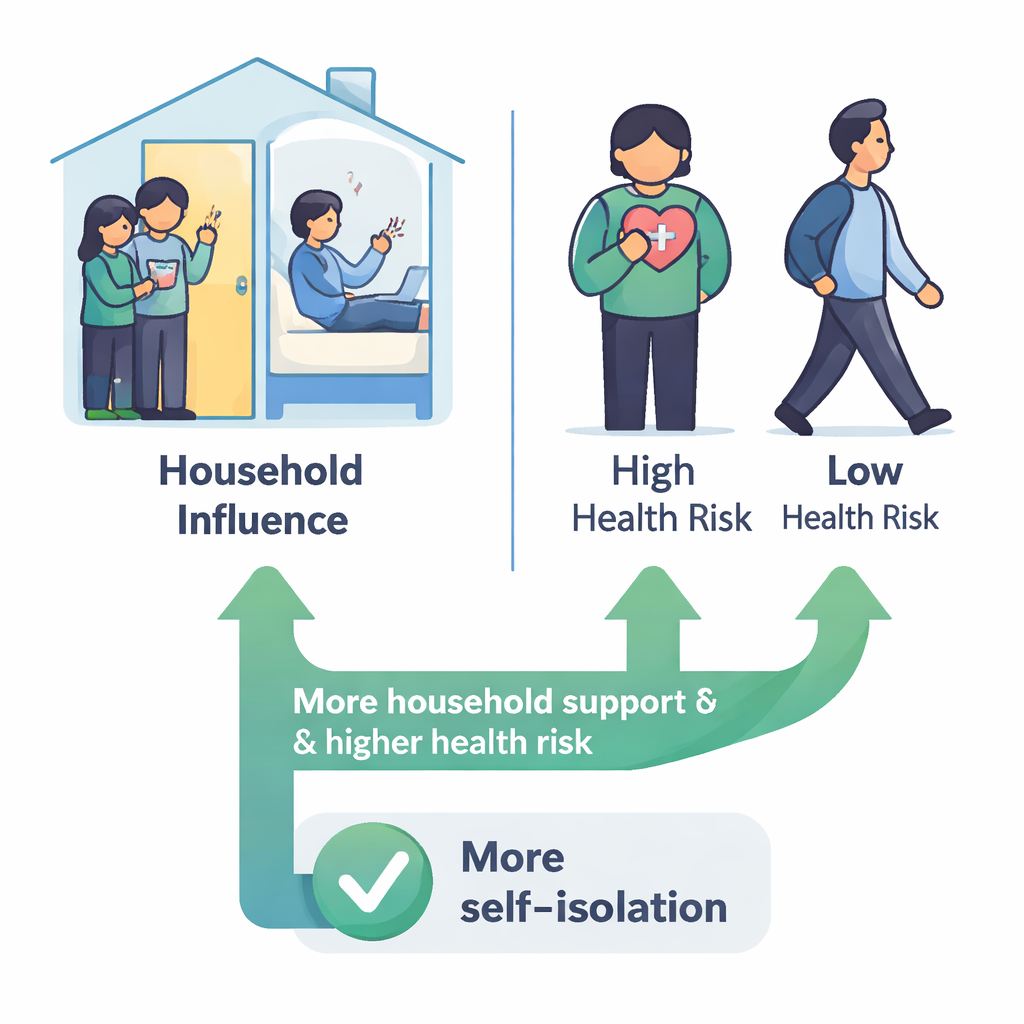
The most powerful driver of self-isolation turned out to be social opportunity, especially what was happening inside the home. People who lived with someone who had self-isolated were far more likely to isolate themselves than those who only knew someone outside the household who had done so. In other words, close-to-home examples spoke louder than distant ones. Personal health also played a role: people who rated their health as poorer or reported existing health conditions were more motivated to self-isolate. Simple worry about COVID-19 contributed but was much less important than feeling personally at risk. By contrast, just having more information about the pandemic or how to protect oneself did not directly translate into staying home.
When knowing more does not always help
One of the more surprising findings was that greater “capability” as measured here—mainly feeling well-informed—was linked to lower motivation to self-isolate. The authors suggest this may reflect information overload and confusion. During the early months of COVID-19, people were bombarded with changing and sometimes conflicting messages about rules and risks. In such an environment, more information can backfire, leaving people feeling overwhelmed or distrustful rather than energised to act. This pattern hints that quality, consistency, and emotional support in communication may matter more than simply increasing the volume of advice.
What this means for the next pandemic
For a layperson, the bottom line is that self-isolation is not just about willpower or knowledge; it is strongly shaped by what happens in your household and how vulnerable you feel. The study suggests that to keep people safely at home during future outbreaks, policymakers should focus on supporting families and housemates to act together, and on giving extra help and clear guidance to those in poorer health, rather than relying solely on broad public information campaigns. While the work cannot prove cause and effect, it offers a practical message: if we want high compliance with isolation, we must create living situations and messages that make “doing the right thing” both socially supported and personally meaningful.
Citation: Oyedele, G.J., Shanker, A., Tildesley, M.J. et al. Assessing the relationships between capability, opportunity, and motivation in influencing self-isolation behaviour during pandemics. Sci Rep 16, 5251 (2026). https://doi.org/10.1038/s41598-026-36198-7
Keywords: self-isolation, COVID-19 behaviour, COM-B model, pandemic compliance, public health messaging