Clear Sky Science · en
Compressive strength prediction of carbonated recycled aggregate concrete using regression based machine learning models
Turning Old Concrete into a Climate Ally
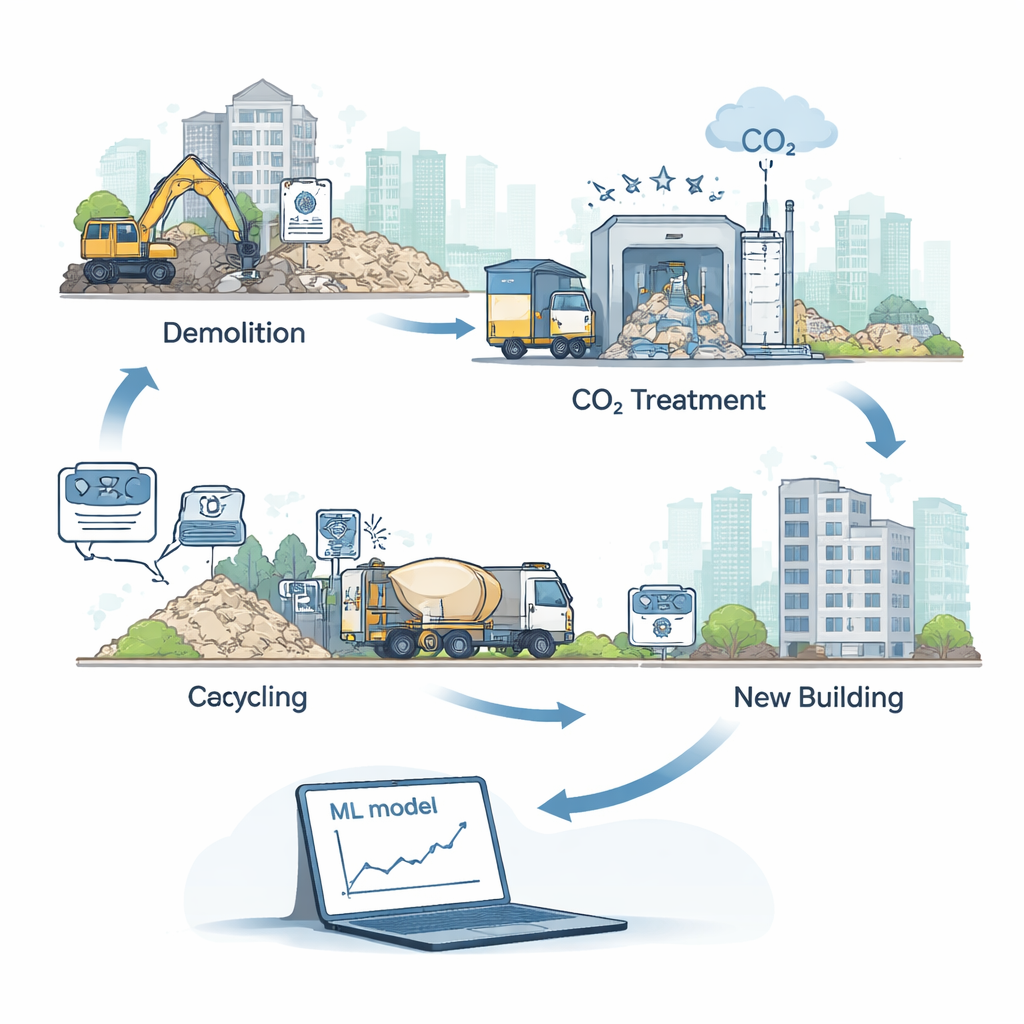
Every year, cities demolish vast amounts of concrete, sending broken chunks to landfills and demanding fresh stone from quarries. This study explores a way to close that loop: taking crushed waste concrete, using it to lock away carbon dioxide, and then predicting how strong the new, greener concrete will be using modern machine learning tools. For anyone interested in climate-friendly cities and smarter use of data, this work shows how artificial intelligence can help engineers design safer, more sustainable buildings from yesterday’s rubble.
Why Reusing Concrete Matters
Concrete is everywhere—roads, bridges, high-rises—and producing it consumes huge amounts of natural rock and energy while emitting large volumes of CO₂. Recycled concrete aggregates, made by crushing old concrete, can ease this burden by reducing quarrying and landfill waste. But there is a catch: these recycled pieces usually carry leftover cement paste on their surface, which makes them more porous and weaker than natural stone. That often means new concrete made with recycled aggregates is not as strong or durable, a serious concern for structural safety.
Making Waste Concrete Stronger with CO₂
To tackle this problem, researchers have turned to carbonation, a process where CO₂ is deliberately introduced to react with compounds in the old cement paste. Inside the recycled particles, the gas forms solid minerals that fill pores, tighten microcracks, and strengthen the contact zones that hold new concrete together. This not only improves material quality—raising density and lowering water absorption—but also stores CO₂ inside the concrete, effectively turning waste into a small carbon sink. The study focused on concrete made with these carbonated recycled aggregates and asked a key question: can we accurately predict how strong this greener concrete will be without running endless laboratory tests?
Teaching Computers to Predict Strength
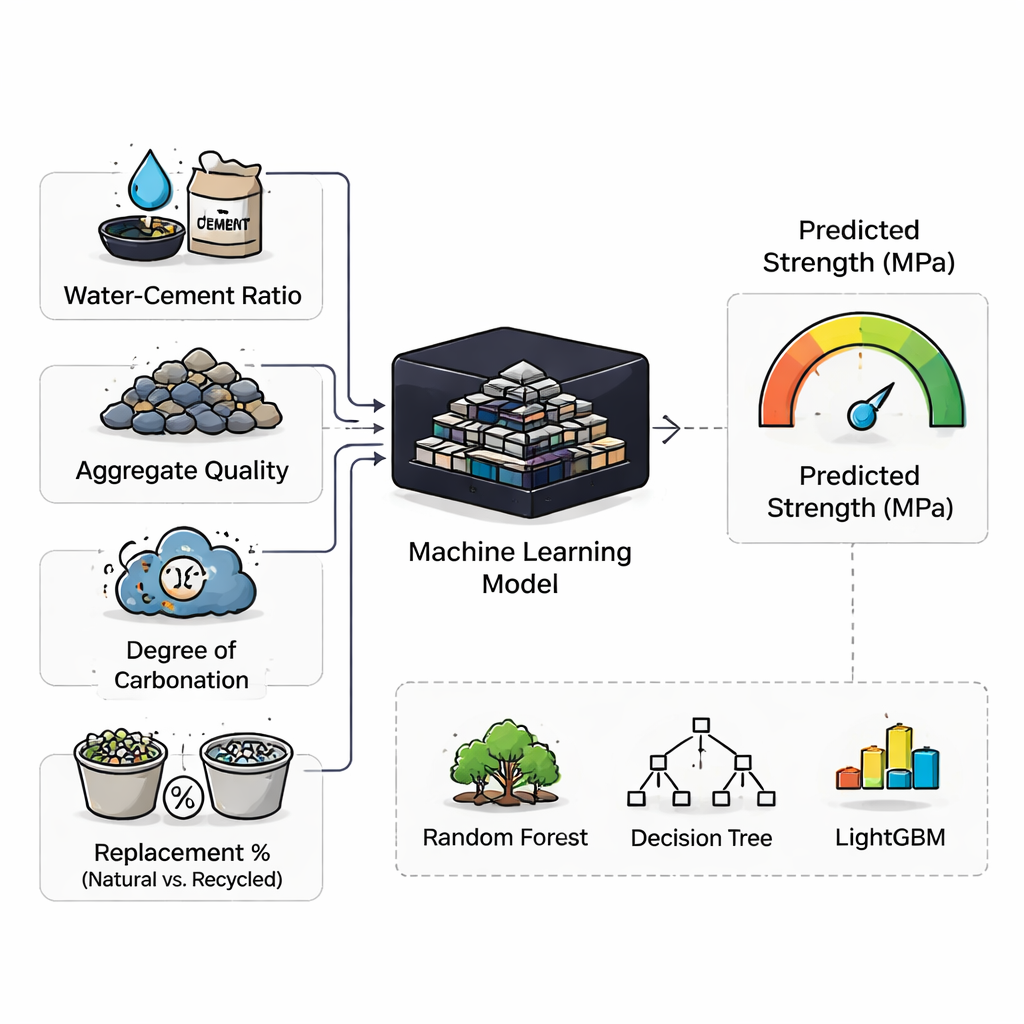
The authors assembled 108 carefully measured concrete samples from earlier experiments. For each one, they recorded how the mix was put together (such as the ratio of water to cement and how much fine and coarse aggregate was used), how good the aggregates were (their water absorption and resistance to crushing), how strong the original “parent” concrete had been, how much CO₂ the recycled pieces took up, and what fraction of natural stone was replaced by recycled material. They then trained several regression-style machine learning models—ranging from simple straight-line formulas to more flexible decision trees and ensembles—to learn the link between these inputs and the resulting compressive strength.
Untangling Complex Mixes with Smart Models
Many of the measured ingredients were strongly interrelated, which can confuse traditional statistical methods. To simplify, the team combined groups of related variables into two composite indices: one describing how the mix was proportioned overall, and another summarizing aggregate performance. They then compared models trained on the full, detailed data with models trained on these compact indices. Simple linear approaches did reasonably well but struggled with the curved, intertwined relationships in the data. In contrast, tree-based ensemble methods—decision trees, random forests, and LightGBM—captured these patterns with remarkable precision, keeping typical prediction errors around just over 1 megapascals of strength and explaining more than 99% of the variation seen in tests.
What Matters Most for Strong Green Concrete
To open the “black box” of the best-performing models, the researchers used SHAP, a technique that shows how much each input typically pushes predictions up or down. They found that how the mix is proportioned—especially the balance between cement, aggregates, and water—is the dominant factor controlling strength. The degree of carbonation in the recycled aggregates also plays a major but nonlinear role: more CO₂ treatment generally helps, but its effect depends on the quality of the original parent concrete. The combined indicator of aggregate performance has a moderate influence, whereas simply increasing the percentage of recycled aggregates matters less than getting the mix design and treatment right.
From Lab Data to Practical Design
In plain terms, this study shows that carbonated recycled aggregate concrete can be both climate-conscious and strong—provided its recipe is carefully tuned. Modern machine learning, especially tree-based ensemble models, can accurately predict strength from a manageable set of mix and material parameters, reducing the need for time-consuming tests on every new combination. For engineers and planners, this means it is increasingly realistic to design structures that reuse old concrete, lock away CO₂, and still meet demanding safety standards, with data-driven tools guiding the way.
Citation: Gebremariam, H.G., Taye, S. & Tarekegn, A.G. Compressive strength prediction of carbonated recycled aggregate concrete using regression based machine learning models. Sci Rep 16, 5825 (2026). https://doi.org/10.1038/s41598-026-36197-8
Keywords: recycled concrete, carbonation, machine learning, compressive strength, sustainable construction