Clear Sky Science · en
Long-range context modeling for software vulnerability detection using an XLNet-based approach
Why hidden software flaws matter
Modern life runs on software, from online banking and hospital systems to video players and chat apps. Yet even tiny mistakes in program code can open the door to hackers, risking data theft or service outages. Security experts increasingly turn to artificial intelligence to scan millions of lines of code for such weaknesses. This paper explores a new AI-based method, called XLNetVD, that is designed to spot subtle software vulnerabilities by reading much larger stretches of code than many existing tools can handle.
From simple word lists to code that understands context
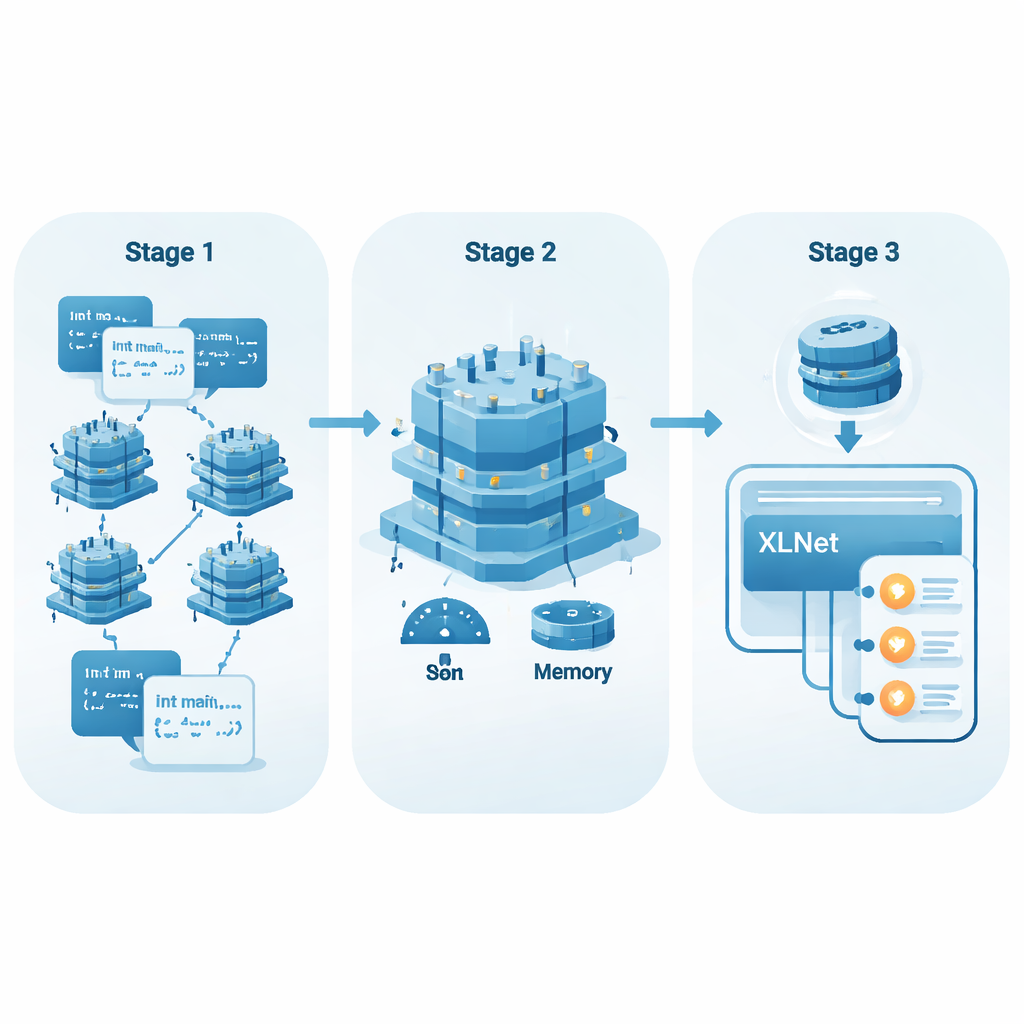
Early AI methods for analyzing code treated each token—such as a variable name or symbol—almost like a dictionary word with a fixed meaning. Techniques like Word2Vec or GloVe learned one vector per token, no matter where it appeared. That works reasonably well for natural language, but it falls short for programs, where the same variable name can behave very differently depending on where and how it is used. Newer models, known as contextual embedding models, instead look at the entire function at once and adjust each token’s representation according to its surroundings. This allows them to pick up on patterns related to data flow, control flow, and how variables depend on one another—patterns that often spell the difference between safe and unsafe code.
Letting the AI read more of the file
Popular code models like CodeBERT and GraphCodeBERT already use this context-aware approach, but they typically limit their “view” to about 512 tokens. For long functions, or for vulnerabilities that are hinted at in widely separated parts of the code, that window can be too short. Important checks near the start of a function may be cut off from risky operations near the end. The authors instead build on XLNet, a model based on Transformer-XL, which can remember information across segments and comfortably process longer sequences (up to 768 tokens in their experiments). This makes it better suited to link distant events in code—for example, understanding that a value was validated earlier, or realizing that it never was.
Making powerful models lighter and faster
Large AI models often demand powerful hardware, which limits their use in everyday development environments. To address this, the authors apply a fine-tuning method called Low-Rank Adaptation (LoRA). Rather than changing all of XLNet’s many parameters, LoRA adds small adapter layers that are much cheaper to train and store. The team introduces a simple score, EffScore, that weighs how much memory and time are saved against any drop in detection quality. Across several leading models, XLNet with LoRA emerges as the most efficient overall, offering strong accuracy while using significantly fewer resources.
Testing on real and synthetic projects
The researchers evaluate XLNetVD on two very different datasets. One consists of real C code from 12 open-source projects—such as media libraries and web servers—with an extremely skewed ratio of about 1 vulnerable function to 65 non-vulnerable ones, reflecting the reality of large software bases. The other is a balanced synthetic collection from the SARD project, where each function is crafted to represent a known weakness type. XLNetVD not only matches or beats prior deep-learning systems and classic static analysis tools on these tests, it also performs well in cross-project settings, where it must find flaws in a project it has not seen before. Its advantage is especially strong for long functions, where longer context is crucial, and across a range of vulnerability categories, including integer overflows, resource mismanagement, and improper input handling.
What this means for everyday software safety
For a non-specialist, the core message is that smarter, context-aware AI can read and reason about code more like an experienced human reviewer, but at machine scale. By letting the model see more of each function and by tuning it efficiently, XLNetVD offers a practical way to prioritize which parts of a huge codebase deserve closer human inspection. It does not replace manual security audits or formal methods, and it cannot guarantee that software is bug-free. However, it significantly improves the odds of catching dangerous mistakes early, even in unfamiliar projects, making it a promising building block for more reliable and secure digital infrastructure.
Citation: Zhao, Y., Lin, G. & Liao, Z. Long-range context modeling for software vulnerability detection using an XLNet-based approach. Sci Rep 16, 5338 (2026). https://doi.org/10.1038/s41598-026-36196-9
Keywords: software vulnerabilities, code security, deep learning, XLNet, LoRA fine-tuning