Clear Sky Science · en
Image segmentation-based analysis reveals correlation between IL-1RA overexpression and worse survival outcomes in oral squamous cell carcinoma
Why inflammation matters in mouth cancer
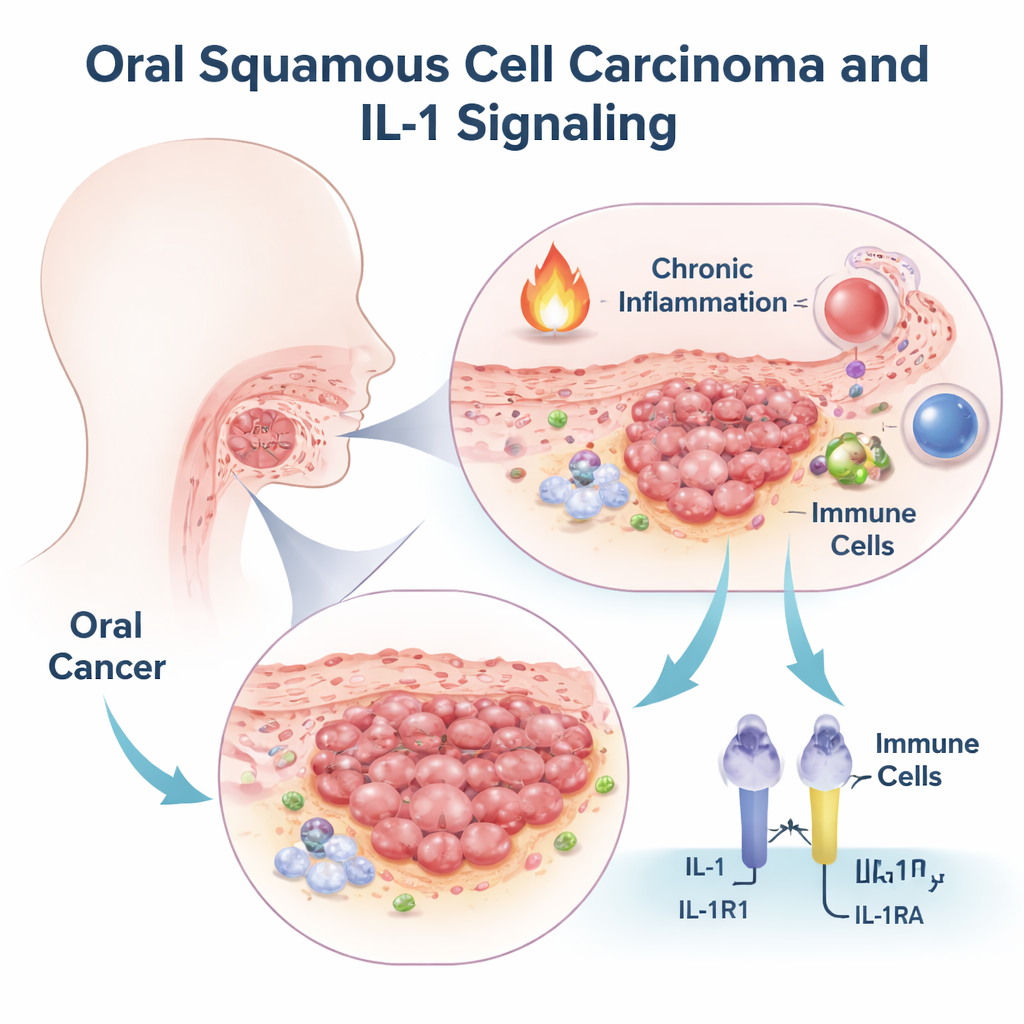
Oral cancer, especially tumors that arise on the tongue and other parts of the mouth lining, is common worldwide and often deadly. Scientists know that long‑lasting inflammation can help cancers grow, but they are still uncovering which inflammatory signals are most dangerous. This study looks closely at a family of chemical messengers called interleukin‑1 (IL‑1) in oral squamous cell carcinoma and asks a simple but important question: can the level of one of these molecules help predict who is more likely to die from the disease?
Taking a closer look at tumor signals
To explore this, researchers examined tissue samples from 44 patients who had surgery for oral squamous cell carcinoma, most of them with advanced disease. Alongside each tumor, they also evaluated nearby mouth lining that did not show precancerous changes, using it as a comparison tissue. They focused on four related molecules in the IL‑1 family: IL‑1α and IL‑1β (two inflammatory signals), IL‑1R1 (their main receptor on cells), and IL‑1RA, a natural “brake” that normally dampens IL‑1 activity. By applying special stains and then using computer‑based image segmentation, the team measured how much of each molecule was present across thousands of microscopic images.
Inflammation dial turned up in cancer tissue
The analysis showed that all four IL‑1‑related molecules were much more abundant in cancer tissue than in the adjacent non‑dysplastic epithelium. In other words, compared with apparently healthy mouth lining, the tumors looked like hotspots of IL‑1 signaling. This pattern reinforces the idea that chronic, smoldering inflammation is woven into the biology of oral cancer. Interestingly, the amount of these molecules did not differ much between the outer parts of the tumor and the deeper, invading edge, suggesting that IL‑1 signaling is switched on throughout the tumor mass rather than only at the front where the cancer pushes into nearby tissue.
When the natural brake may not protect
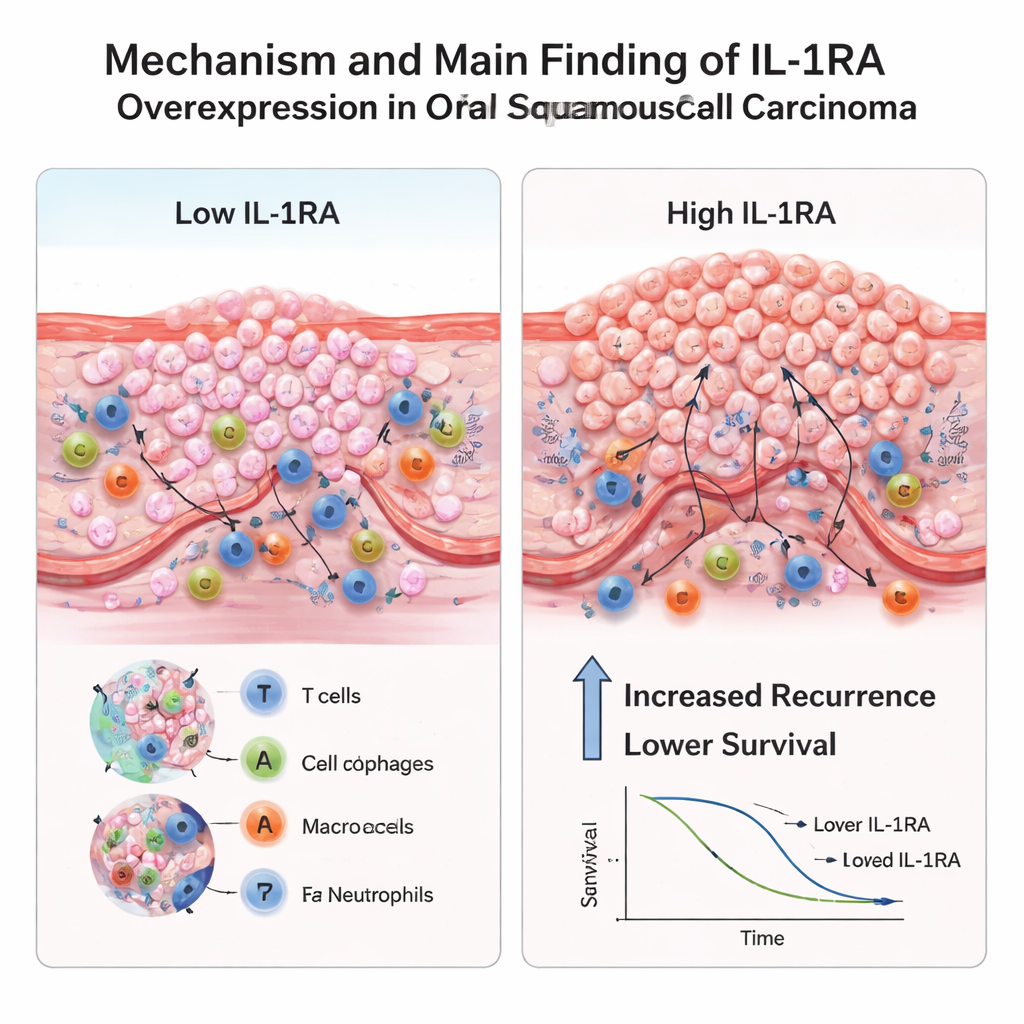
One finding stood out: high levels of IL‑1RA, the molecule usually thought of as an antagonist that blocks IL‑1, were linked to worse patient outcomes. Tumors with stronger IL‑1RA staining were more likely to come back after treatment, and patients with these tumors had lower chances of being alive five years after surgery. When the researchers used statistical models that take several risk factors into account at once, two factors independently predicted poorer overall survival: spread of the cancer to neck lymph nodes and overexpression of IL‑1RA in the tumor. Other IL‑1‑related markers, such as IL‑1α, IL‑1β, and IL‑1R1, did not show the same clear relationship with survival in this group of patients.
A complex role for inflammatory signals
These results add to a growing and sometimes conflicting body of evidence about IL‑1RA in cancer. In some settings, lower levels of IL‑1RA seem to remove an important brake on inflammation and allow tumors to flourish; in others, including this study of oral cancer, high IL‑1RA appears to travel together with more aggressive disease and shorter survival. The authors suggest that the impact of IL‑1RA may depend on where it is located inside or outside cells, how it interacts with the tumor’s supporting tissue, and which other inflammatory signals are present in the tumor microenvironment. They also note that IL‑1 molecules are general markers of inflammation, so a broader panel of immune signals may be needed to fully predict how a tumor will behave.
What this means for patients and future care
For patients and clinicians, the key takeaway is that oral squamous cell carcinoma is not just a cluster of rogue cells, but a disease deeply shaped by inflammatory communication within the tumor and its surroundings. This study shows that tumors with particularly high levels of IL‑1RA are more likely to recur and are linked to lower long‑term survival, placing IL‑1RA on the map as a potential prognostic marker. While more work in larger patient groups is needed before this marker can guide everyday treatment decisions, the findings point toward future strategies that might target IL‑1‑related pathways—either by fine‑tuning inflammation or combining such approaches with existing therapies—to improve outcomes for people with oral cancer.
Citation: Martins, F., Martínez-Flores, R., Pereira, V. et al. Image segmentation-based analysis reveals correlation between IL-1RA overexpression and worse survival outcomes in oral squamous cell carcinoma. Sci Rep 16, 5272 (2026). https://doi.org/10.1038/s41598-026-36193-y
Keywords: oral cancer, inflammation, interleukin-1, biomarkers, survival