Clear Sky Science · en
Engineering characteristics of agro-residue–based geopolymer concrete with fibre reinforcement
Turning Farm Waste into Stronger Buildings
Concrete is the world’s most used man-made material, but making its main ingredient—Portland cement—releases huge amounts of carbon dioxide. This study asks a simple but powerful question: can we turn farm waste and animal waste into a cleaner kind of concrete that still keeps our buildings safe and long‑lasting? By blending ashes from sugarcane, rice husks, and cow dung with tiny rock fibres, the researchers show how yesterday’s waste could become tomorrow’s low‑carbon buildings.
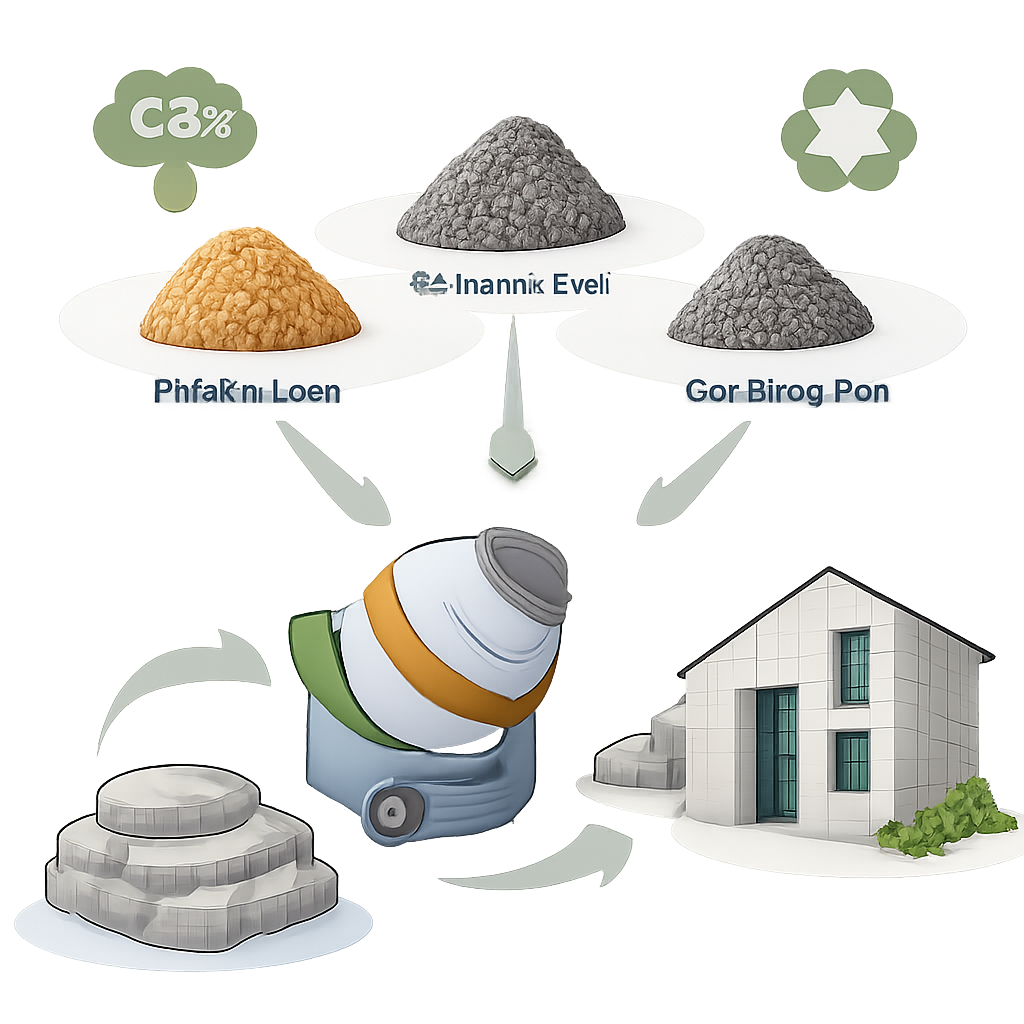
From Fields and Barns to Building Sites
The team focused on a type of binder called “geopolymer,” which can be made by activating materials rich in silica and alumina instead of using cement. They used three agricultural by‑products as the main ingredients: sugarcane bagasse ash from sugar mills, rice husk ash from grain processing, and cow dung ash from rural areas. These powders were carefully burned, dried, and sieved, then mixed in a fixed 40:30:30 ratio. To hold everything together like normal concrete, they added sand and crushed stone, plus a chemical solution based on sodium hydroxide and sodium silicate. Finally, they blended in short basalt fibres—threads made from melted volcanic rock—at different dosages to see how much fibre would help or hurt performance.
How the New Concrete Was Put to the Test
To judge whether this farm‑waste concrete was truly useful, the researchers built it and then stressed it in several ways. Freshly mixed batches were checked for workability using a standard slump test—essentially seeing how easily the wet mix flows and can be placed in moulds. Hardened samples were tested for compressive strength (how much crushing load they can bear), flexural strength (how they behave in bending), and split tensile strength (how they resist pulling apart). Durability was examined by soaking specimens in acid, measuring how much water they absorbed, and running a rapid chloride test that shows how easily salt can move into the concrete—a key issue for bridges and coastal structures. These tests were carried out at multiple ages up to 180 days to see how performance developed over time.
The Sweet Spot for Rock Fibres
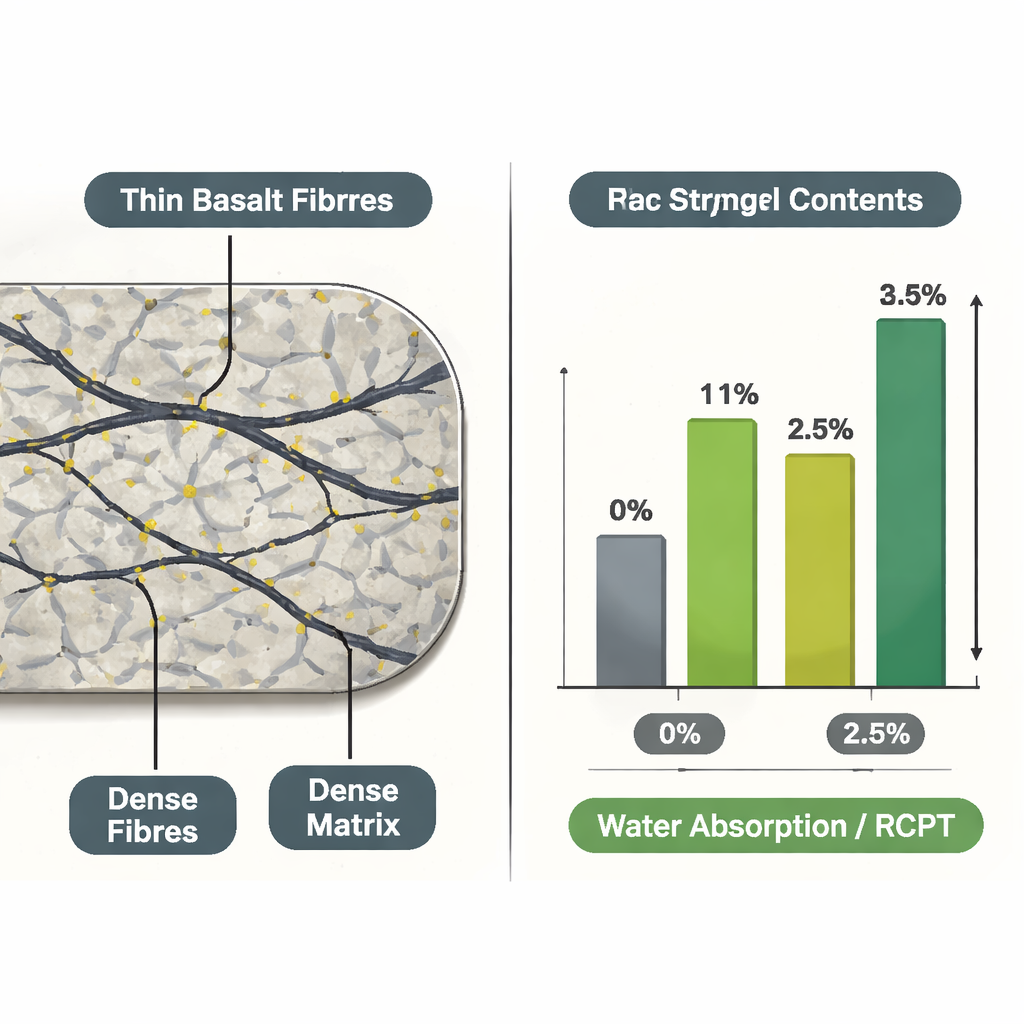
The results revealed a clear “Goldilocks” zone for the basalt fibres. Adding a small amount of fibre made the concrete stronger and tighter, but adding too much caused problems. With no fibres, the concrete already reached about 50 megapascals of compressive strength after 180 days—strong enough for many structural uses. When 1% basalt fibre (by weight of binder) was included, the strength climbed to about 62 megapascals, with similar 30% or so gains in bending and tensile capacity. At this level, the internal fibres act like tiny bridges across microcracks, helping the material carry more load and resist damage. At higher fibre contents, however, workability dropped sharply, the mix became harder to compact, fibres clumped together, and extra voids formed. These defects reduced strength instead of improving it.
Fighting Water, Salts, and Harsh Chemicals
Durability tests told a similar story. The mix without fibres absorbed around 8% water and lost a large share of its mass when exposed to a strong acid solution over 12 weeks. When the fibre content was set at 1%, water absorption fell to about 5%, acid‑related mass loss dropped from roughly 38% in the worst mix down to about 6%, and the electrical charge passed in the chloride test decreased from 3100 to 1600 coulombs—shifting the material from “moderate” to “low” salt penetrability. In other words, the optimally reinforced concrete not only carried more load but also formed a denser internal network that better blocked water and chemicals. Statistical analysis confirmed that the relationship between fibre content and performance was parabolic: properties improved up to around 1% fibre and then declined as fibres were added beyond about 1.5%.
What This Means for Greener Construction
For a non‑specialist, the bottom line is straightforward: this study shows that it is possible to make a strong, durable concrete‑like material using waste from sugarcane, rice, and cattle, while cutting reliance on ordinary cement. When about 1% basalt fibre is added, the material not only stands up well under loads but also better resists water, road salts, and aggressive chemicals—key threats to long‑term performance. Go much above that amount, and the benefits reverse. The work points toward a future in which rural and agro‑industrial waste streams can be turned into reliable building blocks, helping lower carbon emissions, reduce landfill use, and create more circular, climate‑friendly construction systems.
Citation: Ravish, G., Abbass, M. Engineering characteristics of agro-residue–based geopolymer concrete with fibre reinforcement. Sci Rep 16, 5585 (2026). https://doi.org/10.1038/s41598-026-36190-1
Keywords: geopolymer concrete, agricultural waste, basalt fibre, low-carbon construction, concrete durability