Clear Sky Science · en
Enhanced accumulation of anticancer compounds in C. roseus hairy root cultures through elicitation and precursor feeding
Why a Garden Flower Matters for Cancer Care
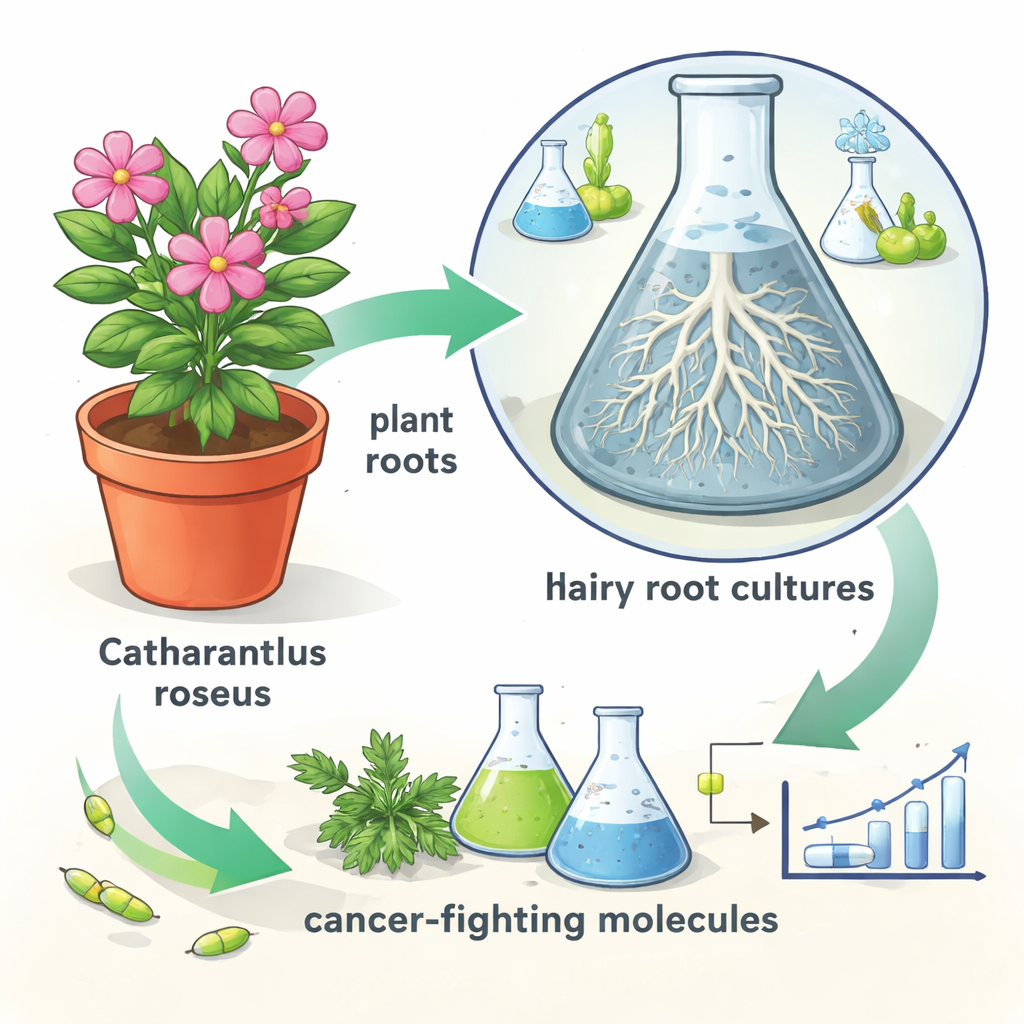
The pink-flowering garden plant Catharanthus roseus, also known as Madagascar periwinkle, quietly provides two powerful cancer drugs: vincristine and vinblastine. Yet these medicines occur in such tiny amounts in the plant that producing enough for patients is expensive and depends heavily on field crops. This study explores how to turn specially grown “hairy roots” of this plant into efficient, controllable mini-factories for these lifesaving compounds, potentially making cancer treatments more reliable and affordable.
Turning Roots into Tiny Medicine Factories
Instead of relying on whole plants grown in fields, the researchers used hairy root cultures—roots encouraged to grow rapidly in flasks after infection with a soil bacterium. These roots keep many of the plant’s natural abilities but can be raised year-round in the lab under stable conditions. In this work, the team grew a single, well-characterized hairy root line of C. roseus in liquid nutrient medium. Once the cultures were established, they added different helper substances to see whether the roots could be coaxed into making more of four important alkaloids: ajmalicine, catharanthine, vincristine, and vinblastine.
Testing Natural “On Switches” and Building Blocks
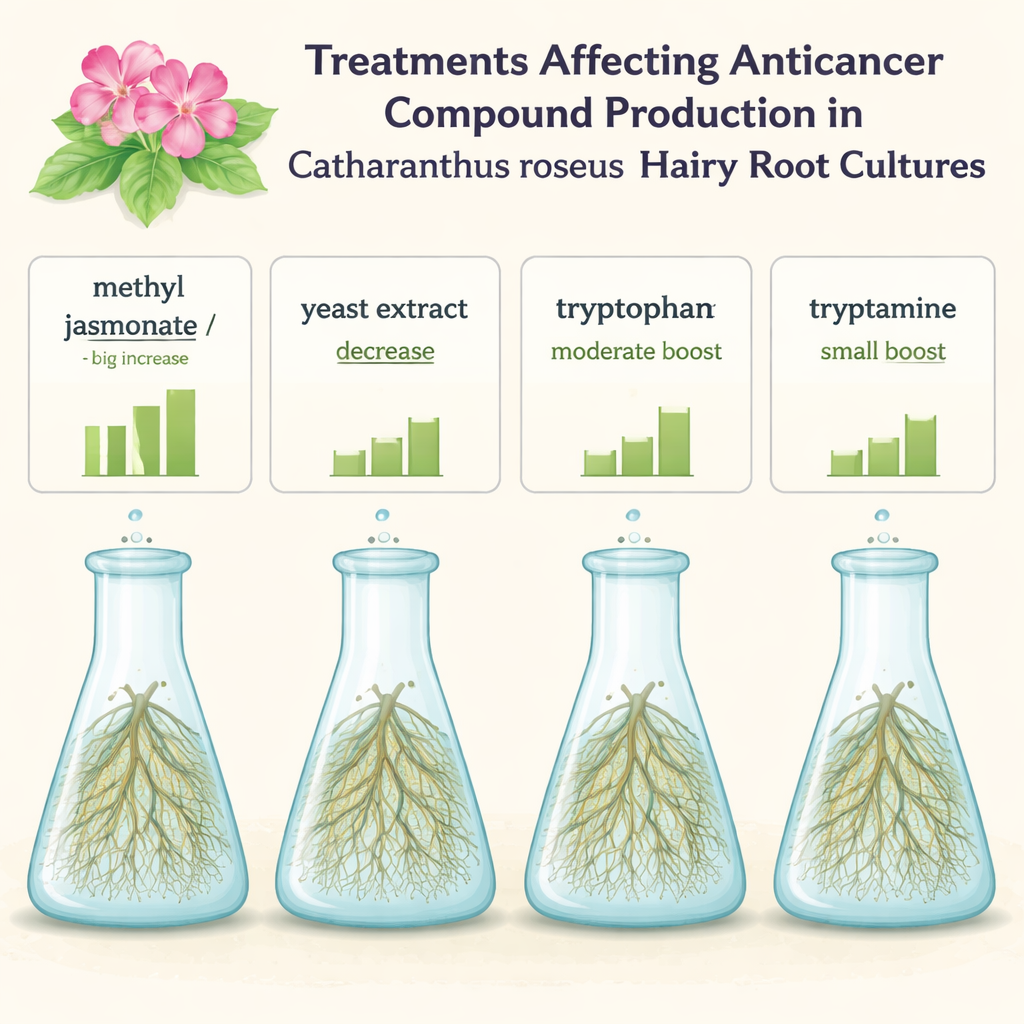
The scientists tried two kinds of additions. First were “elicitors,” signals that mimic stress and often push plants to ramp up their chemical defenses. They tested methyl jasmonate, a plant hormone related to wound and insect responses, and yeast extract, which imitates attack by microbes. Second were “precursors,” simple starting materials the plant normally turns into more complex molecules: the amino acid tryptophan and its direct product, tryptamine. After one week of treatment, the roots were dried and analyzed by high-performance liquid chromatography to measure how much of each alkaloid had accumulated.
Which Treatments Boosted Cancer-Fighting Molecules?
Methyl jasmonate turned out to be the star performer. At all tested doses, it strongly increased ajmalicine and catharanthine, and at 10 micromolar it also boosted vinblastine to about four times the control level, without harming root growth. In contrast, yeast extract generally made things worse: across the tested concentrations it lowered the levels of all four alkaloids, even though the roots were still healthy, suggesting that the signal redirected metabolism away from the desired products. The precursor experiments showed that moderate additions help but too much can backfire. A low dose of tryptophan (50 mg/L) improved catharanthine and vinblastine production, while higher doses reduced several compounds. Tryptamine at 100 mg/L gave only a small rise in vinblastine and lowered other alkaloids, hinting that the pathway has built-in bottlenecks and feedback controls.
Peeking Under the Hood of the Plant’s Chemistry
To understand why some treatments worked better than others, the team measured the activity of two key genes, TDC and STR, which control early steps in the alkaloid assembly line. Using quantitative PCR, they found that effective treatments—10 and 100 micromolar methyl jasmonate, 50 and 250 mg/L tryptophan, and 100 mg/L tryptamine—switched these genes on, sometimes by more than fourfold. At very high levels, however, methyl jasmonate or precursors shut the genes down again, matching the drop in alkaloid output. Yeast extract consistently reduced TDC, and often STR as well, aligning with its poor performance on alkaloid production. These patterns show that successful strategies must both feed the pathway with raw materials and send the right “go” signals at the genetic level.
What This Means for Future Cancer Drug Supplies
In simple terms, the study shows that carefully chosen signals and building blocks can make C. roseus hairy roots produce much more of important cancer-fighting compounds, while other treatments can accidentally slow production. A relatively mild dose of methyl jasmonate, especially combined with an optimal amount of tryptophan, looks promising for scaling up in bioreactors. If refined and validated further, this approach could help industry generate vincristine, vinblastine, and related molecules more efficiently in controlled tanks rather than in fields, supporting a more stable and possibly more affordable supply of critical anticancer medicines.
Citation: Rady, M.R., Mabrouk, D.M. & Ibrahim, M.M. Enhanced accumulation of anticancer compounds in C. roseus hairy root cultures through elicitation and precursor feeding. Sci Rep 16, 4771 (2026). https://doi.org/10.1038/s41598-026-36185-y
Keywords: Catharanthus roseus, hairy root cultures, anticancer alkaloids, methyl jasmonate, plant biotechnology