Clear Sky Science · en
Investigation and countermeasure of the dietary nutrition status of college students from the perspective of healthy China
Why College Eating Habits Matter
College years are often the first time young adults make all their own food choices, juggling late-night study sessions, social life, and tight budgets. This study of more than 800 Chinese college students asks a simple but crucial question: do students know how to eat well, and are they actually doing it? The answers reveal a stubborn gap between what students know and how they eat, with important lessons for families, universities, and anyone concerned about young people’s long-term health. 
Who Was Studied and What Was Measured
Researchers surveyed 815 students at a university in Shanxi Province, China—about one-third male and two-thirds female. They used a standard "KAP" framework, which looks at three pieces of the puzzle: what students know about nutrition (knowledge), how they feel about healthy eating (attitudes), and what they actually do day to day (practices). Students reported their height and weight so the team could calculate body mass index (BMI) and classify them as underweight, normal weight, or overweight/obese. The questionnaire also asked about where students get nutrition information, how often they eat different foods, and simple habits such as drinking water and skipping meals.
What the Scales Revealed About Weight
The BMI results show that just over half of the students—about 55 percent—had a weight in the normal range. More than a quarter (nearly 27 percent) were underweight, and about one in five (18 percent) were overweight or obese. Underweight was much more common among women, while men were more likely to carry extra weight. These patterns match wider social pressures: many young women feel pushed to be very thin, while young men may eat more and move less. Despite these weight differences, the study did not find clear-cut differences in nutrition knowledge, attitudes, or daily eating behaviors across BMI groups, suggesting that weight alone does not tell the full story of how students think about food. 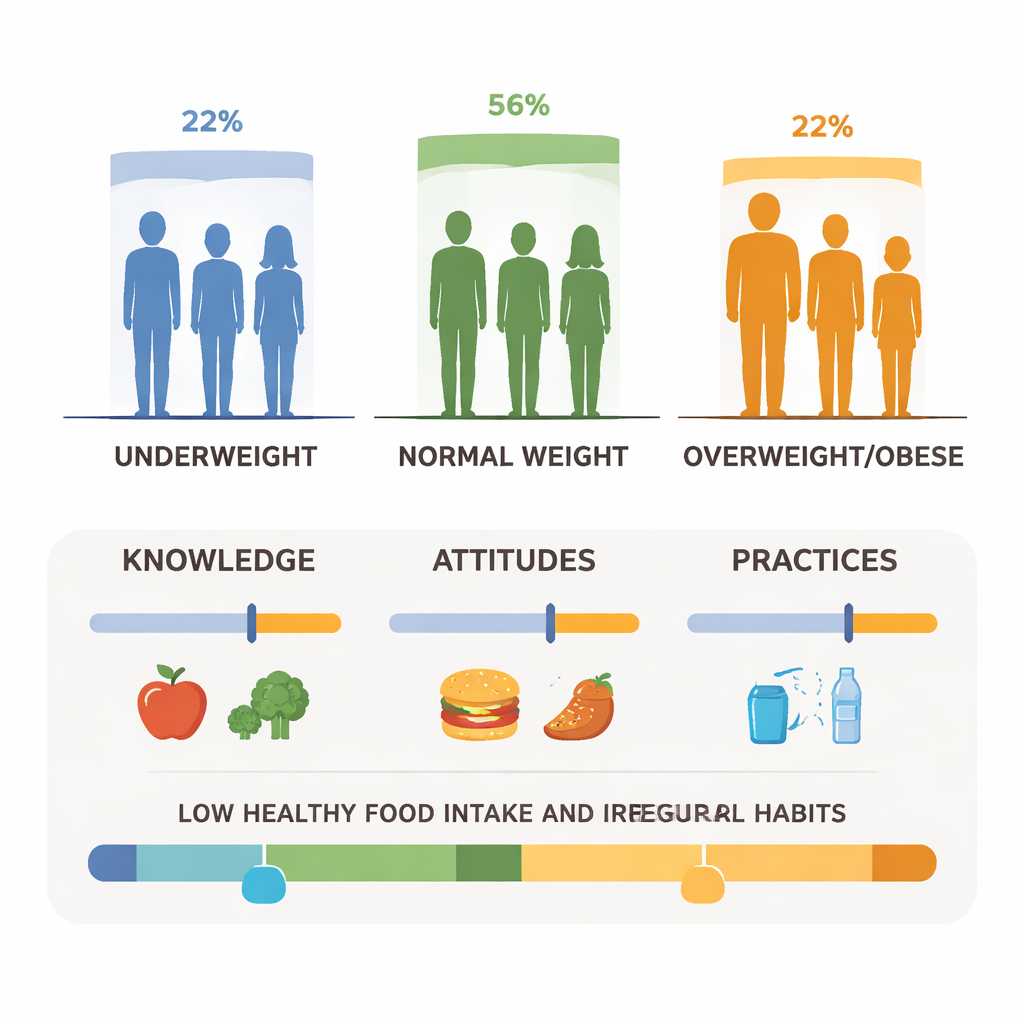
The Knowledge–Attitude–Action Gap
On paper, students’ views on healthy eating look encouraging. Most said they want to learn more about nutrition, think it belongs in campus life, and are willing to change unhealthy habits. Their average attitude score fell in the "excellent" range, and nearly four out of five agreed that drinking water is important even before feeling thirsty. Women, in particular, scored slightly higher than men on both knowledge and attitudes. Yet when it came to actual behavior, the picture darkened. Average scores for knowledge and especially for everyday practices were low, with many students failing even the basic passing line. In simple terms, they liked the idea of healthy eating but struggled to turn that belief into consistent action.
What and How Students Really Eat
When researchers compared student habits with China’s national dietary guidelines, gaps appeared everywhere. Only about one-third of students ate fruit daily, and fewer than one in four drank milk or ate dairy products every day. Fish and seafood were rare on the menu, and many students skipped breakfast, ordered late-night takeout, or snacked frequently. A sizable share smoked or preferred very spicy foods, which can irritate the digestive system. Water intake was also poor: only 17 percent met the recommended daily amount, while many drank just a few cups a day. Students tended to get their nutrition information from online media and friends rather than from classes, books, or health professionals, and many were unsure how much of that information to trust. Some female students even tried to replace full meals with fruit and vegetables alone in an effort to lose weight, a pattern that can lead to nutrient shortages and fatigue.
How Campuses Can Help Students Eat Better
For a general reader, the core message is straightforward: knowing about healthy food and valuing it are not enough if campus life makes it hard to eat well. This study shows that Chinese college students have middling knowledge, mostly good intentions, but weak follow-through in their daily diets. The authors argue that universities should step in more actively—offering clear, science-based nutrition education through social media, apps, and short videos; improving cafeteria options; and making safe drinking water easy to access. Tailoring programs to the different pressures faced by men and women could help close the gap between understanding and behavior. In doing so, campuses can support not just students’ grades and energy levels today, but also their long-term health as China pursues its broader "Healthy China" goals.
Citation: Yuan, Y., Liu, X., Yang, S. et al. Investigation and countermeasure of the dietary nutrition status of college students from the perspective of healthy China. Sci Rep 16, 5579 (2026). https://doi.org/10.1038/s41598-026-36178-x
Keywords: college nutrition, student eating habits, healthy diet, body weight, health education