Clear Sky Science · en
Experimental investigation of the effect of steel fibers on the multiaxial behavior of lightweight concrete
Lighter buildings that stay strong
Modern cities rely on concrete, but all that gray stone is heavy. Engineers use lightweight concrete to reduce the weight of tall buildings and long bridges, which can lower costs and improve energy efficiency. The catch is that this lighter material is usually weaker and more brittle. This study asks a simple but important question: can mixing thin steel fibers into lightweight concrete, and squeezing it from the sides as it is loaded, make it behave more like traditional strong concrete used in demanding structures?
Why lighter concrete needs extra help
Lightweight concrete replaces some of the usual crushed stone with puffed, porous clay pellets called LECA. These air-filled pellets make the concrete much lighter and improve thermal insulation, but they also introduce many tiny voids and weak spots. Under heavy loads, this concrete tends to crack suddenly rather than deform gradually, which is not ideal for columns or earthquake‑resisting walls. Engineers know that adding short steel fibers can help control cracking, and that squeezing concrete from the sides (called confinement) can make it stronger and more ductile. Yet, until now, their combined effect on lightweight concrete under realistic three‑directional stresses had not been studied in a systematic way.
How the tests were carried out
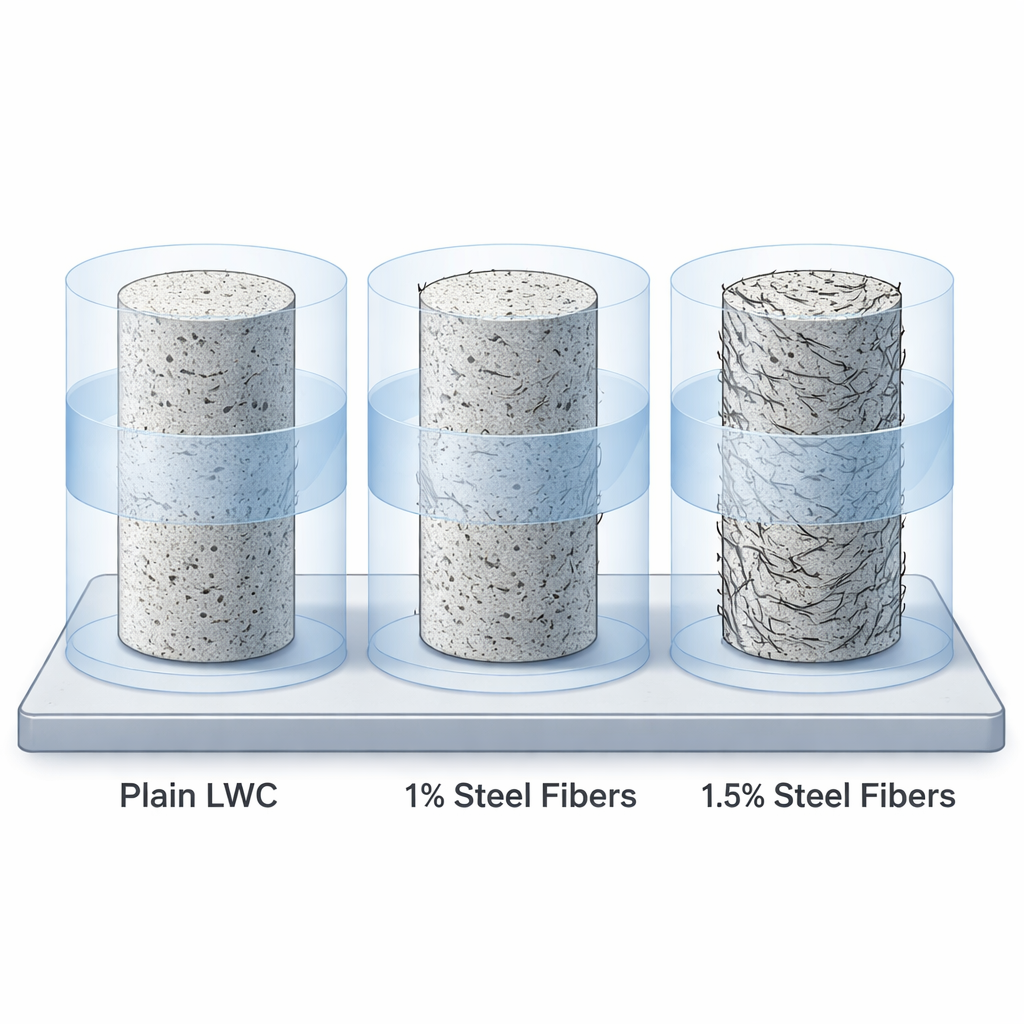
The researchers produced a structural‑grade lightweight concrete using LECA, natural sand, cement, water and a modern superplasticizer to keep the mix workable. They then created versions of this concrete with three different amounts of hooked steel fibers: 0.5%, 1.0% and 1.5% of the volume. Dozens of cylindrical specimens were cast and cured, and then tested in a special steel pressure cell. Some cylinders were simply squeezed from the top (uniaxial compression), while others were squeezed both from the top and uniformly from all sides (triaxial compression) at side pressures of 5 and 10 megapascals—levels similar to what concrete might feel deep inside a heavily loaded column.
What happened when the concrete was crushed
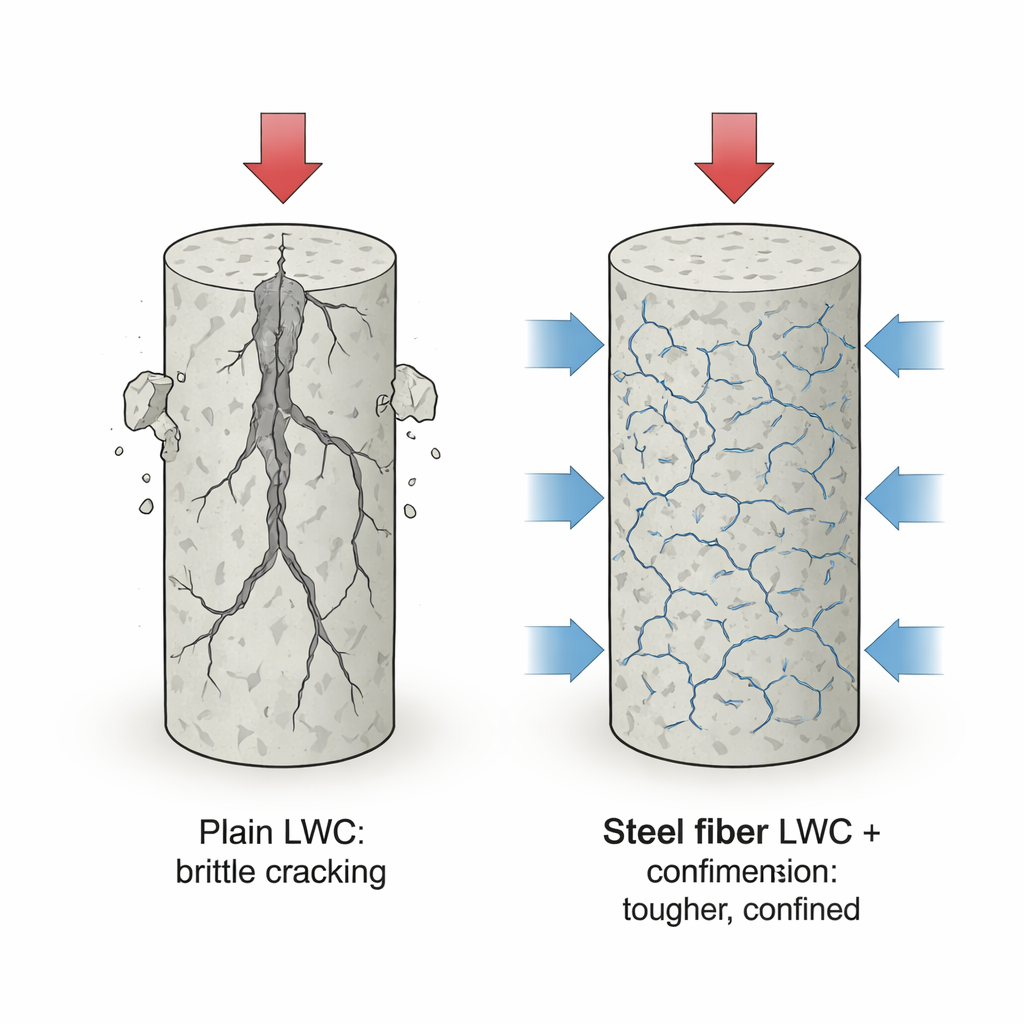
Under simple top‑to‑bottom loading, adding steel fibers clearly helped. The mix with about 1% steel fibers reached roughly 40% higher compressive strength than the plain lightweight concrete and showed a stiffer, more gradual stress–strain curve, meaning it could carry more load and deform a bit more before failing. However, when fiber content was pushed to 1.5%, strength gains leveled off and test results became less consistent, probably because too many fibers clumped together and disturbed the cement paste. In all cases, fibers acted like tiny stitches across microcracks, slowing their growth and turning sudden splitting into a more controlled failure.
Confinement turns brittle crushing into controlled damage
When the cylinders were also squeezed from the sides, the behavior changed dramatically. Even plain lightweight concrete became much stronger under confinement, but the biggest improvements occurred when confinement and fibers worked together. At a side pressure of 10 megapascals, the compressive strength of plain lightweight concrete was about 33 megapascals. With 1% fibers, this jumped to roughly 45 megapascals, and with 1.5% fibers it climbed to about 55 megapascals—around two‑thirds higher than the confined plain mix. The way the cylinders failed also shifted. Instead of long vertical cracks tearing the specimens apart, confined fiber‑reinforced mixes showed shorter, inclined cracks, localized crushing and clear signs of fibers pulling out rather than snapping. The concrete held together longer, absorbing more energy before losing its capacity.
Translating the results into design language
To make the findings useful for real‑world design, the team analyzed the data with standard engineering models that relate side pressure to strength. A key indicator, the confinement efficiency coefficient (called K), describes how much extra strength comes from squeezing concrete laterally. For plain lightweight concrete this value was around 1.8 under higher confinement, noticeably lower than what is typical for normal‑weight concrete. With 1.5% fibers, K increased to about 3.4—squarely within the range reported for ordinary structural concrete. In other words, by adding a modest amount of steel fibers and providing adequate confinement, engineers can make lightweight concrete behave, under complex loads, much more like its heavier counterpart.
What this means for everyday structures
For non‑specialists, the takeaway is straightforward: it is possible to build lighter structures without giving up much in terms of safety and robustness. The study shows that carefully chosen doses of steel fibers (around 1% for lightly confined members and up to 1.5% for well‑confined ones) can offset the natural weaknesses of lightweight aggregates. When these fiber‑rich mixes are used in columns, core walls or prefabricated modules that are already held in place by surrounding elements, the concrete can carry higher loads, deform more gracefully during earthquakes and suffer less catastrophic cracking. In practical terms, this opens the door to slimmer, lighter building components that still meet stringent performance demands.
Citation: Sorkohi, S.M., Hashemi, S.K., Naghipour, M. et al. Experimental investigation of the effect of steel fibers on the multiaxial behavior of lightweight concrete. Sci Rep 16, 6461 (2026). https://doi.org/10.1038/s41598-026-36168-z
Keywords: lightweight concrete, steel fibers, confinement, triaxial compression, structural columns